Vagina
Fibromuscular canal from the cervix to the vestibule. Its fornices, relations and split nerve and lymph supply matter for pelvic exams, vaginitis, prolapse and cancer spread.
Core anatomy
- Location
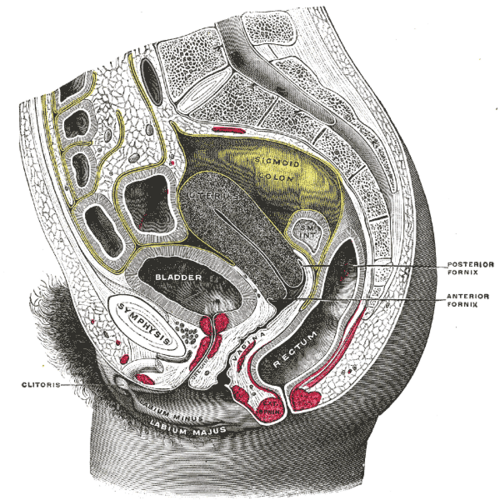
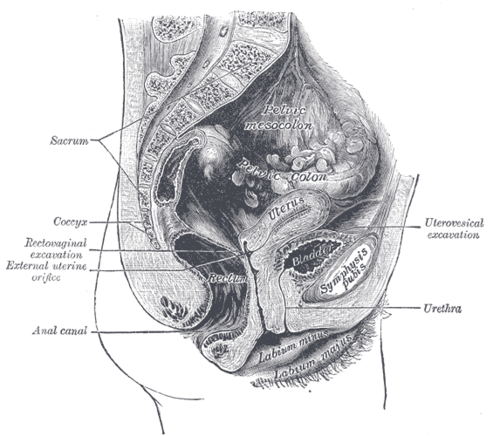
Runs upward and backward from the vestibule of the vulva to the cervix, passing through the urogenital hiatus of the pelvic diaphragm. About 7–9 cm long; the posterior wall is longer than the anterior wall.
- Parts
- Fornices: recesses around the cervix — anterior, posterior (the deepest, next to the rectouterine pouch) and two lateral
- Vaginal orifice in the vestibule, partly closed by the hymen (or its remnants)
- Wall: non-keratinized stratified squamous epithelium (no glands; lubrication from cervical mucus and transudate), smooth muscle, adventitia
- Relations
Anterior: the base of the urinary bladder and the urethra. Posterior: the rectouterine pouch (upper), the rectum (middle) and the perineal body and anal canal (lower). Lateral: levator ani, pelvic fascia and, near the lateral fornices, the ureters and uterine arteries.
- Arterial supply
Vaginal arteries (from the internal iliac artery or uterine artery) for the upper part; the internal pudendal artery for the lower part.
- Venous drainage
Vaginal venous plexus → internal iliac veins.
- Lymphatic drainage
Upper part → internal and external iliac nodes; middle → internal iliac nodes; lower part (near the orifice) → sacral, common iliac and superficial inguinal nodes. See pelvic and inguinal lymph drainage.
- Innervation
Upper three-quarters: visceral (uterovaginal plexus), sensitive mainly to stretch. Lower quarter: somatic (deep perineal nerve from the pudendal nerve), sensitive to pain and touch.
Found in
Mentioned in
- Anal canal
- Internal iliac artery
- Pelvic and inguinal lymph drainage
- Pudendal nerve
- Rectouterine pouch
- Rectum
- Urethra
- Uterine artery
- Uterus
- Vulva
Generated automatically from links in other entries.
Swipe sideways to see the whole diagram →


Clinical correlations
Vaginitis PANCE
- Mechanism / lesion
Bacterial vaginosis (overgrowth of Gardnerella and anaerobes), vulvovaginal candidiasis, or trichomoniasis.
- Classic presentation
Bacterial vaginosis: thin gray discharge, fishy odor, clue cells, pH > 4.5, positive whiff test → metronidazole. Candidiasis: thick white "cottage cheese" discharge, itching, normal pH (≤ 4.5), pseudohyphae on KOH → fluconazole or topical azole. Trichomoniasis: frothy yellow-green discharge, strawberry cervix, motile trichomonads, pH > 4.5 → metronidazole, and treat partners.
Anterior and posterior wall prolapse
- Mechanism / lesion
Loss of fascial support of the vaginal walls. See pelvic diaphragm.
- Classic presentation
Cystocele (anterior wall bulge, urinary symptoms) and rectocele (posterior wall bulge, difficulty emptying the rectum).
Obstetric and traumatic injuries
- Mechanism / lesion
Lacerations at delivery; rarely vesicovaginal or rectovaginal fistula after obstructed labor, surgery or radiation.
- Classic presentation
Continuous leakage of urine (vesicovaginal) or passage of gas/stool (rectovaginal) through the vagina.
Gartner duct cyst
- Mechanism / lesion
Remnant of the mesonephric (Wolffian) duct in the lateral vaginal wall.
- Classic presentation
Usually an asymptomatic cystic swelling of the lateral wall.
High-yield PANCE pearls
- BV: fishy odor, clue cells, pH > 4.5 → metronidazole.
- Candida: cottage-cheese discharge, normal pH → fluconazole.
- Trichomonas: frothy green discharge, strawberry cervix → metronidazole + treat partner.
- Posterior fornix is next to the rectouterine pouch (fluid, blood, abscess).
- Lower vagina drains to superficial inguinal nodes.
Imaging anatomy
- MRI
Local staging of vaginal and cervical cancers and assessment of fistulas.
- Ultrasound
The transvaginal probe images the uterus and adnexa; the vagina itself is best seen with a small amount of gel instilled.
- Key views & landmarks
- MRI pelvis (T2) with vaginal gel for tumors and fistulas
Physical exam
- Surface landmarks
The cervix is felt at the top of the vagina, surrounded by the fornices; the ischial spines are palpable laterally.
- Palpation
Speculum exam (walls, discharge, cervix); bimanual exam through the vagina for the uterus and adnexa; rectovaginal exam for the rectouterine pouch and uterosacral ligaments.
- Strength / function testing
Wet mount (saline and KOH), pH and whiff test for discharge; NAAT for gonorrhea, chlamydia and trichomonas.
Self-quiz
A 26-year-old woman has a thin gray vaginal discharge with a fishy odor, worse after intercourse. Vaginal pH is 5.0 and the wet mount shows epithelial cells covered with bacteria. What is the most appropriate treatment?
Correct answer: B
Bacterial vaginosis: thin gray discharge, fishy odor (positive whiff test), pH > 4.5 and clue cells. Treatment is metronidazole (or clindamycin). Fluconazole treats candidiasis.
Show answer
B
Bacterial vaginosis: thin gray discharge, fishy odor (positive whiff test), pH > 4.5 and clue cells. Treatment is metronidazole (or clindamycin). Fluconazole treats candidiasis.
Which part of the vagina has somatic innervation and is sensitive to pain?
Correct answer: D
Only the lower part near the orifice receives somatic fibers (pudendal nerve). The upper three-quarters is supplied by the visceral uterovaginal plexus and is relatively insensitive to pain.
Show answer
D
Only the lower part near the orifice receives somatic fibers (pudendal nerve). The upper three-quarters is supplied by the visceral uterovaginal plexus and is relatively insensitive to pain.
Which fornix is most closely related to the rectouterine pouch?
Correct answer: B
The posterior fornix, the deepest fornix, is separated from the rectouterine pouch only by the vaginal wall and peritoneum — the historical route for culdocentesis.
Show answer
B
The posterior fornix, the deepest fornix, is separated from the rectouterine pouch only by the vaginal wall and peritoneum — the historical route for culdocentesis.
A 23-year-old woman has a frothy yellow-green vaginal discharge. Exam shows a "strawberry" cervix, and the wet mount shows motile flagellated organisms. What is the most appropriate management?
Correct answer: D
This is trichomoniasis (frothy yellow-green discharge, strawberry cervix, motile trichomonads, pH > 4.5). Treat with metronidazole and treat partners.
Show answer
D
This is trichomoniasis (frothy yellow-green discharge, strawberry cervix, motile trichomonads, pH > 4.5). Treat with metronidazole and treat partners.
A 30-year-old woman has vulvar itching and a thick white "cottage cheese" discharge. Vaginal pH is 4.0, and a KOH preparation shows pseudohyphae. What is the most appropriate treatment?
Correct answer: E
Vulvovaginal candidiasis has a thick white discharge, itching, a normal pH (≤ 4.5) and pseudohyphae on KOH. Treat with fluconazole or a topical azole. Bacterial vaginosis and trichomoniasis have a pH above 4.5.
Show answer
E
Vulvovaginal candidiasis has a thick white discharge, itching, a normal pH (≤ 4.5) and pseudohyphae on KOH. Treat with fluconazole or a topical azole. Bacterial vaginosis and trichomoniasis have a pH above 4.5.