Vulva
Female external genitalia in the urogenital triangle — mons pubis, labia, clitoris, vestibule and vestibular glands. Bartholin gland cysts and abscesses, lichen sclerosus and vulvar cancer are the key problems.
Core anatomy
- Location
In the urogenital triangle of the perineum, below the pubic symphysis.
- Parts
- Mons pubis: fat pad over the pubic symphysis
- Labia majora: hair-bearing folds (homologous to the scrotum); the round ligaments of the uterus end in them
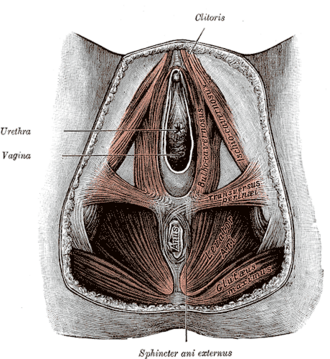
- Labia minora: hairless folds enclosing the vestibule; anteriorly they form the prepuce and frenulum of the clitoris
- Vestibule: the space between the labia minora containing the external urethral orifice, the vaginal orifice, and the openings of the greater and lesser vestibular glands and paraurethral (Skene) glands
- Clitoris: glans, body and two crura (attached to the ischiopubic rami, covered by ischiocavernosus); erectile tissue homologous to the corpora cavernosa of the penis
- Bulbs of the vestibule: erectile tissue on either side of the vaginal orifice, covered by bulbospongiosus (homologous to the bulb of the penis)
- Greater vestibular (Bartholin) glands: pea-sized glands behind the bulbs; ducts open into the vestibule at about 4 and 8 o'clock, posterolateral to the vaginal orifice
- Relations
Structures of the superficial perineal pouch (clitoris, bulbs, Bartholin glands, ischiocavernosus, bulbospongiosus) lie beneath the vulvar skin (see perineal pouches). The urethra and vagina open into the vestibule.
- Arterial supply
Internal pudendal artery (posterior labial branches, arteries of the bulb and clitoris) and external pudendal arteries (anterior labial branches).
- Venous drainage
Internal and external pudendal veins.
- Lymphatic drainage
Superficial inguinal nodes (the glans of the clitoris may also drain to deep inguinal or internal iliac nodes). See pelvic and inguinal lymph drainage.
- Innervation
Anterior: ilioinguinal nerve and the genital branch of the genitofemoral nerve (L1, from the lumbar plexus). Posterior: the pudendal nerve (posterior labial nerves, dorsal nerve of the clitoris) and perineal branches of the posterior femoral cutaneous nerve. Cavernous nerves (parasympathetic) for erectile tissue.
Found in
Mentioned in
Generated automatically from links in other entries.
Swipe sideways to see the whole diagram →

Clinical correlations
Bartholin duct cyst and abscess PANCE
- Mechanism / lesion
Obstruction of the greater vestibular gland duct; abscesses are polymicrobial (occasionally gonorrhea or chlamydia).
- Classic presentation
Unilateral swelling of the posterior labium at 4 or 8 o'clock; an abscess is exquisitely painful, tender and fluctuant. Symptomatic abscesses need incision and drainage with a Word catheter or marsupialization. A new Bartholin mass in a woman over about 40 is biopsied to exclude carcinoma.
Lichen sclerosus PANCE
- Mechanism / lesion
Chronic inflammatory skin disease of the anogenital area, most common in postmenopausal women.
- Classic presentation
Intense itching, thin white "cigarette-paper" skin, figure-of-eight pattern around the vulva and anus, loss of labial architecture. Treat with a high-potency topical steroid (clobetasol); long-term follow-up because of an increased risk of squamous cell carcinoma.
Vulvar cancer
- Mechanism / lesion
Usually squamous cell carcinoma — HPV-related (younger) or associated with lichen sclerosus (older).
- Classic presentation
A pruritic lump or ulcer, often in an older woman; spreads to the inguinal nodes. Biopsy any persistent vulvar lesion.
High-yield PANCE pearls
- Painful fluctuant mass at 4 or 8 o'clock of the vestibule → Bartholin abscess → I&D with Word catheter.
- White, thin, itchy vulvar skin in a postmenopausal woman → lichen sclerosus → clobetasol; SCC risk.
- Vulvar lymph → superficial inguinal nodes.
Imaging anatomy
- MRI
Staging of vulvar cancer; CT/PET for inguinal and pelvic nodes.
- Ultrasound
Rarely needed; can distinguish a cyst from a solid mass.
Physical exam
- Surface landmarks
The vestibule lies between the labia minora; the Bartholin gland openings are posterolateral to the vaginal orifice at 4 and 8 o'clock.
- Palpation
Palpate the Bartholin gland areas between the thumb (outside) and index finger (inside the introitus) for swelling or tenderness; palpate the inguinal nodes.
- Strength / function testing
Inspect the skin of the whole vulva and perianal area in good light; biopsy persistent or atypical lesions.
Self-quiz
A 28-year-old woman has 3 days of painful swelling on the left side of the vaginal opening. Exam shows a 4-cm tender, fluctuant mass in the posterior left labium at 4 o'clock. What is the most appropriate treatment?
Correct answer: B
A painful fluctuant mass at 4 or 8 o'clock is a Bartholin gland abscess. Incision and drainage with a Word catheter (or marsupialization) lets a tract epithelialize and reduces recurrence; simple aspiration often recurs.
Show answer
B
A painful fluctuant mass at 4 or 8 o'clock is a Bartholin gland abscess. Incision and drainage with a Word catheter (or marsupialization) lets a tract epithelialize and reduces recurrence; simple aspiration often recurs.
Which structure is homologous to the scrotum?
Correct answer: B
The labia majora develop from the labioscrotal swellings, as does the scrotum. The labia minora correspond to the ventral penile skin (urethral folds) and the clitoris to the penis.
Show answer
B
The labia majora develop from the labioscrotal swellings, as does the scrotum. The labia minora correspond to the ventral penile skin (urethral folds) and the clitoris to the penis.
A 68-year-old woman has intense vulvar itching. The skin is thin, white and wrinkled in a figure-of-eight pattern around the vulva and anus. What is the most appropriate treatment?
Correct answer: E
This is lichen sclerosus. Treat with a high-potency topical steroid such as clobetasol, with long-term follow-up because of the increased risk of squamous cell carcinoma.
Show answer
E
This is lichen sclerosus. Treat with a high-potency topical steroid such as clobetasol, with long-term follow-up because of the increased risk of squamous cell carcinoma.