Uterine artery
Branch of the internal iliac artery that crosses above the ureter beside the cervix to supply the uterus. It is ligated in hysterectomy, embolized for fibroids and postpartum hemorrhage, and greatly enlarged in pregnancy.
Core anatomy
- Location
Base of the broad ligament (in the cardinal ligament) and then along the lateral margin of the uterus.
- Origin
Anterior division of the internal iliac artery (sometimes sharing a trunk with the vaginal or umbilical artery).
- Course
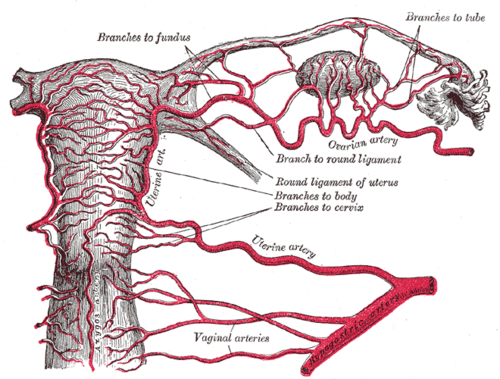
Runs medially across the pelvic floor in the base of the broad ligament and passes above and in front of the ureter about 1–2 cm lateral to the supravaginal cervix ("water under the bridge"). It reaches the uterus at about the level of the internal os, then ascends tortuously along the lateral uterus to the uterine horn.
- Branches
- Vaginal (cervicovaginal) branches to the cervix and upper vagina
- Arcuate arteries in the myometrium → radial arteries → spiral arteries (to the functional layer of the endometrium, shed at menstruation) and basal arteries
- Tubal and ovarian branches, which anastomose with the ovarian artery
- Supplies
The uterus, cervix, upper vagina, medial part of the uterine tube and part of the ovary.
- Anastomoses
With the ovarian artery (from the aorta) near the uterotubal junction; with the vaginal arteries below.
- Termination
Ends by anastomosing with the ovarian artery near the uterine horn.
- Notes
In pregnancy the uterine arteries enlarge enormously, and trophoblast remodels the spiral arteries into low-resistance vessels; failure of this remodeling is linked to preeclampsia and fetal growth restriction. Uterine blood flow at term is on the order of 500–750 mL/min, which is why postpartum hemorrhage can be torrential. verify
Structures supplied
Mentioned in
Generated automatically from links in other entries.

Clinical correlations
Hysterectomy and the ureter PANCE
- Mechanism / lesion
The uterine vessels are clamped next to the cervix, where the ureter passes beneath them.
- Classic presentation
Clamping, ligation or thermal injury of the ureter → hydronephrosis, urinoma, fistula. Surgeons identify the ureter before clamping.
Uterine artery embolization
- Mechanism / lesion
Catheter-directed embolization through the internal iliac arteries.
- Classic presentation
Treats symptomatic fibroids and postpartum hemorrhage while preserving the uterus. Post-embolization pain and fever are common.
Uterine artery Doppler in pregnancy
- Mechanism / lesion
High resistance and an early diastolic "notch" reflect poor spiral artery remodeling.
- Classic presentation
Used in some settings to predict preeclampsia and fetal growth restriction.
High-yield PANCE pearls
- Water under the bridge: uterine artery passes over the ureter beside the cervix.
- Spiral arteries supply the functional endometrium; their poor remodeling → preeclampsia.
- Fibroids and PPH can be treated by uterine artery embolization.
Imaging anatomy
- X-ray
Catheter angiography for embolization.
- CT
CT angiography locates active pelvic bleeding.
- Ultrasound
Color Doppler shows the uterine arteries lateral to the cervix; pulsatility index and notching are assessed in pregnancy.
Physical exam
- Surface landmarks
Reaches the uterus about 1–2 cm lateral to the cervix at the level of the internal os; not palpable.
Self-quiz
The uterine artery is a branch of which artery?
Correct answer: C
The uterine artery comes from the anterior division of the internal iliac artery. The ovarian artery, with which it anastomoses, comes from the abdominal aorta.
Show answer
C
The uterine artery comes from the anterior division of the internal iliac artery. The ovarian artery, with which it anastomoses, comes from the abdominal aorta.
Which vessels supply the functional layer of the endometrium that is shed during menstruation?
Correct answer: C
Spiral arteries supply the functional layer; their constriction at the end of the luteal phase causes ischemia and shedding. Straight (basal) arteries supply the basal layer, which persists.
Show answer
C
Spiral arteries supply the functional layer; their constriction at the end of the luteal phase causes ischemia and shedding. Straight (basal) arteries supply the basal layer, which persists.
During hysterectomy, why is the ureter at risk when the uterine vessels are clamped?
Correct answer: B
"Water under the bridge": the uterine artery passes above and in front of the ureter about 1–2 cm lateral to the supravaginal cervix. Clamping, ligation or thermal injury here can cause hydronephrosis, urinoma or a fistula, so surgeons identify the ureter before clamping.
Show answer
B
"Water under the bridge": the uterine artery passes above and in front of the ureter about 1–2 cm lateral to the supravaginal cervix. Clamping, ligation or thermal injury here can cause hydronephrosis, urinoma or a fistula, so surgeons identify the ureter before clamping.
Near the uterine horn, the uterine artery anastomoses with which artery?
Correct answer: D
The uterine artery ascends tortuously along the lateral uterus and ends by anastomosing with the ovarian artery (from the aorta) near the uterine horn and uterotubal junction. These collaterals preserve perfusion when the uterine or internal iliac arteries are ligated or embolized.
Show answer
D
The uterine artery ascends tortuously along the lateral uterus and ends by anastomosing with the ovarian artery (from the aorta) near the uterine horn and uterotubal junction. These collaterals preserve perfusion when the uterine or internal iliac arteries are ligated or embolized.
A 42-year-old woman has heavy bleeding from symptomatic fibroids and wants to keep her uterus. Which catheter-directed procedure can treat her?
Correct answer: C
Uterine artery embolization, performed through catheters in the internal iliac arteries, treats symptomatic fibroids (and postpartum hemorrhage) while preserving the uterus. Post-embolization pain and fever are common.
Show answer
C
Uterine artery embolization, performed through catheters in the internal iliac arteries, treats symptomatic fibroids (and postpartum hemorrhage) while preserving the uterus. Post-embolization pain and fever are common.