Trochlear nerve (CN IV)
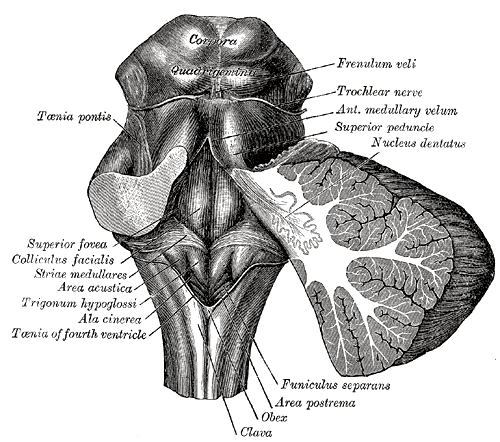
Thinnest cranial nerve and the only one to exit the back of the brainstem. It supplies the superior oblique; a palsy causes vertical diplopia worse on looking down and a compensatory head tilt away from the affected side.
Core anatomy
- Origin
Trochlear nucleus in the midbrain at the level of the inferior colliculus.
- Course
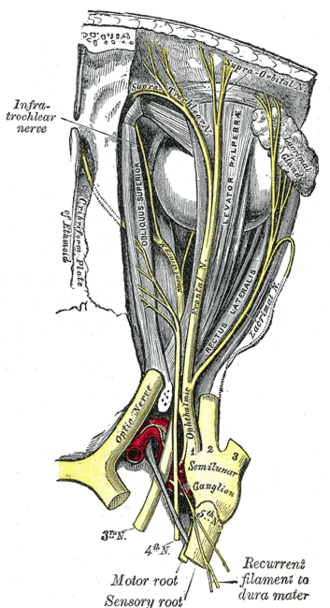
Fibers decussate and emerge from the dorsal surface of the brainstem just below the inferior colliculus — the only cranial nerve to do so — so each nucleus supplies the contralateral superior oblique. The nerve winds around the cerebral peduncle (the longest intracranial course), runs in the lateral wall of the cavernous sinus (see dural venous sinuses) and enters the orbit through the superior orbital fissure outside the common tendinous ring.
- Motor
Superior oblique only (see extraocular muscles) — depresses the adducted eye, and intorts and abducts it.
- Relations
Its long, thin intracranial course along the tentorial edge makes it vulnerable to head trauma.
Muscles innervated
- Extraocular muscles — LR6 SO4, rest 3: lateral rectus — abducens nerve (CN VI); superior oblique — trochlear nerve (CN IV); superior, inferior and medial recti and inferior oblique — oculomotor nerve (CN III, which also supplies levator palpebrae superioris).
Found in
Mentioned in
Generated automatically from links in other entries.
Swipe sideways to see the whole diagram →


Clinical correlations
Fourth nerve palsy PANCE
- Mechanism / lesion
Head trauma (most common acquired cause), congenital (decompensates in adulthood), microvascular ischemia, and less often tumors.
- Classic presentation
Vertical (and oblique) diplopia, worst when looking down and in — reading or walking down stairs. The affected eye is higher (hypertropia), especially in adduction. Patients tilt the head away from the affected side to compensate (intorting the unaffected eye). Old photos showing a longstanding head tilt suggest a congenital palsy.
High-yield PANCE pearls
- Diplopia going down stairs or reading → CN IV (superior oblique).
- Head tilt away from the affected side.
- CN IV: only nerve exiting the dorsal brainstem; crosses → supplies the contralateral SO.
- Most common acquired cause → head trauma.
Imaging anatomy
- MRI
MRI brain and orbits if there is no trauma or vascular explanation, or if other neurologic signs are present.
Physical exam
- Strength / function testing
Ask the patient to look down and in (toward the nose) — isolates the superior oblique. Note hypertropia on the cover test.
Parks–Bielschowsky three-step test
- Technique
Identify (1) which eye is higher in primary gaze, (2) whether the deviation worsens on looking left or right, and (3) whether it worsens with head tilt to the left or right.
- Positive test
For a right CN IV palsy — right hypertropia, worse on left gaze and on right head tilt.
- Significance
Localizes a vertical deviation to a single paretic muscle, most often the superior oblique.
Self-quiz
After a bicycle accident, a 30-year-old has double vision when going down stairs. His right eye is higher than the left, and he tilts his head to the left. Which nerve is injured?
Correct answer: B
A right superior oblique (CN IV) palsy leaves the right eye higher, with diplopia worst looking down and in (stairs). Patients tilt the head away from the affected side (to the left). Trauma is the most common cause.
Show answer
B
A right superior oblique (CN IV) palsy leaves the right eye higher, with diplopia worst looking down and in (stairs). Patients tilt the head away from the affected side (to the left). Trauma is the most common cause.
Which feature is unique to the trochlear nerve?
Correct answer: B
CN IV is the only cranial nerve to emerge from the dorsal brainstem; its fibers decussate, so each nucleus supplies the contralateral superior oblique. It is the thinnest nerve with the longest intracranial course.
Show answer
B
CN IV is the only cranial nerve to emerge from the dorsal brainstem; its fibers decussate, so each nucleus supplies the contralateral superior oblique. It is the thinnest nerve with the longest intracranial course.
Why is the trochlear nerve especially vulnerable to head trauma?
Correct answer: C
CN IV has the longest intracranial course and is thin, running along the tentorial edge, so head trauma is its most common acquired cause of palsy.
Show answer
C
CN IV has the longest intracranial course and is thin, running along the tentorial edge, so head trauma is its most common acquired cause of palsy.
Each trochlear nucleus supplies which superior oblique muscle?
Correct answer: A
Trochlear fibers decussate before emerging from the dorsal brainstem, so each nucleus supplies the contralateral superior oblique.
Show answer
A
Trochlear fibers decussate before emerging from the dorsal brainstem, so each nucleus supplies the contralateral superior oblique.
What is the main action of the superior oblique when the eye is adducted?
Correct answer: D
The superior oblique depresses the adducted eye (and intorts and abducts it), which is why CN IV palsy causes diplopia when looking down and in, such as reading or going downstairs.
Show answer
D
The superior oblique depresses the adducted eye (and intorts and abducts it), which is why CN IV palsy causes diplopia when looking down and in, such as reading or going downstairs.