Vagus nerve (CN X)
Longest cranial nerve — motor to the palate, pharynx and larynx, and parasympathetic supply to the thoracic and abdominal viscera down to the distal transverse colon. A lesion causes hoarseness, dysphagia and a uvula deviated away from the lesion.
Core anatomy
- Origin
Emerges from the postolivary sulcus of the medulla oblongata below CN IX. Nuclei: nucleus ambiguus (motor to pharynx, larynx, palate), dorsal motor nucleus of the vagus (parasympathetic), nucleus of the solitary tract (visceral sensation, taste from the epiglottis), spinal trigeminal nucleus (ear).
- Course
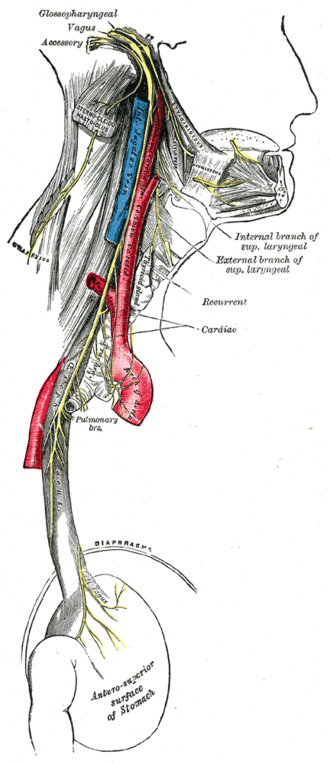
Leaves through the jugular foramen (superior and inferior ganglia) → descends in the carotid sheath between and behind the internal/common carotid artery and internal jugular vein → right vagus crosses in front of the right subclavian artery (giving the right recurrent laryngeal nerve) → left vagus crosses the aortic arch (giving the left recurrent laryngeal nerve) → both pass behind the lung roots → form the esophageal plexus → anterior (mainly left) and posterior (mainly right) vagal trunks pass through the esophageal hiatus (T10) → abdominal viscera.
- Branches
- Auricular branch (Arnold nerve) — external ear canal (ear-canal cough reflex)
- Pharyngeal branches → pharyngeal plexus (pharynx and soft palate)
- Superior laryngeal nerve — internal (sensation above the vocal folds) and external (cricothyroid)
- Recurrent laryngeal nerve — all other intrinsic laryngeal muscles
- Cardiac branches (slow the heart — mainly SA and AV nodes), pulmonary branches (bronchoconstriction, secretion)
- Esophageal, gastric, hepatic, celiac and renal branches — parasympathetic to the foregut and midgut (to about the distal third of the transverse colon)
- Motor
Muscles of the soft palate (except tensor veli palatini — V3), pharynx (except stylopharyngeus — IX), larynx (larynx), palatoglossus, and the upper esophagus. Parasympathetic to the heart, lungs and gut.
- Sensory
Laryngopharynx and larynx (cough reflex), part of the external ear, visceral afferents from thoracic and abdominal organs (most vagal fibers are afferent), aortic arch baroreceptors and chemoreceptors.
- Relations
In the neck in the carotid sheath; in the thorax, related to the thoracic aorta, esophagus and lung roots; in the abdomen, the trunks lie on the stomach.
Branches
Other structures innervated
Mentioned in
Generated automatically from links in other entries.
Swipe sideways to see the whole diagram →

Clinical correlations
Vagus nerve lesion PANCE
- Mechanism / lesion
Jugular foramen tumors, lateral medullary (Wallenberg) stroke, skull-base surgery, carotid dissection; distal lesions affect only the recurrent laryngeal branch.
- Classic presentation
Uvula deviates away from the lesion (the intact side pulls it), the ipsilateral palate fails to elevate, hoarseness (cord paralysis), dysphagia, nasal regurgitation, reduced cough and gag (efferent).
Vasovagal (reflex) syncope and vagal maneuvers PANCE
- Mechanism / lesion
Excess vagal outflow (with sympathetic withdrawal) → bradycardia and vasodilation; vagal maneuvers slow AV nodal conduction.
- Classic presentation
Vasovagal syncope — prodrome (warmth, nausea, pallor) after pain, fear or prolonged standing, rapid recovery. Valsalva or carotid sinus massage can terminate AV-nodal re-entrant SVT.
Vagal effects in the gut
- Mechanism / lesion
Vagal stimulation increases gastric acid and motility; vagotomy (historical ulcer surgery) and vagal injury during fundoplication or esophagectomy impair gastric emptying.
- Classic presentation
Gastroparesis, diarrhea (dumping) after vagal injury; vagus nerve stimulation is used for refractory epilepsy and depression.
High-yield PANCE pearls
- Uvula deviates away from a CN X lesion (toward the normal side).
- Hoarseness + dysphagia + absent gag + ipsilateral Horner + crossed sensory loss → Wallenberg (lateral medulla).
- Gag reflex efferent = CN X.
- Vagal maneuvers (Valsalva, carotid massage) → first step for stable SVT.
- Vagal trunks pass through the esophageal hiatus at T10.
Imaging anatomy
- CT
Contrast CT of the neck and chest along the course of the vagus and recurrent laryngeal nerve (skull base to aortopulmonary window) for unexplained vocal cord paralysis.
- MRI
MRI brainstem and skull base for medullary strokes and jugular foramen lesions.
Physical exam
- Strength / function testing
Ask the patient to say "ah": watch the soft palate rise symmetrically and the uvula stay midline. Gag reflex (efferent limb), voice quality (hoarseness, nasal speech), cough strength, swallowing (water swallow test for aspiration risk).
Self-quiz
When a patient says "ah," the uvula deviates to the right and the left soft palate does not elevate. Which nerve is affected?
Correct answer: B
With a left vagus lesion, the intact right palatal muscles pull the uvula toward the right — the uvula deviates away from the side of the lesion.
Show answer
B
With a left vagus lesion, the intact right palatal muscles pull the uvula toward the right — the uvula deviates away from the side of the lesion.
A hemodynamically stable 25-year-old has a narrow-complex regular tachycardia at 190/min. What is the first step?
Correct answer: B
For stable SVT, start with vagal maneuvers (increase vagal tone at the AV node); if unsuccessful, give adenosine. Unstable patients need synchronized cardioversion.
Show answer
B
For stable SVT, start with vagal maneuvers (increase vagal tone at the AV node); if unsuccessful, give adenosine. Unstable patients need synchronized cardioversion.
Which nerve carries the efferent limb of the gag reflex?
Correct answer: B
The gag reflex has its afferent limb in CN IX and its efferent limb in CN X (pharyngeal and palatal muscles).
Show answer
B
The gag reflex has its afferent limb in CN IX and its efferent limb in CN X (pharyngeal and palatal muscles).
How far along the gut does vagal parasympathetic supply extend?
Correct answer: E
The vagus supplies the foregut and midgut, to about the distal third of the transverse colon. Beyond that, the pelvic splanchnic nerves (S2–S4) take over.
Show answer
E
The vagus supplies the foregut and midgut, to about the distal third of the transverse colon. Beyond that, the pelvic splanchnic nerves (S2–S4) take over.
Which pharyngeal muscle is NOT supplied by the vagus nerve?
Correct answer: A
Stylopharyngeus is supplied by CN IX. The vagus supplies the other pharyngeal muscles and the soft palate except tensor veli palatini (V3).
Show answer
A
Stylopharyngeus is supplied by CN IX. The vagus supplies the other pharyngeal muscles and the soft palate except tensor veli palatini (V3).