Glossopharyngeal nerve (CN IX)
Mainly sensory — posterior tongue, oropharynx and middle ear, plus the carotid sinus and body. It is the afferent limb of the gag reflex and supplies the parotid gland (parasympathetic) and stylopharyngeus.
Core anatomy
- Origin
Emerges from the medulla oblongata in the postolivary sulcus, above the vagus. Nuclei: nucleus ambiguus (motor), inferior salivatory nucleus (parasympathetic), nucleus of the solitary tract (taste and visceral sensation), spinal trigeminal nucleus (general sensation).
- Course
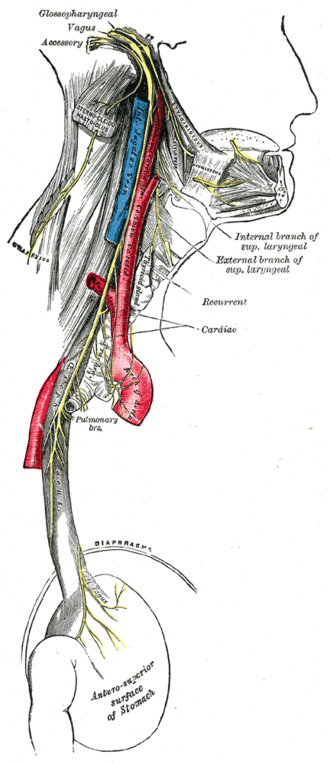
Leaves the skull through the jugular foramen (with CN X and XI and the internal jugular vein), with superior and inferior ganglia; descends between the internal carotid artery and internal jugular vein, curves forward around stylopharyngeus, and passes between the internal and external carotid arteries (see common and internal carotid arteries) to reach the tonsillar bed and the posterior tongue.
- Branches
- Tympanic nerve → tympanic plexus (middle ear sensation) → lesser petrosal nerve → otic ganglion → auriculotemporal nerve (V3) → parotid gland secretion
- Carotid sinus nerve → carotid sinus (baroreceptor) and carotid body (chemoreceptor)
- Nerve to stylopharyngeus
- Pharyngeal branches (to the pharyngeal plexus), tonsillar and lingual branches
- Motor
Stylopharyngeus only (elevates the pharynx during swallowing).
- Sensory
General sensation and taste from the posterior third of the tongue, the oropharynx and palatine tonsils (afferent limb of the gag reflex), the middle ear and pharyngotympanic tube; carotid sinus and body.
- Relations
Leaves the jugular foramen with CN X and XI, so lesions there (tumors, glomus jugulare) affect all three.
Other structures innervated
Mentioned in
Generated automatically from links in other entries.

Clinical correlations
Jugular foramen syndrome (Vernet syndrome)
- Mechanism / lesion
A mass at the jugular foramen (glomus jugulare tumor, schwannoma, metastasis, basilar skull fracture).
- Classic presentation
Palsies of CN IX, X and XI — loss of the gag reflex and taste on the posterior tongue, dysphagia, hoarseness, uvula deviated away from the lesion, weak SCM and trapezius.
Glossopharyngeal neuralgia
- Mechanism / lesion
Usually vascular compression of the nerve root (analogous to trigeminal neuralgia).
- Classic presentation
Brief, severe, stabbing pain in the throat, tonsil, base of tongue and ear, triggered by swallowing, talking or yawning; occasionally with bradycardia or syncope (carotid sinus connection). Carbamazepine first-line.
Referred ear pain PANCE
- Mechanism / lesion
CN IX supplies both the oropharynx and the middle ear.
- Classic presentation
Otalgia after tonsillectomy or with pharyngitis, tonsillar abscess or oropharyngeal cancer — always examine the throat in a patient with ear pain and a normal ear exam.
High-yield PANCE pearls
- Gag reflex: afferent CN IX, efferent CN X.
- Taste and sensation from the posterior 1/3 of the tongue → CN IX.
- Carotid sinus (baroreceptor) and body (chemoreceptor) → CN IX.
- Ear pain with a normal ear exam → look at the oropharynx (referred via CN IX/X).
Imaging anatomy
- CT
CT of the skull base shows erosion of the jugular foramen by glomus tumors.
- MRI
MRI of the skull base and jugular foramen for lower cranial nerve palsies.
Physical exam
- Strength / function testing
Gag reflex (touch each side of the posterior pharynx — compare sides; many normal people have a weak gag); palatal elevation on saying "ah" (mainly CN X); taste on the posterior tongue is rarely tested. Examine the ear and the throat together.
Self-quiz
Touching the left posterior pharyngeal wall produces no gag, but touching the right side produces a gag with bilateral palatal elevation. Which nerve is most likely damaged?
Correct answer: B
The palate elevates normally (efferent CN X intact on both sides) when the right side is stimulated, but the left stimulus is not sensed — the afferent limb (left CN IX) is damaged.
Show answer
B
The palate elevates normally (efferent CN X intact on both sides) when the right side is stimulated, but the left stimulus is not sensed — the afferent limb (left CN IX) is damaged.
Parasympathetic fibers to the parotid gland travel initially in which cranial nerve?
Correct answer: B
Preganglionic fibers from the inferior salivatory nucleus travel in CN IX (tympanic → lesser petrosal nerves) to the otic ganglion; postganglionic fibers reach the parotid via the auriculotemporal nerve (V3).
Show answer
B
Preganglionic fibers from the inferior salivatory nucleus travel in CN IX (tympanic → lesser petrosal nerves) to the otic ganglion; postganglionic fibers reach the parotid via the auriculotemporal nerve (V3).
A tumor at the left jugular foramen causes loss of the left gag reflex, hoarseness, dysphagia and weak shoulder shrug. Which cranial nerves are involved?
Correct answer: C
CN IX, X and XI leave the skull together through the jugular foramen (with the internal jugular vein), so a mass there (glomus jugulare, schwannoma, metastasis) affects all three — jugular foramen (Vernet) syndrome.
Show answer
C
CN IX, X and XI leave the skull together through the jugular foramen (with the internal jugular vein), so a mass there (glomus jugulare, schwannoma, metastasis) affects all three — jugular foramen (Vernet) syndrome.