Hypoglossal nerve (CN XII)
Motor nerve to the tongue. A lower motor neuron lesion makes the protruded tongue deviate toward the weak side, with atrophy and fasciculations.
Core anatomy
- Origin
Hypoglossal nucleus in the floor of the fourth ventricle in the medulla oblongata; rootlets emerge in the preolivary sulcus between the pyramid and the olive.
- Course
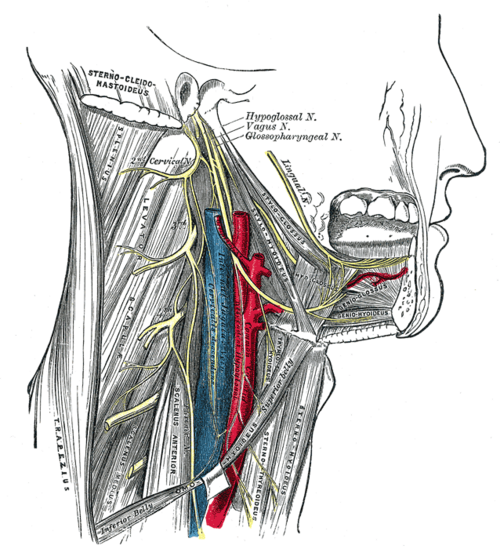
Leaves the skull through the hypoglossal canal → descends between the internal carotid artery and internal jugular vein → loops forward around the occipital artery → crosses superficial to the internal and external carotid arteries above the bifurcation (see common and internal carotid arteries) → runs forward on hyoglossus above the hyoid, below the submandibular duct, into the tongue. C1 fibers travel with it (superior root of the ansa cervicalis, and to thyrohyoid and geniohyoid; see cervical plexus).
- Motor
All intrinsic and extrinsic muscles of the tongue except palatoglossus (CN X) — genioglossus, hyoglossus, styloglossus.
- Relations
At risk in carotid endarterectomy, submandibular gland excision and neck dissection.
Other structures innervated
Mentioned in
Generated automatically from links in other entries.
Swipe sideways to see the whole diagram →

Clinical correlations
Hypoglossal nerve lesion PANCE
- Mechanism / lesion
LMN: skull-base tumors, carotid dissection, carotid endarterectomy, medial medullary stroke, ALS (bulbar, with fasciculations). UMN: contralateral cortical/corticobulbar stroke.
- Classic presentation
LMN: tongue deviates toward the side of the lesion on protrusion (the intact genioglossus pushes it over), with ipsilateral atrophy and fasciculations, dysarthria. UMN: the tongue deviates away from the cortical lesion (toward the weak side of the body) without atrophy; often mild because of partly bilateral input.
Medial medullary syndrome PANCE
- Mechanism / lesion
Occlusion of the anterior spinal artery or vertebral branches supplying the medial medulla.
- Classic presentation
Ipsilateral tongue deviation/atrophy (XII), contralateral hemiparesis (pyramid) and contralateral loss of vibration and proprioception (medial lemniscus).
High-yield PANCE pearls
- Tongue deviates toward a CN XII LMN lesion ("lick your wounds").
- Tongue atrophy + fasciculations → LMN (e.g. ALS).
- Ipsilateral tongue weakness + contralateral hemiparesis + contralateral loss of proprioception → medial medullary syndrome.
- Tongue deviation after carotid endarterectomy → CN XII injury.
Imaging anatomy
- MRI
MRI brain and skull base (hypoglossal canal), with MRA or CTA of the neck when carotid dissection is possible.
Physical exam
- Strength / function testing
Inspect the tongue at rest in the mouth (atrophy, fasciculations — look at rest, since protrusion causes normal tremor), then on protrusion (deviation), side-to-side movement and pushing against the cheek; speech ("la-la-la").
Self-quiz
A patient has sudden right-sided weakness and loss of vibration sense in the right limbs. Her tongue deviates to the left on protrusion. Where is the lesion?
Correct answer: B
Left medial medullary syndrome: left CN XII (tongue deviates to the left), left pyramid (right hemiparesis — the pyramids decussate below) and left medial lemniscus (right-sided loss of vibration/proprioception — already crossed).
Show answer
B
Left medial medullary syndrome: left CN XII (tongue deviates to the left), left pyramid (right hemiparesis — the pyramids decussate below) and left medial lemniscus (right-sided loss of vibration/proprioception — already crossed).
Which tongue muscle is NOT supplied by the hypoglossal nerve?
Correct answer: D
Palatoglossus is supplied by the vagus (pharyngeal plexus); all other tongue muscles are supplied by CN XII.
Show answer
D
Palatoglossus is supplied by the vagus (pharyngeal plexus); all other tongue muscles are supplied by CN XII.
In an upper motor neuron (cortical) lesion of hypoglossal control, how does the tongue behave?
Correct answer: B
An LMN lesion makes the tongue deviate toward the lesion with atrophy and fasciculations. A UMN (cortical) lesion makes it deviate away from the cortical lesion (toward the weak side of the body), without atrophy, and is often mild.
Show answer
B
An LMN lesion makes the tongue deviate toward the lesion with atrophy and fasciculations. A UMN (cortical) lesion makes it deviate away from the cortical lesion (toward the weak side of the body), without atrophy, and is often mild.
Through which opening does the hypoglossal nerve leave the skull?
Correct answer: D
CN XII exits through the hypoglossal canal, just anterolateral to the foramen magnum. CN IX–XI use the jugular foramen.
Show answer
D
CN XII exits through the hypoglossal canal, just anterolateral to the foramen magnum. CN IX–XI use the jugular foramen.
In the neck, the hypoglossal nerve crosses which vessels, making it vulnerable in carotid surgery?
Correct answer: E
The hypoglossal nerve loops forward superficial to the internal and external carotid arteries above the bifurcation, so it is at risk during carotid endarterectomy.
Show answer
E
The hypoglossal nerve loops forward superficial to the internal and external carotid arteries above the bifurcation, so it is at risk during carotid endarterectomy.