Tongue
Muscular organ of taste, speech and swallowing. Its mixed embryologic origin gives it four different nerve supplies, and hypoglossal lesions make it deviate toward the weak side.
Core anatomy
- Location
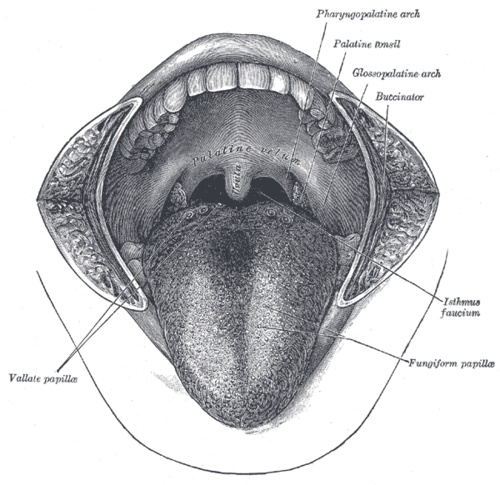
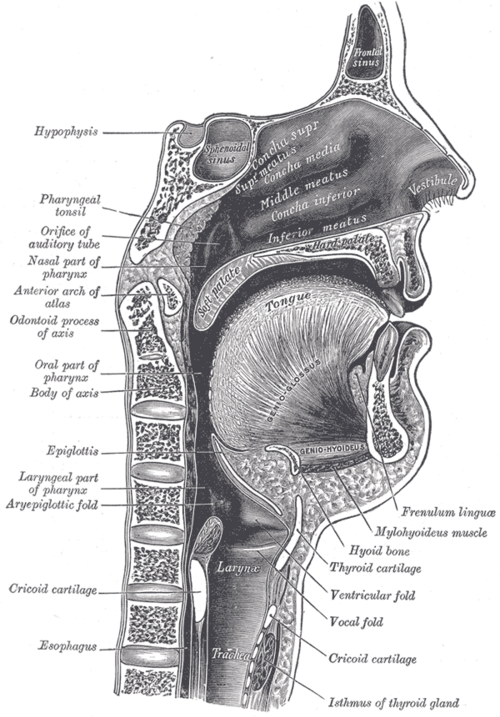
Floor of the mouth (oral part, anterior two-thirds) and front wall of the oropharynx (pharyngeal part, posterior third), divided by the V-shaped sulcus terminalis with the foramen cecum at its apex.
- Parts
- Anterior two-thirds (oral part): papillae — filiform (no taste buds), fungiform, circumvallate (in a V in front of the sulcus terminalis), foliate
- Posterior third (pharyngeal part): lingual tonsil
- Intrinsic muscles (change shape): superior and inferior longitudinal, transverse, vertical
- Extrinsic muscles (change position): genioglossus (protrudes), hyoglossus (depresses), styloglossus (retracts and elevates), palatoglossus (elevates the back)
- Foramen cecum: origin of the thyroid diverticulum (thyroglossal duct)
- Relations
The lingual nerve loops under the submandibular duct in the floor of the mouth; the hypoglossal nerve lies on hyoglossus.
- Arterial supply
Lingual artery (from the external carotid artery).
- Venous drainage
Lingual veins → internal jugular vein.
- Lymphatic drainage
Tip → submental nodes; lateral anterior two-thirds → submandibular nodes; posterior third → deep cervical (jugulodigastric) nodes, often bilaterally (see cervical lymph nodes).
- Innervation
Motor: all muscles by the hypoglossal nerve (CN XII) except palatoglossus (vagus, CN X). Anterior two-thirds: general sensation — lingual nerve (V3); taste — chorda tympani (CN VII). Posterior third: general sensation and taste — CN IX. Epiglottic region/root: CN X (internal laryngeal).
Mentioned in
Generated automatically from links in other entries.


Clinical correlations
Hypoglossal nerve (CN XII) lesion PANCE
- Mechanism / lesion
Lower motor neuron lesion (skull base tumors, carotid dissection or surgery, medullary stroke).
- Classic presentation
On protrusion the tongue deviates toward the weak (lesioned) side (the intact genioglossus pushes it over), with ipsilateral atrophy and fasciculations. An upper motor neuron lesion causes deviation away from the cortical lesion without atrophy.
Oral cavity cancer PANCE
- Mechanism / lesion
Squamous cell carcinoma; risk factors — tobacco, alcohol, betel quid; HPV for oropharyngeal (base of tongue, tonsil) cancers.
- Classic presentation
A non-healing ulcer or indurated mass on the lateral border of the tongue, leukoplakia/erythroplakia, referred otalgia, neck nodes. Biopsy any lesion persisting over 2–3 weeks.
Ankyloglossia and glossitis
- Mechanism / lesion
Short lingual frenulum (tongue-tie); glossitis from B12, folate or iron deficiency.
- Classic presentation
Tongue-tie — feeding difficulty in infants (frenotomy); atrophic glossitis — smooth red sore tongue.
High-yield PANCE pearls
- Tongue deviates toward the side of a CN XII LMN lesion.
- Taste: anterior 2/3 = CN VII (chorda tympani); posterior 1/3 = CN IX; sensation anterior 2/3 = V3.
- All tongue muscles = CN XII except palatoglossus (CN X).
- Non-healing lateral tongue ulcer in a smoker/drinker → SCC → biopsy.
- Smooth red tongue → B12/folate/iron deficiency.
Imaging anatomy
- CT
Contrast CT of the neck for staging oral cancers and nodes.
- MRI
Best for tongue tumor depth and extent.
- Key views & landmarks
- MRI oral cavity/neck
Physical exam
- Surface landmarks
Sulcus terminalis and circumvallate papillae, frenulum, openings of the submandibular ducts beside the frenulum.
- Palpation
Bimanual palpation of the tongue and floor of the mouth (gloved), especially the lateral borders and base; palpate the neck nodes.
- Strength / function testing
CN XII: inspect the tongue at rest (atrophy, fasciculations), then protrusion (deviation) and side-to-side movement against the cheek. Taste testing is rarely done.
Self-quiz
After a right carotid endarterectomy, a patient's tongue deviates to the right when protruded, and the right side of the tongue later shows atrophy. Which nerve was injured?
Correct answer: B
A lower motor neuron lesion of the right hypoglossal nerve weakens the right genioglossus, so the intact left genioglossus pushes the tongue toward the right (weak) side, with right-sided atrophy. The hypoglossal nerve crosses the carotid arteries in the neck.
Show answer
B
A lower motor neuron lesion of the right hypoglossal nerve weakens the right genioglossus, so the intact left genioglossus pushes the tongue toward the right (weak) side, with right-sided atrophy. The hypoglossal nerve crosses the carotid arteries in the neck.
Taste from the anterior two-thirds of the tongue is carried by which nerve?
Correct answer: B
Taste from the anterior two-thirds travels in the chorda tympani (CN VII), which joins the lingual nerve. The lingual nerve (V3) carries general sensation, and CN IX carries both from the posterior third.
Show answer
B
Taste from the anterior two-thirds travels in the chorda tympani (CN VII), which joins the lingual nerve. The lingual nerve (V3) carries general sensation, and CN IX carries both from the posterior third.
Which tongue muscle is NOT supplied by the hypoglossal nerve?
Correct answer: D
All tongue muscles are supplied by CN XII except palatoglossus, supplied by the vagus (CN X) through the pharyngeal plexus.
Show answer
D
All tongue muscles are supplied by CN XII except palatoglossus, supplied by the vagus (CN X) through the pharyngeal plexus.
Lymph from the tip of the tongue drains first to which nodes?
Correct answer: B
The tip of the tongue drains to the submental nodes, the lateral anterior two-thirds to the submandibular nodes, and the posterior third to the deep cervical nodes, often bilaterally.
Show answer
B
The tip of the tongue drains to the submental nodes, the lateral anterior two-thirds to the submandibular nodes, and the posterior third to the deep cervical nodes, often bilaterally.
Which nerve carries both general sensation and taste from the posterior third of the tongue?
Correct answer: E
The posterior third receives both general sensation and taste from CN IX. The anterior two-thirds has general sensation from the lingual nerve (V3) and taste from the chorda tympani (CN VII).
Show answer
E
The posterior third receives both general sensation and taste from CN IX. The anterior two-thirds has general sensation from the lingual nerve (V3) and taste from the chorda tympani (CN VII).