Circle of Willis
Arterial ring at the base of the brain joining the carotid (anterior) and vertebrobasilar (posterior) circulations. It provides collateral flow, and its branch points are where berry aneurysms form.
Core anatomy
- Origin
Formed by the terminal internal carotid arteries (common and internal carotid arteries) and the basilar artery (vertebrobasilar system).
- Course
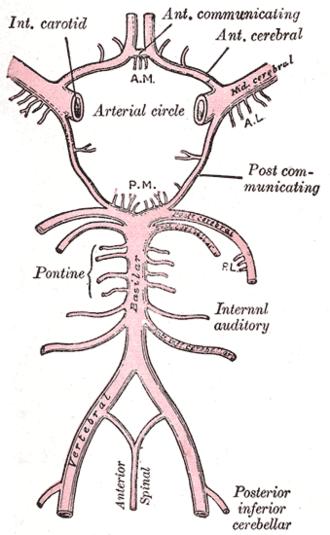
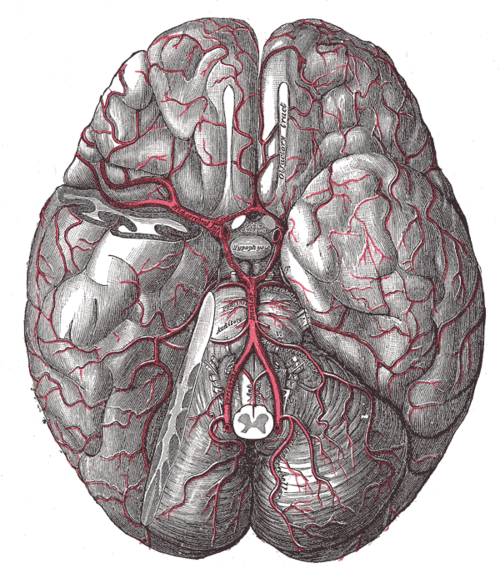
Lies in the interpeduncular cistern (subarachnoid space) around the optic chiasm, infundibulum and mammillary bodies. Components: the two anterior cerebral arteries (A1 segments) joined by the anterior communicating artery; the two internal carotid arteries; the two posterior communicating arteries connecting each ICA to the posterior cerebral artery (P1 segments) from the basilar bifurcation.
- Branches
- Anterior cerebral arteries and middle cerebral arteries (see cerebral arteries (ACA, MCA, PCA))
- Anterior communicating artery (AComm)
- Posterior communicating arteries (PComm) — beside oculomotor nerve (CN III)
- Posterior cerebral arteries
- Small central (perforating) branches to the hypothalamus, thalamus, internal capsule and basal ganglia; anterior choroidal artery (from the ICA)
- Supplies
The whole brain via its branches; the perforators supply deep structures (hypothalamus, thalamus, internal capsule).
- Anastomoses
Allows flow from one side or from the posterior circulation to compensate for a slowly narrowing carotid; a complete, symmetric circle is present in only a minority of people, so collateral capacity varies. verify
- Relations
The AComm lies above the optic chiasm; the PComm runs alongside CN III.
Branches
Structures supplied
Found in
Mentioned in
Generated automatically from links in other entries.
Swipe sideways to see the whole diagram →


Clinical correlations
Saccular (berry) aneurysms PANCE
- Mechanism / lesion
Thin-walled outpouchings at arterial branch points — most at the AComm junction, then the PComm–ICA junction and the MCA bifurcation. Risk factors — hypertension, smoking, ADPKD, Ehlers–Danlos, coarctation of the aorta, family history.
- Classic presentation
Rupture → subarachnoid hemorrhage (thunderclap headache; see cranial meninges and intracranial hemorrhage). Unruptured aneurysms can compress nearby structures: PComm aneurysm → pupil-involving CN III palsy; AComm aneurysm → visual field defects (chiasm). Treated by endovascular coiling or surgical clipping.
Collateral failure and watershed infarction
- Mechanism / lesion
Incomplete circle or severe hypotension.
- Classic presentation
Carotid occlusion may be silent with a good circle or cause a large MCA infarct without one; profound hypotension causes watershed (border-zone) infarcts between territories.
High-yield PANCE pearls
- Most common berry aneurysm site → anterior communicating artery.
- PComm aneurysm → CN III palsy with a dilated pupil.
- Berry aneurysms + kidney cysts → ADPKD.
- Circle of Willis lies in the subarachnoid space → aneurysm rupture = SAH.
Imaging anatomy
- CT
CT angiography — aneurysms and vessel occlusion; noncontrast CT for SAH first.
- MRI
MRA (time-of-flight, no contrast needed) for screening, e.g. in ADPKD with a family history of aneurysm.
- Key views & landmarks
- Digital subtraction (catheter) angiography — gold standard and route for coiling
Physical exam
- Strength / function testing
Pupils and eye movements (CN III compression), visual fields (chiasm); in suspected SAH — level of consciousness and neck stiffness.
Self-quiz
A ruptured berry aneurysm most commonly arises from which artery?
Correct answer: B
About a third of saccular aneurysms arise at the anterior communicating artery, followed by the posterior communicating–ICA junction and the MCA bifurcation.
Show answer
B
About a third of saccular aneurysms arise at the anterior communicating artery, followed by the posterior communicating–ICA junction and the MCA bifurcation.
A 38-year-old with autosomal dominant polycystic kidney disease has a mother who died of a brain hemorrhage. What screening test is most appropriate?
Correct answer: B
ADPKD carries an increased risk of intracranial berry aneurysms; with a family history of aneurysm or SAH, screening with MRA (or CTA) is recommended.
Show answer
B
ADPKD carries an increased risk of intracranial berry aneurysms; with a family history of aneurysm or SAH, screening with MRA (or CTA) is recommended.
An unruptured posterior communicating artery aneurysm typically presents with which finding?
Correct answer: E
The PComm runs alongside CN III, so an aneurysm compresses its superficial pupillomotor fibers, causing a pupil-involving CN III palsy that needs emergency vascular imaging.
Show answer
E
The PComm runs alongside CN III, so an aneurysm compresses its superficial pupillomotor fibers, causing a pupil-involving CN III palsy that needs emergency vascular imaging.
An anterior communicating artery aneurysm can compress which structure and cause visual field defects?
Correct answer: C
The AComm lies above the optic chiasm, so an aneurysm there can cause visual field defects. AComm is the most common site of berry aneurysms.
Show answer
C
The AComm lies above the optic chiasm, so an aneurysm there can cause visual field defects. AComm is the most common site of berry aneurysms.
The circle of Willis lies in which space, so that aneurysm rupture causes which hemorrhage?
Correct answer: A
The circle lies in the subarachnoid space (interpeduncular cistern), so a ruptured berry aneurysm causes subarachnoid hemorrhage with a thunderclap headache.
Show answer
A
The circle lies in the subarachnoid space (interpeduncular cistern), so a ruptured berry aneurysm causes subarachnoid hemorrhage with a thunderclap headache.