Thalamus
Paired relay station of the diencephalon. Almost all sensory information (except smell) and motor loops pass through it to the cortex; thalamic strokes cause contralateral sensory loss and sometimes severe pain.
Core anatomy
- Location
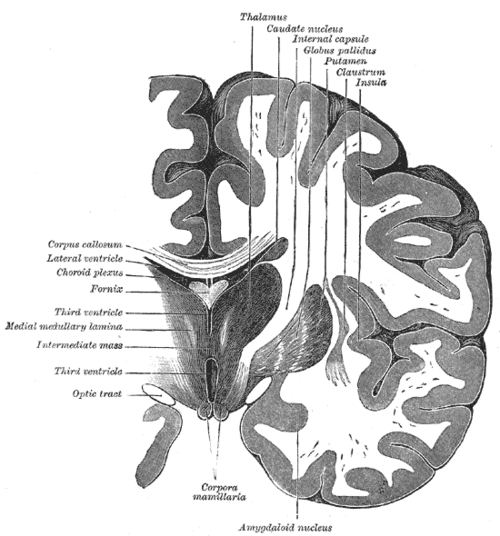
On each side of the third ventricle, medial to the posterior limb of the internal capsule, above the hypothalamus and midbrain.
- Parts
- VPL (ventral posterolateral) — body sensation: dorsal columns/medial lemniscus and spinothalamic tract → somatosensory cortex
- VPM (ventral posteromedial) — face sensation (trigeminal) and taste
- LGN (lateral geniculate) — vision (optic tract → optic radiations); "Lateral = Light"
- MGN (medial geniculate) — hearing (inferior colliculus → auditory cortex); "Medial = Music"
- VL and VA — motor: input from the cerebellum (VL) and basal ganglia (VA/VL) → motor and premotor cortex
- Anterior nucleus — Papez circuit (mammillothalamic tract → cingulate gyrus); mediodorsal nucleus — prefrontal cortex, memory and emotion
- Pulvinar (visual attention), intralaminar and reticular nuclei (arousal, thalamocortical rhythms)
- Relations
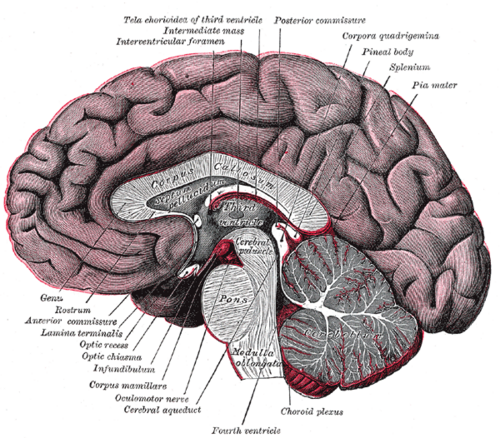
Forms the lateral walls of the third ventricle; the two thalami are often joined by the interthalamic adhesion.
- Arterial supply
Thalamoperforating (thalamogeniculate) branches of the posterior cerebral artery and the posterior communicating artery, plus the anterior choroidal artery — see cerebral arteries (ACA, MCA, PCA) and circle of Willis.
- Venous drainage
Internal cerebral veins → great cerebral vein (of Galen) → straight sinus.
- Notes
Relay nuclei connecting ascending tracts (dorsal column–medial lemniscus pathway, spinothalamic tract) with the cerebral cortex and lobes.
Mentioned in
- Basal ganglia
- Circle of Willis
- Dorsal column–medial lemniscus pathway
- Hypothalamus
- Internal capsule
- Limbic system
- Optic nerve and visual pathway (CN II)
- Spinothalamic tract
- Vertebrobasilar system
- Vestibulocochlear nerve (CN VIII)
Generated automatically from links in other entries.


Clinical correlations
Thalamic (lacunar) stroke PANCE
- Mechanism / lesion
Occlusion of a thalamoperforating branch of the PCA (hypertension, diabetes — small vessel disease).
- Classic presentation
Pure sensory stroke — contralateral loss of all sensory modalities over the face, arm and leg (VPL + VPM) without weakness.
Thalamic pain syndrome (Dejerine–Roussy) PANCE
- Mechanism / lesion
Weeks to months after a thalamic (VPL) stroke.
- Classic presentation
Severe, burning contralateral pain and allodynia in the area of sensory loss; treated with neuropathic agents (amitriptyline, gabapentinoids).
Thalamic hemorrhage
- Mechanism / lesion
Hypertensive rupture of thalamic perforators (second most common site after the putamen).
- Classic presentation
Contralateral sensory loss and hemiparesis (internal capsule), eyes deviated downward, and hydrocephalus from rupture into the third ventricle.
High-yield PANCE pearls
- Pure contralateral sensory loss (face, arm, leg) → thalamic lacunar stroke (VPL/VPM).
- Burning pain on the numb side after a stroke → thalamic pain syndrome.
- VPL = body; VPM = face and taste; LGN = vision; MGN = hearing.
- Olfaction is the only sense that bypasses the thalamus.
Imaging anatomy
- CT
CT for thalamic hemorrhage and intraventricular extension.
- MRI
MRI with DWI for small thalamic infarcts; bilateral paramedian thalamic infarcts suggest an artery of Percheron occlusion.
Physical exam
- Strength / function testing
Compare light touch, pinprick, temperature, vibration and proprioception on both sides of the face, arm and leg; a sharp midline split (including the face) suggests a thalamic lesion.
Self-quiz
A 64-year-old with hypertension develops numbness of the entire right side of the face, arm and leg. Strength, language and vision are normal. Which structure is most likely affected?
Correct answer: A
A pure sensory stroke of the whole contralateral half of the body including the face is a lacunar infarct of the left thalamus (VPL and VPM). A posterior limb lesion would cause mainly weakness.
Show answer
A
A pure sensory stroke of the whole contralateral half of the body including the face is a lacunar infarct of the left thalamus (VPL and VPM). A posterior limb lesion would cause mainly weakness.
Which thalamic nucleus relays visual information?
Correct answer: B
The lateral geniculate nucleus receives the optic tract and projects via the optic radiations to V1. The medial geniculate relays hearing.
Show answer
B
The lateral geniculate nucleus receives the optic tract and projects via the optic radiations to V1. The medial geniculate relays hearing.
Two months after a thalamic stroke, a patient develops severe burning pain on the numb side of the body. What is the diagnosis?
Correct answer: D
Thalamic pain syndrome follows a VPL stroke, causing severe contralateral burning pain and allodynia in the area of sensory loss. It is treated with neuropathic agents.
Show answer
D
Thalamic pain syndrome follows a VPL stroke, causing severe contralateral burning pain and allodynia in the area of sensory loss. It is treated with neuropathic agents.
Which sensory modality reaches the cortex without relaying in the thalamus?
Correct answer: A
Olfaction is the only sense that bypasses the thalamus. Vision relays in the LGN, hearing in the MGN, and taste and face sensation in VPM.
Show answer
A
Olfaction is the only sense that bypasses the thalamus. Vision relays in the LGN, hearing in the MGN, and taste and face sensation in VPM.
The medial geniculate nucleus relays which sense?
Correct answer: C
"Medial = Music": the MGN relays hearing from the inferior colliculus to the auditory cortex. "Lateral = Light": the LGN relays vision.
Show answer
C
"Medial = Music": the MGN relays hearing from the inferior colliculus to the auditory cortex. "Lateral = Light": the LGN relays vision.