Hypothalamus
Small part of the diencephalon that controls the pituitary, autonomic nervous system, temperature, hunger, thirst and circadian rhythm. Its disorders include central diabetes insipidus and craniopharyngioma.
Core anatomy
- Location
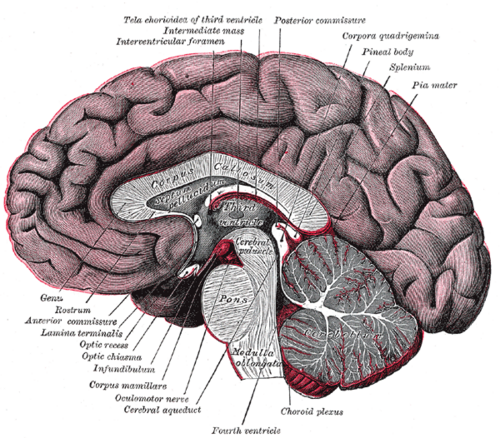
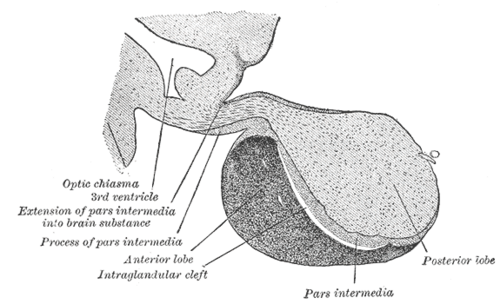
Below the thalamus, forming the floor and lower lateral walls of the third ventricle; the optic chiasm lies in front and the mammillary bodies behind; the infundibulum (stalk) connects it to the pituitary gland.
- Parts
- Supraoptic and paraventricular nuclei — make ADH (vasopressin) and oxytocin, transported down axons to the posterior pituitary
- Arcuate nucleus (and others) — releasing hormones (GnRH, TRH, CRH, GHRH, somatostatin) and dopamine (inhibits prolactin) into the hypophyseal portal system
- Suprachiasmatic nucleus — circadian rhythm (retinal input; melatonin via the pineal)
- Lateral area — hunger (lesion → anorexia); ventromedial nucleus — satiety (lesion → hyperphagia, obesity)
- Anterior hypothalamus — heat loss (cooling), parasympathetic; posterior hypothalamus — heat conservation, sympathetic
- Preoptic area — thermoregulation (fever set point via prostaglandin E2), sexual behavior
- Mammillary bodies — memory (Papez circuit; see limbic system)
- Thirst centers and osmoreceptors (organum vasculosum of the lamina terminalis)
- Relations
The optic chiasm lies anteroinferiorly — hypothalamic/suprasellar tumors cause visual field defects.
- Arterial supply
Small perforating branches of the circle of Willis (anterior and posterior communicating, anterior and posterior cerebral arteries).
- Venous drainage
Into the basal and internal cerebral veins; the hypophyseal portal veins carry releasing hormones to the anterior pituitary.
- Notes
Receives limbic, visceral and retinal input; outputs to the pituitary, brainstem autonomic nuclei and spinal cord.
Mentioned in
Generated automatically from links in other entries.


Clinical correlations
Central diabetes insipidus PANCE
- Mechanism / lesion
Deficient ADH — pituitary/hypothalamic surgery, head trauma, tumors (craniopharyngioma, germinoma), infiltrative disease, idiopathic.
- Classic presentation
Polyuria of dilute urine and polydipsia, high-normal or high serum sodium, low urine osmolality. Water deprivation test: urine stays dilute; urine osmolality rises after desmopressin (central) — no rise in nephrogenic DI (lithium, hypercalcemia). Treat central DI with desmopressin.
SIADH PANCE
- Mechanism / lesion
Excess ADH — CNS disease (meningitis, hemorrhage, trauma), small cell lung cancer, drugs (SSRIs, carbamazepine), pulmonary disease, postoperative.
- Classic presentation
Euvolemic hypotonic hyponatremia with inappropriately concentrated urine (urine osmolality > 100) and urine Na > 30. Fluid restriction; hypertonic saline if severe symptoms (correct slowly).
Craniopharyngioma PANCE
- Mechanism / lesion
Benign tumor from Rathke pouch remnants in the suprasellar region; peak in children (also adults 50s–60s).
- Classic presentation
Headache, bitemporal hemianopia, growth failure/hypopituitarism, diabetes insipidus; imaging shows a calcified, cystic suprasellar mass.
High-yield PANCE pearls
- Polyuria + dilute urine + rise in urine osm after desmopressin → central DI.
- No response to desmopressin → nephrogenic DI (lithium, hypercalcemia).
- Euvolemic hyponatremia + concentrated urine → SIADH.
- Child + bitemporal hemianopia + calcified suprasellar mass → craniopharyngioma.
- Supraoptic/paraventricular nuclei → ADH and oxytocin.
Imaging anatomy
- CT
CT shows calcification in craniopharyngioma.
- MRI
MRI of the sella and hypothalamus — loss of the posterior pituitary "bright spot" on T1 in central DI; thickened stalk (germinoma, histiocytosis, hypophysitis); suprasellar masses.
Physical exam
- Strength / function testing
Visual fields (chiasm), growth and pubertal assessment in children, volume status and weight, signs of hypopituitarism; strict intake/output and serum/urine osmolality in suspected DI.
Self-quiz
A 25-year-old develops polyuria of 6 L/day after a motorcycle crash with head injury. Serum sodium is 148 mEq/L and urine osmolality is 120 mOsm/kg, rising to 450 after desmopressin. What is the diagnosis?
Correct answer: B
Dilute urine with high-normal sodium that concentrates after desmopressin indicates central DI — here from head trauma damaging the hypothalamus or stalk.
Show answer
B
Dilute urine with high-normal sodium that concentrates after desmopressin indicates central DI — here from head trauma damaging the hypothalamus or stalk.
An 8-year-old boy has headaches, short stature and bitemporal visual field loss. CT shows a calcified cystic mass above the sella. What is the most likely diagnosis?
Correct answer: B
A calcified cystic suprasellar mass in a child with growth failure and bitemporal hemianopia is a craniopharyngioma (Rathke pouch remnant).
Show answer
B
A calcified cystic suprasellar mass in a child with growth failure and bitemporal hemianopia is a craniopharyngioma (Rathke pouch remnant).
A patient on long-term lithium has polyuria with dilute urine. Urine osmolality does not rise after desmopressin. What is the diagnosis?
Correct answer: C
Nephrogenic DI (lithium, hypercalcemia) doesn't respond to desmopressin because the kidney can't respond to ADH. In central DI, urine osmolality rises after desmopressin.
Show answer
C
Nephrogenic DI (lithium, hypercalcemia) doesn't respond to desmopressin because the kidney can't respond to ADH. In central DI, urine osmolality rises after desmopressin.
A lesion of the ventromedial nucleus of the hypothalamus causes which change?
Correct answer: A
The ventromedial nucleus mediates satiety; its lesion causes hyperphagia and obesity. A lesion of the lateral area (hunger) causes anorexia.
Show answer
A
The ventromedial nucleus mediates satiety; its lesion causes hyperphagia and obesity. A lesion of the lateral area (hunger) causes anorexia.
Which hypothalamic nucleus controls circadian rhythm using retinal input?
Correct answer: D
The suprachiasmatic nucleus receives retinohypothalamic input and sets circadian rhythm (with melatonin release from the pineal). The supraoptic and paraventricular nuclei make ADH and oxytocin.
Show answer
D
The suprachiasmatic nucleus receives retinohypothalamic input and sets circadian rhythm (with melatonin release from the pineal). The supraoptic and paraventricular nuclei make ADH and oxytocin.