Pituitary gland
Master endocrine gland in the sella turcica below the optic chiasm, with anterior (hormone-producing) and posterior (ADH, oxytocin) lobes. Adenomas cause hormone excess, hypopituitarism and bitemporal hemianopia.
Core anatomy
- Location
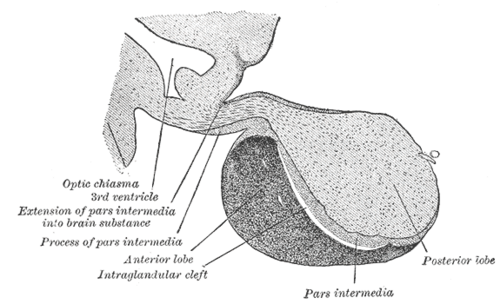
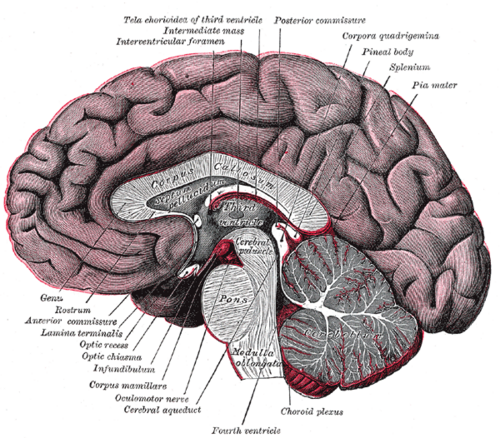
In the sella turcica (hypophyseal fossa) of the sphenoid bone, roofed by the diaphragma sellae, connected to the hypothalamus by the infundibular stalk.
- Parts
- Anterior lobe (adenohypophysis) — from Rathke pouch (oral ectoderm): GH, prolactin, ACTH, TSH, FSH and LH; controlled by hypothalamic releasing hormones via the hypophyseal portal system (prolactin is mainly under inhibitory dopamine control)
- Posterior lobe (neurohypophysis) — from neuroectoderm (downgrowth of the diencephalon): stores and releases ADH and oxytocin made in the hypothalamus
- Intermediate lobe — rudimentary in humans
- Relations
Above: the optic chiasm (see optic nerve and visual pathway (CN II)). Laterally: the cavernous sinuses with the internal carotid arteries and CN III, IV, V1, V2 and VI (see dural venous sinuses). Below: the sphenoid sinus (transsphenoidal surgical approach; see paranasal sinuses).
- Arterial supply
Superior and inferior hypophyseal arteries (from the internal carotid). The anterior lobe receives most of its blood through the portal veins — it has a vulnerable, low-pressure supply (Sheehan syndrome).
- Venous drainage
Hypophyseal veins → cavernous sinuses (inferior petrosal sinus sampling is used to localize ACTH secretion).
- Innervation
Posterior lobe — hypothalamo-hypophyseal tract (axons of supraoptic and paraventricular neurons); anterior lobe — hormonal, not neural, control.
Mentioned in
Generated automatically from links in other entries.


Clinical correlations
Pituitary adenomas PANCE
- Mechanism / lesion
Benign tumors — prolactinoma (most common functioning adenoma), GH-secreting (acromegaly/gigantism), ACTH-secreting (Cushing disease), nonfunctioning macroadenomas; MEN 1.
- Classic presentation
Hormone excess: prolactinoma — galactorrhea, amenorrhea, infertility, low libido, ED; GH — enlarged hands and feet, coarse facies, jaw growth, sweating (check IGF-1, confirm with failure of GH suppression on OGTT); ACTH — Cushing syndrome. Mass effect (macroadenomas, 1 cm or larger): headache, bitemporal hemianopia, hypopituitarism, CN palsies (cavernous sinus), mildly raised prolactin from stalk compression. Prolactinoma → dopamine agonist (cabergoline) first; most others → transsphenoidal surgery.
Pituitary apoplexy PANCE
- Mechanism / lesion
Sudden hemorrhage or infarction of a (often unknown) pituitary adenoma.
- Classic presentation
Sudden severe headache, visual loss, ophthalmoplegia (cavernous sinus), altered consciousness and acute adrenal insufficiency (hypotension). Emergency: IV hydrocortisone, then decompression if vision is threatened.
Sheehan syndrome and hypopituitarism PANCE
- Mechanism / lesion
Postpartum hemorrhage → ischemic necrosis of the enlarged anterior pituitary; also tumors, surgery, radiation, trauma.
- Classic presentation
Failure to lactate, amenorrhea, fatigue, hypotension, hypothyroidism, loss of pubic/axillary hair after a complicated delivery. Replace cortisol first, then thyroid hormone.
High-yield PANCE pearls
- Galactorrhea + amenorrhea → check prolactin (and pregnancy, TSH, medications) → cabergoline for prolactinoma.
- Big hands/feet, coarse features → acromegaly → IGF-1, then OGTT GH suppression.
- Sudden headache + visual loss + ophthalmoplegia + hypotension → pituitary apoplexy → IV hydrocortisone.
- No lactation after postpartum hemorrhage → Sheehan syndrome.
- Hypopituitarism → give glucocorticoid before thyroid hormone.
Imaging anatomy
- CT
CT for hemorrhage in suspected apoplexy if MRI is unavailable, and bone anatomy before surgery.
- MRI
MRI of the pituitary (sella) with gadolinium — microadenomas (under 1 cm) and macroadenomas, stalk, chiasm and cavernous sinus invasion.
- Key views & landmarks
- Dedicated pituitary protocol MRI (thin coronal slices)
- Formal visual field testing
Physical exam
- Strength / function testing
Visual fields by confrontation (bitemporal defects), eye movements (cavernous sinus), signs of hormone excess (acromegaly, Cushing, galactorrhea) or deficiency (hypotension, hypothyroidism, hypogonadism).
Self-quiz
A 28-year-old woman has amenorrhea and milky nipple discharge. Pregnancy test is negative, TSH is normal, and prolactin is 180 ng/mL. MRI shows a 7-mm pituitary lesion. What is the first-line treatment?
Correct answer: B
A prolactinoma is treated first with a dopamine agonist (cabergoline), which shrinks the tumor and normalizes prolactin in most patients. Surgery is for intolerance or resistance.
Show answer
B
A prolactinoma is treated first with a dopamine agonist (cabergoline), which shrinks the tumor and normalizes prolactin in most patients. Surgery is for intolerance or resistance.
A 45-year-old man has a sudden severe headache, double vision and hypotension. MRI shows hemorrhage into a pituitary macroadenoma. What is the most urgent treatment?
Correct answer: B
Pituitary apoplexy causes acute ACTH deficiency; hypotension requires stress-dose IV hydrocortisone. Surgical decompression follows if vision or consciousness is affected.
Show answer
B
Pituitary apoplexy causes acute ACTH deficiency; hypotension requires stress-dose IV hydrocortisone. Surgical decompression follows if vision or consciousness is affected.
After a delivery complicated by massive hemorrhage, a woman cannot breastfeed and later develops amenorrhea and fatigue. What is the most likely diagnosis?
Correct answer: C
Sheehan syndrome is ischemic necrosis of the enlarged anterior pituitary after postpartum hemorrhage, causing failure to lactate, amenorrhea and hypopituitarism.
Show answer
C
Sheehan syndrome is ischemic necrosis of the enlarged anterior pituitary after postpartum hemorrhage, causing failure to lactate, amenorrhea and hypopituitarism.
In a patient with hypopituitarism, which hormone must be replaced first?
Correct answer: A
Replace glucocorticoid before thyroid hormone; giving levothyroxine first increases cortisol clearance and can precipitate adrenal crisis.
Show answer
A
Replace glucocorticoid before thyroid hormone; giving levothyroxine first increases cortisol clearance and can precipitate adrenal crisis.
What is the best initial screening test for suspected acromegaly?
Correct answer: E
IGF-1 is the screening test for acromegaly (GH fluctuates too much for a random level). It is confirmed by failure of GH suppression on an oral glucose tolerance test.
Show answer
E
IGF-1 is the screening test for acromegaly (GH fluctuates too much for a random level). It is confirmed by failure of GH suppression on an oral glucose tolerance test.