Penis
Male copulatory and urinary organ made of three erectile bodies — two corpora cavernosa and the corpus spongiosum around the urethra. Erectile dysfunction, priapism, penile fracture and phimosis/paraphimosis are its key problems.
Core anatomy
- Location
The root is fixed in the superficial perineal pouch of the urogenital triangle; the body hangs free, suspended from the pubic symphysis by the suspensory and fundiform ligaments.
- Parts
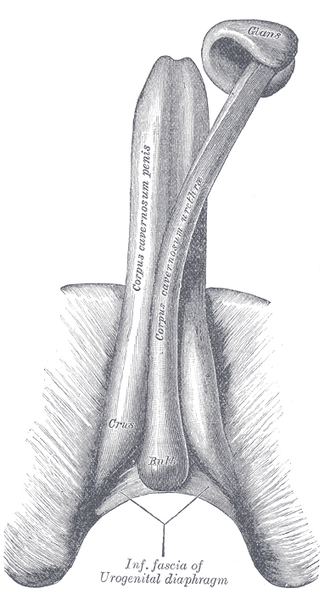
- Root: the bulb (attached to the perineal membrane, covered by bulbospongiosus; contains the spongy urethra) and two crura (attached to the ischiopubic rami, covered by ischiocavernosus)
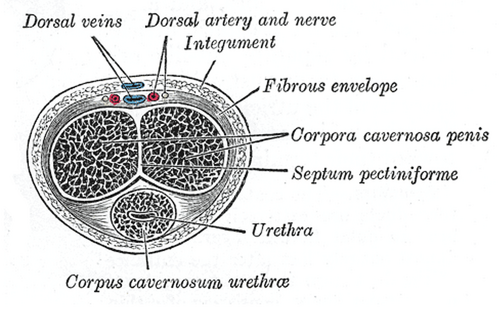
- Body: two dorsal corpora cavernosa and one ventral corpus spongiosum (containing the spongy urethra), each surrounded by tunica albuginea
- Glans: the expanded end of the corpus spongiosum; corona, external urethral orifice, and the prepuce (foreskin)
- Coverings (deep to superficial): tunica albuginea, deep (Buck) fascia enclosing all three bodies and the deep dorsal vessels and nerves, superficial (dartos) fascia, skin
- Relations
The deep dorsal vein lies in the midline with a dorsal artery and dorsal nerve on each side, all beneath Buck fascia (vein-artery-nerve from medial to lateral).
- Arterial supply
Branches of the internal pudendal artery (from the internal iliac artery): deep arteries (cavernosal) in the corpora cavernosa, whose helicine branches fill the erectile spaces; dorsal arteries; and the artery of the bulb. External pudendal arteries supply the skin.
- Venous drainage
Deep dorsal vein (beneath Buck fascia) → prostatic venous plexus; superficial dorsal vein → external pudendal → great saphenous vein.
- Lymphatic drainage
Skin → superficial inguinal nodes; glans and corpora → deep inguinal and internal iliac nodes. See pelvic and inguinal lymph drainage.
- Innervation
Dorsal nerve of the penis (from the pudendal nerve, S2–S4): sensation of the skin and glans. Cavernous nerves (parasympathetic, pelvic splanchnic S2–S4): vasodilation (nitric oxide) → erection. Sympathetic: emission and detumescence. Perineal branches of the pudendal nerve supply bulbospongiosus and ischiocavernosus (ejaculation). See pelvic autonomic nerves.
- Notes
Mnemonic for sexual function: "Point and Shoot" — parasympathetic for erection, sympathetic for emission, and somatic pudendal (bulbospongiosus) for ejaculation.
Found in
Mentioned in
Generated automatically from links in other entries.


Clinical correlations
Erectile dysfunction PANCE
- Mechanism / lesion
Most often vascular (atherosclerosis — it can precede coronary disease by years); also neurogenic (diabetes, prostatectomy, spinal cord injury), hormonal (low testosterone), drugs (antihypertensives, SSRIs) and psychogenic (morning erections preserved).
- Classic presentation
Persistent inability to achieve or maintain an erection. First-line treatment is a PDE-5 inhibitor (sildenafil, tadalafil), which is contraindicated with nitrates (severe hypotension). Screen for cardiovascular risk factors.
Priapism PANCE
- Mechanism / lesion
Ischemic (low-flow) — the common, painful emergency: sickle cell disease, trazodone, antipsychotics, intracavernosal injections. Non-ischemic (high-flow) — painless, after perineal trauma (arteriocavernous fistula).
- Classic presentation
Erection lasting over 4 hours unrelated to sexual stimulation. Ischemic: rigid, painful, dark hypoxic corporal blood. Treat with corporal aspiration and intracavernosal phenylephrine; delay risks fibrosis and permanent ED.
Penile fracture
- Mechanism / lesion
Rupture of the tunica albuginea of a corpus cavernosum when the erect penis bends forcibly (usually during intercourse).
- Classic presentation
A "pop", rapid detumescence, swelling and bruising ("eggplant deformity"). With Buck fascia intact, the hematoma stays on the shaft; if it is torn, bruising spreads to the perineum ("butterfly"). Treat with prompt surgical repair; up to about 1 in 5 have a urethral injury (blood at the meatus). verify
Phimosis and paraphimosis PANCE
- Mechanism / lesion
Phimosis: the foreskin cannot be retracted (normal in young boys). Paraphimosis: a retracted foreskin that cannot be returned over the glans, constricting it.
- Classic presentation
Paraphimosis is a urologic emergency — a swollen glans with a tight band; reduce manually (after compression and analgesia), and incise if that fails.
Peyronie disease
- Mechanism / lesion
Fibrous plaque in the tunica albuginea.
- Classic presentation
Painful erection and penile curvature toward the plaque; a palpable plaque on the shaft.
High-yield PANCE pearls
- ED in a man with risk factors → think cardiovascular disease; PDE-5 inhibitors are contraindicated with nitrates.
- Painful erection > 4 h in sickle cell disease or on trazodone → ischemic priapism → aspiration + phenylephrine.
- Retracted foreskin that won't reduce → paraphimosis (emergency).
- Erection = parasympathetic (NO, cGMP); emission = sympathetic; ejaculation = somatic (Point and Shoot).
Imaging anatomy
- MRI
Shows the site of tunica albuginea rupture when ultrasound is inconclusive.
- Ultrasound
Penile duplex Doppler ultrasound after intracavernosal vasodilator injection assesses arterial inflow and venous leak in ED; it also shows tunica albuginea tears and Peyronie plaques. Cavernosal blood gas distinguishes ischemic from non-ischemic priapism.
- Key views & landmarks
- Penile duplex Doppler ultrasound
Physical exam
- Surface landmarks
The corpus spongiosum and urethra lie on the ventral (underside) of the shaft; the corpora cavernosa form the dorsal bulk.
- Palpation
Retract the foreskin (then replace it) to inspect the glans and meatus; palpate the shaft for plaques (Peyronie) and tenderness.
- Strength / function testing
Bulbocavernosus reflex (S2–S4): squeezing the glans (or tugging an indwelling catheter) causes contraction of the anal sphincter felt on DRE. Its return marks the end of spinal shock; its absence is seen in cauda equina and conus lesions.
Self-quiz
A 58-year-old man with angina taking isosorbide mononitrate asks for sildenafil for erectile dysfunction. What is the main concern?
Correct answer: B
PDE-5 inhibitors increase cGMP, as nitrates do; combined they can cause profound hypotension, so they are contraindicated together.
Show answer
B
PDE-5 inhibitors increase cGMP, as nitrates do; combined they can cause profound hypotension, so they are contraindicated together.
A 19-year-old man with sickle cell disease has a painful erection that has lasted 6 hours. What is the most appropriate initial treatment?
Correct answer: C
This is ischemic priapism, a urologic emergency. Aspiration of corporal blood and intracavernosal phenylephrine (an α1-agonist) are first-line; prolonged ischemia causes fibrosis and permanent erectile dysfunction.
Show answer
C
This is ischemic priapism, a urologic emergency. Aspiration of corporal blood and intracavernosal phenylephrine (an α1-agonist) are first-line; prolonged ischemia causes fibrosis and permanent erectile dysfunction.
Which nerve provides sensation to the glans penis?
Correct answer: C
The dorsal nerve of the penis, a branch of the pudendal nerve, provides sensation to the glans and most of the skin of the shaft — the target of a dorsal penile nerve block. The cavernous nerves are autonomic.
Show answer
C
The dorsal nerve of the penis, a branch of the pudendal nerve, provides sensation to the glans and most of the skin of the shaft — the target of a dorsal penile nerve block. The cavernous nerves are autonomic.
A 35-year-old man hears a "pop" during intercourse, followed by rapid loss of erection and marked swelling and bruising of the shaft ("eggplant deformity"). Which structure is torn?
Correct answer: A
Penile fracture is rupture of the tunica albuginea of a corpus cavernosum when the erect penis is bent forcibly. If Buck fascia is intact the hematoma stays on the shaft; if torn, bruising spreads to the perineum. Treatment is prompt surgical repair; blood at the meatus suggests an associated urethral injury.
Show answer
A
Penile fracture is rupture of the tunica albuginea of a corpus cavernosum when the erect penis is bent forcibly. If Buck fascia is intact the hematoma stays on the shaft; if torn, bruising spreads to the perineum. Treatment is prompt surgical repair; blood at the meatus suggests an associated urethral injury.
A 40-year-old man retracted his foreskin several hours ago and cannot return it over the glans. The glans is swollen and painful, with a tight band behind it. What is the diagnosis?
Correct answer: C
Paraphimosis is a retracted foreskin that cannot be returned over the glans, constricting it. It is a urologic emergency, managed with manual reduction after compression and analgesia, and incision if that fails. Phimosis is a foreskin that cannot be retracted.
Show answer
C
Paraphimosis is a retracted foreskin that cannot be returned over the glans, constricting it. It is a urologic emergency, managed with manual reduction after compression and analgesia, and incision if that fails. Phimosis is a foreskin that cannot be retracted.