Biceps brachii
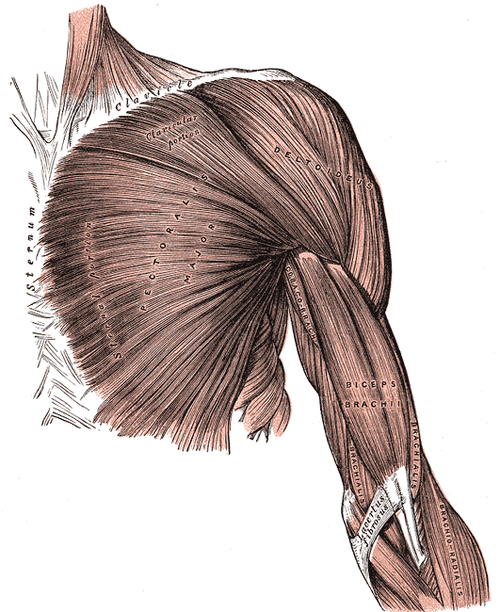
Two-headed muscle of the anterior arm and the most powerful supinator of the forearm; it also flexes the elbow.
Core anatomy
- Location
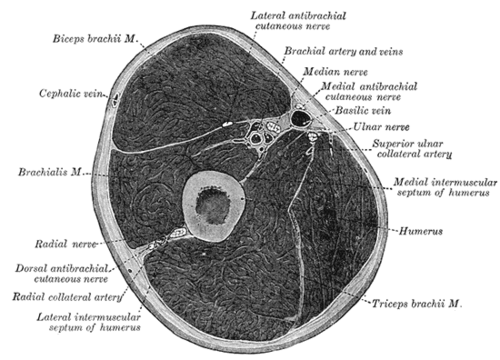
Anterior compartment of the arm, crossing both the shoulder and elbow joints.
- Group
Anterior (flexor) compartment of the arm, with brachialis and coracobrachialis.
- Origin
Long head: supraglenoid tubercle of the scapula (and the superior glenoid labrum). Short head: tip of the coracoid process of the scapula.
- Insertion
Radial tuberosity of the radius, and the bicipital aponeurosis (lacertus fibrosus) into the deep fascia of the medial forearm.
- Innervation
Musculocutaneous nerve (C5, C6)
- Blood supply
Muscular branches of the brachial artery
- Action
- Supinates the forearm (most powerful when the elbow is flexed)
- Flexes the elbow (most effective with the forearm supinated)
- The short head helps resist shoulder dislocation; the long head assists weak shoulder flexion
- Relations
The long head tendon runs inside the glenohumeral joint capsule (intracapsular but extrasynovial), then descends in the intertubercular (bicipital) groove held by the transverse humeral ligament. In the cubital fossa the tendon lies lateral to the brachial artery and median nerve; the bicipital aponeurosis passes over both. The median cubital vein lies superficial to the aponeurosis.
Found in
Mentioned in
Generated automatically from links in other entries.
Swipe sideways to see the whole diagram →


Clinical correlations
Proximal (long head) biceps tendon rupture PANCE
- Mechanism / lesion
Usually degenerative, in older adults with rotator cuff disease or subacromial impingement. May follow a minor lifting effort.
- Classic presentation
A sudden pop and anterior shoulder pain, then bruising and a distal bulge of the muscle belly ("Popeye" sign) on elbow flexion. Functional loss is usually minimal because the short head and brachialis remain.
Distal biceps tendon rupture PANCE
- Mechanism / lesion
Usually middle-aged men, from an eccentric load: a heavy weight forcing a flexed elbow into extension.
- Classic presentation
A pop at the antecubital fossa, then bruising, proximal retraction of the belly ("reverse Popeye"), and weakness of supination (more than flexion). The hook test is positive. Referred early for orthopedic evaluation, since repair is time-sensitive in active patients.
Bicipital tendinopathy / tenosynovitis
- Mechanism / lesion
Overuse, often coexisting with impingement or rotator cuff tendinopathy.
- Classic presentation
Anterior shoulder pain localized to the bicipital groove, worse with lifting and overhead activity. Positive Speed and Yergason tests.
SLAP lesion
- Mechanism / lesion
Tear of the superior labrum from anterior to posterior at the long head's attachment, e.g. in throwing athletes or after a fall on an outstretched arm.
- Classic presentation
Deep shoulder pain with overhead activity, clicking or catching. O'Brien (active compression) test may be positive.
High-yield PANCE pearls
- Popeye sign = long head rupture (older patient, often with cuff disease).
- Distal rupture: eccentric load, weak supination, positive hook test.
- Tests: Speed (resisted forward flexion), Yergason (resisted supination).
- Biceps reflex: C5–C6, musculocutaneous nerve.
- Biceps is the strongest supinator; brachialis is the strongest pure elbow flexor.
Imaging anatomy
- X-ray
Usually normal. Excludes bony avulsion from the radial tuberosity and other fractures.
- MRI
Distal tendon: tear and retraction are best seen with the FABS position (Flexed elbow, ABducted shoulder, forearm Supinated), which shows the whole tendon in one plane. Proximal: tendinopathy and subluxation from the groove. MR arthrography is used for SLAP lesions.
- Ultrasound
Short axis at the bicipital groove: the tendon is an oval hyperechoic structure in the groove. An empty groove means rupture or medial dislocation. Fluid around the tendon suggests tenosynovitis or a joint effusion. Distal tendon: assessed anteriorly and via medial or lateral windows.
- Key views & landmarks
- Ultrasound short axis over the intertubercular groove
- MRI elbow FABS view for the distal tendon
Physical exam
- Surface landmarks
The muscle belly forms the anterior arm contour. The distal tendon is palpable in the cubital fossa when the patient flexes against resistance, with the brachial pulse just medial to it.
- Palpation
The long head tendon is palpable in the bicipital groove with the arm slightly internally rotated (about 10°).
- Strength / function testing
Resisted elbow flexion with the forearm supinated and resisted supination. Biceps reflex at the distal tendon.
Speed's test
- Technique
Elbow extended, forearm supinated. The patient forward-flexes the shoulder against resistance.
- Positive test
Pain in the bicipital groove.
- Significance
Biceps (long head) tendinopathy or SLAP lesion.
Yergason's test
- Technique
Elbow flexed to 90°, forearm pronated. The patient supinates against resistance.
- Positive test
Pain in the bicipital groove, or the tendon subluxing from the groove.
- Significance
Biceps tendinopathy or instability of the tendon in the groove.
Hook test
- Technique
Elbow flexed to 90° and forearm supinated. The examiner tries to hook an index finger under the lateral edge of the distal biceps tendon in the antecubital fossa.
- Positive test
No cord-like tendon can be hooked.
- Significance
Complete distal biceps tendon rupture.
O'Brien (active compression) test
- Technique
Shoulder flexed to 90° and adducted about 10–15°, elbow extended. The patient resists downward force first with the thumb down (full internal rotation), then with the palm up.
- Positive test
Pain (deep in the shoulder) with thumb down that is relieved with palm up.
- Significance
Suggests a SLAP lesion (deep pain) or AC joint pathology (pain on top of the shoulder).
Self-quiz
A 45-year-old man felt a pop in his right antecubital fossa while catching a heavy falling box. He has bruising and marked weakness of forearm supination. The examiner can't hook a finger under a tendon in the antecubital fossa. Which structure is injured?
Correct answer: B
Eccentric load, a pop at the elbow, weak supination and a positive hook test indicate a distal biceps tendon rupture. A long head rupture produces a Popeye deformity with little weakness.
Show answer
B
Eccentric load, a pop at the elbow, weak supination and a positive hook test indicate a distal biceps tendon rupture. A long head rupture produces a Popeye deformity with little weakness.
A 68-year-old man with chronic shoulder pain notices a new bulge in his lower anterior arm after lifting a suitcase. Strength is nearly normal. What is the most likely diagnosis?
Correct answer: B
The Popeye sign comes from a long head of biceps rupture, typically degenerative with coexisting rotator cuff disease. The short head and brachialis keep elbow flexion strength largely intact.
Show answer
B
The Popeye sign comes from a long head of biceps rupture, typically degenerative with coexisting rotator cuff disease. The short head and brachialis keep elbow flexion strength largely intact.
Which test is performed by resisting supination with the elbow flexed at 90° and the forearm pronated?
Correct answer: B
Yergason's test stresses the long head of biceps through resisted supination. Speed's test uses resisted forward flexion with the elbow extended.
Show answer
B
Yergason's test stresses the long head of biceps through resisted supination. Speed's test uses resisted forward flexion with the elbow extended.
The long head of biceps brachii originates from which structure?
Correct answer: C
The long head arises from the supraglenoid tubercle and superior labrum. The short head arises from the coracoid process. The infraglenoid tubercle is the origin of the long head of triceps.
Show answer
C
The long head arises from the supraglenoid tubercle and superior labrum. The short head arises from the coracoid process. The infraglenoid tubercle is the origin of the long head of triceps.
The biceps reflex tests which spinal segments and which peripheral nerve?
Correct answer: B
Biceps brachii is supplied by the musculocutaneous nerve (C5, C6), and the biceps reflex tests C5–C6. The triceps reflex tests C7 (radial nerve) and the brachioradialis reflex C6 (radial nerve).
Show answer
B
Biceps brachii is supplied by the musculocutaneous nerve (C5, C6), and the biceps reflex tests C5–C6. The triceps reflex tests C7 (radial nerve) and the brachioradialis reflex C6 (radial nerve).