Musculocutaneous nerve
Lateral cord branch that pierces coracobrachialis, supplies the anterior arm muscles, and ends as the lateral cutaneous nerve of the forearm.
Core anatomy
- Location
Anterior compartment of the arm, between biceps brachii and brachialis.
- Root values
C5, C6, C7
- Origin
Terminal branch of the lateral cord of the brachial plexus.
- Course
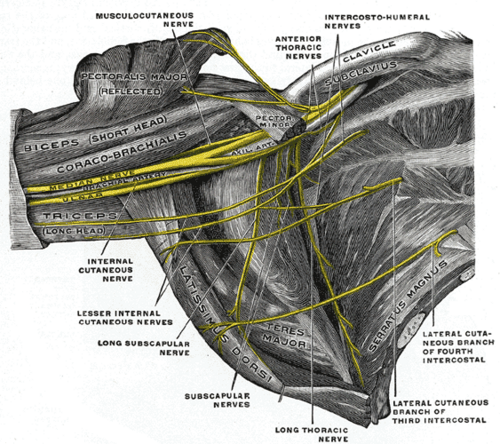
Leaves the axilla by piercing coracobrachialis, then descends between biceps brachii and brachialis, supplying all three anterior arm muscles. Lateral to the biceps tendon, just above the elbow, it pierces the deep fascia and continues as the lateral cutaneous nerve of the forearm (lateral antebrachial cutaneous nerve).
- Branches
- Muscular branches to coracobrachialis, biceps brachii and brachialis
- Lateral cutaneous nerve of the forearm (terminal sensory branch)
- Motor
Coracobrachialis, biceps brachii, brachialis (all flexor muscles of the anterior arm).
- Sensory
Skin of the lateral (radial) forearm, via the lateral cutaneous nerve of the forearm.
- Relations
In the axilla it lies lateral to the axillary artery and median nerve. In the arm it runs between biceps (superficial) and brachialis (deep).
Muscles innervated
- Biceps brachii — musculocutaneous nerve (C5, C6)
Other structures innervated
Mentioned in
Generated automatically from links in other entries.

Clinical correlations
Musculocutaneous nerve injury
- Mechanism / lesion
Uncommon in isolation because the nerve is protected deep in the arm. Causes include penetrating trauma to the arm or axilla, shoulder dislocation or surgery, and compression during strenuous exercise or prolonged positioning.
- Classic presentation
Weak elbow flexion and supination. Some flexion remains through brachioradialis (radial nerve) and some supination through supinator. Reduced or absent biceps reflex. Sensory loss over the lateral forearm.
Lateral cutaneous nerve of the forearm injury
- Mechanism / lesion
Irritation near the cubital fossa, e.g. during venipuncture of the cephalic or median cubital vein, or compression by the biceps tendon/aponeurosis.
- Classic presentation
Burning pain or numbness along the lateral forearm, with no motor deficit.
High-yield PANCE pearls
- Pierces coracobrachialis; supplies the three anterior-arm flexors (coracobrachialis, biceps, brachialis).
- Biceps reflex (C5–C6) tests the musculocutaneous nerve.
- Continues as the lateral cutaneous nerve of the forearm.
Imaging anatomy
- X-ray
Not visible. Radiographs assess associated shoulder or humeral injury.
- MRI
MRI shows denervation edema or atrophy of biceps and brachialis in chronic injury.
- Ultrasound
Commonly identified during axillary brachial plexus block. At the axilla it often lies separately from the other terminal nerves, within or between coracobrachialis and biceps, so it usually needs a separate injection.
- Key views & landmarks
- Ultrasound in the axilla, short axis to the axillary artery
Physical exam
- Strength / function testing
Resisted elbow flexion with the forearm supinated (isolates biceps and brachialis from brachioradialis). Biceps reflex (C5–C6). Pinprick sensation over the lateral forearm.
Self-quiz
A 30-year-old man sustains a stab wound to the anterolateral upper arm. He has weak elbow flexion and forearm supination, an absent biceps reflex and numbness over the lateral forearm. Which nerve is injured?
Correct answer: D
The musculocutaneous nerve supplies biceps and brachialis and continues as the lateral cutaneous nerve of the forearm. Elbow flexion is not lost completely because brachioradialis (radial nerve) still contributes.
Show answer
D
The musculocutaneous nerve supplies biceps and brachialis and continues as the lateral cutaneous nerve of the forearm. Elbow flexion is not lost completely because brachioradialis (radial nerve) still contributes.
Which muscle does the musculocutaneous nerve pierce as it enters the arm?
Correct answer: B
The musculocutaneous nerve typically pierces coracobrachialis and then descends between biceps brachii and brachialis.
Show answer
B
The musculocutaneous nerve typically pierces coracobrachialis and then descends between biceps brachii and brachialis.
A patient has numbness of the lateral forearm after venipuncture at the cubital fossa. Which nerve was most likely irritated?
Correct answer: C
The lateral cutaneous nerve of the forearm, the terminal branch of the musculocutaneous nerve, becomes superficial lateral to the biceps tendon near the cephalic and median cubital veins. The PIN and AIN are deep motor nerves.
Show answer
C
The lateral cutaneous nerve of the forearm, the terminal branch of the musculocutaneous nerve, becomes superficial lateral to the biceps tendon near the cephalic and median cubital veins. The PIN and AIN are deep motor nerves.
Flashcards
See also
- Upper limb nerve injuries (comparison table)