Ulnar artery
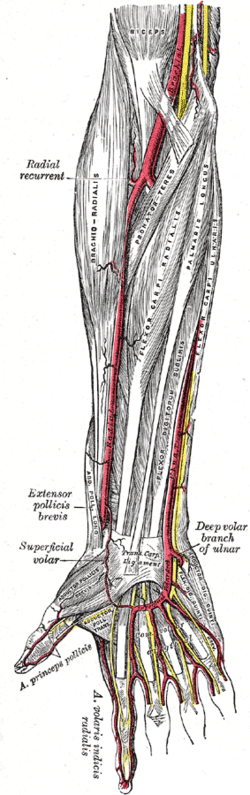
Larger terminal branch of the brachial artery. It gives the common interosseous artery, enters the hand through Guyon's canal, and forms most of the superficial palmar arch.
Core anatomy
- Location
Medial anterior forearm → Guyon's canal → superficial palm.
- Origin
Terminal branch of the brachial artery in the cubital fossa.
- Course
Passes deep to the ulnar head of pronator teres and descends deep to flexor digitorum superficialis, then between flexor carpi ulnaris and flexor digitorum profundus. In the distal forearm the ulnar nerve lies medial to it. At the wrist it passes superficial to the flexor retinaculum, lateral to the pisiform, through Guyon's canal with the ulnar nerve. It ends as the superficial palmar arch.
- Branches
- Anterior and posterior ulnar recurrent arteries (elbow anastomosis)
- Common interosseous artery → anterior and posterior interosseous arteries (deep forearm)
- Palmar and dorsal carpal branches
- Deep palmar branch (joins the deep palmar arch)
- Superficial palmar arch → common palmar digital arteries
- Supplies
Medial forearm muscles, deep forearm (via the interosseous arteries), medial carpus, and most of the fingers (via the superficial palmar arch).
- Anastomoses
Superficial and deep palmar arches with the radial artery. The recurrent branches join the periarticular anastomosis of the elbow.
- Termination
Superficial palmar arch, completed by the superficial palmar branch of the radial artery. The arch lies at about the level of the distal border of the fully extended thumb. verify
Structures supplied
Found in
Mentioned in
Generated automatically from links in other entries.

Clinical correlations
Hypothenar hammer syndrome
- Mechanism / lesion
Repetitive blunt trauma to the hypothenar eminence (using the palm as a hammer) damages the superficial ulnar artery where it crosses the hook of hamate, causing aneurysm or thrombosis with distal emboli.
- Classic presentation
Pain, pallor, coldness and Raynaud-like changes of the ulnar-side fingers (typically 4th and 5th) in a manual worker. The Allen test shows poor ulnar filling. May compress the ulnar nerve in Guyon's canal.
Ulnar artery injury at the wrist
- Mechanism / lesion
Lacerations at the medial wrist; the ulnar nerve is often cut at the same time.
- Classic presentation
Bleeding, with numbness of the little finger and intrinsic weakness if the nerve is involved.
High-yield PANCE pearls
- Ulnar artery → mainly the superficial palmar arch.
- Travels with the ulnar nerve through Guyon's canal (superficial to the flexor retinaculum).
- Hypothenar hammer syndrome: manual worker, digital ischemia of the ulnar fingers.
Imaging anatomy
- CT
CT angiography shows aneurysm or occlusion in hypothenar hammer syndrome and in trauma.
- Ultrasound
Duplex ultrasound for patency, aneurysm or thrombosis at the hook of hamate, and flow assessment before radial artery procedures.
- Key views & landmarks
- Duplex at the wrist and hypothenar region
- Catheter or CT angiography of the hand (tortuous "corkscrew" ulnar artery is described in hypothenar hammer syndrome) verify
Physical exam
- Surface landmarks
Pulse palpable at the medial wrist, lateral to the FCU tendon and just proximal to the pisiform. It is fainter than the radial pulse.
- Palpation
Palpate lateral to the FCU tendon, proximal to the pisiform.
Allen test
- Technique
See radial artery. Release each artery in turn after occluding both.
- Positive test
Delayed palmar flushing when the ulnar artery is released indicates poor ulnar flow.
- Significance
Assesses the contribution of each artery to the palmar arches.
Self-quiz
A 45-year-old mechanic who often strikes objects with the heel of his hand has cold, painful 4th and 5th fingers with episodic pallor. Which vessel is most likely injured?
Correct answer: B
Hypothenar hammer syndrome: repetitive trauma damages the superficial ulnar artery over the hook of hamate, causing thrombosis or aneurysm with emboli to the ulnar fingers.
Show answer
B
Hypothenar hammer syndrome: repetitive trauma damages the superficial ulnar artery over the hook of hamate, causing thrombosis or aneurysm with emboli to the ulnar fingers.
Which branch of the ulnar artery supplies the deep compartments of the forearm?
Correct answer: B
The common interosseous artery divides into the anterior and posterior interosseous arteries, which run on either side of the interosseous membrane.
Show answer
B
The common interosseous artery divides into the anterior and posterior interosseous arteries, which run on either side of the interosseous membrane.
The ulnar artery enters the hand through which structure?
Correct answer: B
The ulnar artery and ulnar nerve pass through Guyon's canal, superficial to the flexor retinaculum. The carpal tunnel contains the median nerve and the long flexor tendons.
Show answer
B
The ulnar artery and ulnar nerve pass through Guyon's canal, superficial to the flexor retinaculum. The carpal tunnel contains the median nerve and the long flexor tendons.