Radial artery
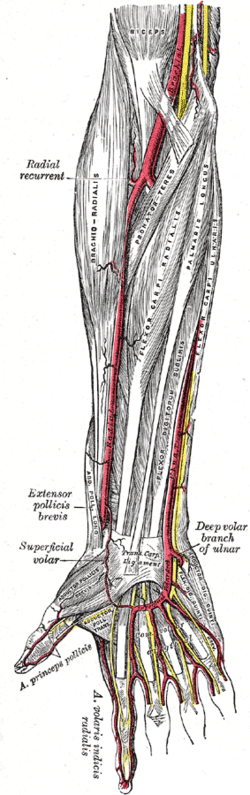
Smaller terminal branch of the brachial artery. It is palpated at the wrist, used for ABGs, arterial lines and cardiac catheterization, and forms most of the deep palmar arch.
Core anatomy
- Location
Lateral anterior forearm → wrist (pulse point) → anatomical snuffbox → deep palm.
- Origin
Terminal branch of the brachial artery in the cubital fossa, at about the level of the neck of the radius.
- Course
Descends in the lateral forearm, deep to brachioradialis proximally, then superficial in the distal forearm, where it lies lateral to the flexor carpi radialis tendon over the distal radius (pulse point). At the wrist it curves dorsally around the lateral carpus, crosses the floor of the anatomical snuffbox (over the scaphoid and trapezium), then passes between the two heads of the first dorsal interosseous muscle into the palm and between the heads of adductor pollicis to form the deep palmar arch.
- Branches
- Radial recurrent artery (elbow anastomosis)
- Muscular branches
- Palmar carpal branch and superficial palmar branch (joins the superficial palmar arch)
- Dorsal carpal branch (dorsal carpal arch)
- Princeps pollicis artery and radialis indicis artery (thumb and index finger)
- Deep palmar arch (with the deep palmar branch of the ulnar artery)
- Supplies
Lateral forearm muscles, radius, carpal bones (including the retrograde supply of the scaphoid), thumb and index finger, deep palm.
- Anastomoses
The superficial palmar arch (mainly from the ulnar artery) and the deep palmar arch (mainly from the radial artery) connect the two arteries, so either can usually supply the hand if the other is occluded. This dual supply is what the Allen test checks before radial artery procedures.
- Termination
Deep palmar arch.
Structures supplied
Found in
Mentioned in
Generated automatically from links in other entries.

Clinical correlations
Arterial puncture and cannulation PANCE
- Mechanism / lesion
Its superficial position over the distal radius and the hand's dual blood supply make it the preferred site for arterial blood gas sampling and arterial lines. It's also used for transradial cardiac catheterization.
- Classic presentation
Complications include hematoma, thrombosis or occlusion, pseudoaneurysm, and rarely hand ischemia. Assess collateral (ulnar) flow beforehand.
Radial artery harvest (CABG conduit)
- Mechanism / lesion
The radial artery is used as a conduit in coronary artery bypass grafting.
- Classic presentation
Adequate ulnar collateral flow to the hand must be confirmed before harvest.
High-yield PANCE pearls
- Radial pulse: lateral to the FCR tendon at the distal radius.
- Perform an Allen test (or modified Allen) before radial artery puncture or cannulation.
- Radial artery → mainly the deep palmar arch; ulnar artery → mainly the superficial arch.
- Radial artery crosses the anatomical snuffbox, over the scaphoid and trapezium.
Imaging anatomy
- X-ray
Not visible, though calcification may be seen in diabetes or end-stage kidney disease (medial arterial calcification).
- CT
CT angiography for trauma or ischemia of the hand.
- Ultrasound
Ultrasound-guided radial arterial line placement improves first-pass success. Duplex shows patency, diameter (before catheterization or harvest) and complications such as thrombosis or pseudoaneurysm.
- Key views & landmarks
- Transverse ultrasound at the distal radius, lateral to FCR
Physical exam
- Surface landmarks
Wrist: pulse palpated against the distal radius, lateral to the FCR tendon, just proximal to the wrist crease. Snuffbox: pulse palpable in the floor of the anatomical snuffbox.
- Palpation
Use the pads of the index and middle fingers. Compare both sides for rate, rhythm and volume.
Allen test (modified)
- Technique
The patient makes a tight fist. The examiner occludes both the radial and ulnar arteries at the wrist. The patient opens the hand (now blanched), and the examiner releases pressure on the ulnar artery only.
- Positive test
(Abnormal) Color takes too long to return to the palm. Thresholds of roughly 5–10 seconds are quoted. verify
- Significance
A delayed return suggests inadequate ulnar collateral flow, which argues against cannulating or harvesting the radial artery on that side. Repeating the test with radial release assesses the radial contribution.
Self-quiz
Before placing a radial arterial line, a PA occludes both the radial and ulnar arteries while the patient clenches the fist, then releases the ulnar artery. The palm stays pale for 15 seconds. What does this indicate?
Correct answer: B
A delayed return of color after releasing the ulnar artery suggests poor ulnar collateral flow through the palmar arches. If the radial artery were then occluded by cannulation, the hand could become ischemic.
Show answer
B
A delayed return of color after releasing the ulnar artery suggests poor ulnar collateral flow through the palmar arches. If the radial artery were then occluded by cannulation, the hand could become ischemic.
The radial pulse at the wrist is palpated immediately lateral to which tendon?
Correct answer: B
The radial artery lies lateral to the flexor carpi radialis tendon, over the distal radius. The median nerve lies deep to palmaris longus, between FCR and FDS.
Show answer
B
The radial artery lies lateral to the flexor carpi radialis tendon, over the distal radius. The median nerve lies deep to palmaris longus, between FCR and FDS.
The radial artery contributes mainly to which structure in the hand?
Correct answer: B
The radial artery forms most of the deep palmar arch, joined by the deep palmar branch of the ulnar artery. The superficial arch is formed mainly by the ulnar artery.
Show answer
B
The radial artery forms most of the deep palmar arch, joined by the deep palmar branch of the ulnar artery. The superficial arch is formed mainly by the ulnar artery.
At the wrist, the radial artery crosses the floor of which region?
Correct answer: C
The radial artery curves dorsally around the lateral carpus and crosses the floor of the anatomical snuffbox over the scaphoid and trapezium, then passes between the heads of the first dorsal interosseous muscle to form the deep palmar arch.
Show answer
C
The radial artery curves dorsally around the lateral carpus and crosses the floor of the anatomical snuffbox over the scaphoid and trapezium, then passes between the heads of the first dorsal interosseous muscle to form the deep palmar arch.
In the proximal forearm, the radial artery lies deep to which muscle?
Correct answer: A
The radial artery runs deep to brachioradialis proximally, then becomes superficial in the distal forearm, where it lies lateral to the flexor carpi radialis tendon (the pulse point).
Show answer
A
The radial artery runs deep to brachioradialis proximally, then becomes superficial in the distal forearm, where it lies lateral to the flexor carpi radialis tendon (the pulse point).
Flashcards
See also
- Ulnar artery
- Scaphoid
- Wrist joint
- Fall on an outstretched hand (clinical case)