Recurrent laryngeal nerve
Branch of the vagus that loops under the subclavian artery on the right and the aortic arch on the left, then climbs in the tracheoesophageal groove to supply the larynx. Injury causes hoarseness, a classic thyroidectomy complication.
Core anatomy
- Root values
Vagus nerve (CN X) — motor fibers from the nucleus ambiguus
- Origin
Branch of the vagus nerve (CN X) in the root of the neck (right) or the thorax (left).
- Course
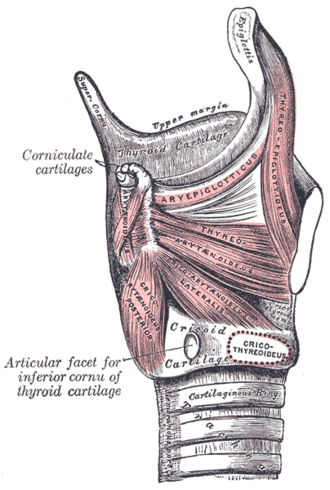
Right: hooks under the right subclavian artery. Left: hooks under the aortic arch just lateral to the ligamentum arteriosum (see thoracic aorta), so it is longer and has a thoracic course. Both ascend in the tracheoesophageal groove, pass close to the inferior thyroid artery behind the thyroid gland, and enter the larynx behind the cricothyroid joint (under the inferior constrictor), where the terminal part is called the inferior laryngeal nerve.
- Branches
- Cardiac, tracheal and esophageal branches
- Inferior laryngeal nerve — motor to all intrinsic laryngeal muscles except cricothyroid
- Motor
All intrinsic muscles of the larynx except cricothyroid — including the posterior cricoarytenoid, the only abductor of the vocal folds.
- Sensory
Laryngeal mucosa below the vocal folds.
- Relations
Close to the inferior thyroid artery and the posterior thyroid capsule (ligament of Berry); the left nerve is related to the aortic arch, left main bronchus, left atrium and aortopulmonary window lymph nodes.
- Notes
A non-recurrent right laryngeal nerve occurs in a small minority of people, usually with an aberrant right subclavian artery. verify
Other structures innervated
Mentioned in
Generated automatically from links in other entries.
Swipe sideways to see the whole diagram →

Clinical correlations
Recurrent laryngeal nerve injury PANCE
- Mechanism / lesion
Thyroidectomy/parathyroidectomy (most common iatrogenic cause), anterior cervical spine surgery, and tumors. The left nerve is also at risk in the chest — lung cancer (apex/hilum), aortic arch aneurysm, mediastinal nodes, and even a massively enlarged left atrium (Ortner syndrome, e.g. mitral stenosis).
- Classic presentation
Unilateral: hoarse, breathy voice, weak cough, possible aspiration; the paralyzed cord sits near the midline (paramedian). Bilateral: both cords paramedian → stridor and airway obstruction, often needing tracheostomy, with a relatively normal voice.
External (superior) laryngeal nerve injury
- Mechanism / lesion
Injured while ligating the superior thyroid vessels (runs close to them).
- Classic presentation
Paralysis of cricothyroid → inability to tense the cord → loss of high pitch and voice fatigue (e.g. singers) rather than hoarseness.
High-yield PANCE pearls
- New hoarseness after thyroidectomy → recurrent laryngeal nerve injury.
- The left RLN loops under the aortic arch → hoarseness can be the first sign of lung cancer, aortic aneurysm or mitral stenosis (Ortner).
- Bilateral RLN palsy → stridor/airway compromise.
- External laryngeal nerve injury → loss of high-pitched voice (cricothyroid).
Imaging anatomy
- X-ray
A chest X-ray is part of the workup of unexplained vocal cord paralysis (apical or hilar mass, mediastinal widening).
- CT
Contrast CT from the skull base to the aortopulmonary window (neck and chest) to search along the whole course of the nerve for unexplained vocal cord paralysis.
Physical exam
- Surface landmarks
The nerve cannot be palpated; it lies in the tracheoesophageal groove behind the thyroid lobes.
- Strength / function testing
Voice quality, cough strength, stridor; laryngoscopy shows an immobile cord. Many surgeons document cord function before and after thyroid surgery and use intraoperative nerve monitoring.
Self-quiz
A 64-year-old man with a 50-pack-year smoking history has had hoarseness for 6 weeks. Laryngoscopy shows a paralyzed left vocal cord with no mass. Where is the most likely lesion?
Correct answer: B
The left recurrent laryngeal nerve loops under the aortic arch, so a left hilar lung cancer or aortopulmonary window nodes can compress it. CT from the skull base to the mediastinum is indicated.
Show answer
B
The left recurrent laryngeal nerve loops under the aortic arch, so a left hilar lung cancer or aortopulmonary window nodes can compress it. CT from the skull base to the mediastinum is indicated.
The day after a total thyroidectomy, a patient has inspiratory stridor and increasing respiratory distress but a nearly normal voice. What is the most likely cause?
Correct answer: B
Bilateral recurrent laryngeal nerve injury leaves both cords near the midline, narrowing the airway and causing stridor, while the voice may be relatively preserved. Neck hematoma and hypocalcemic laryngospasm are other causes of post-thyroidectomy airway compromise to consider.
Show answer
B
Bilateral recurrent laryngeal nerve injury leaves both cords near the midline, narrowing the airway and causing stridor, while the voice may be relatively preserved. Neck hematoma and hypocalcemic laryngospasm are other causes of post-thyroidectomy airway compromise to consider.
The left recurrent laryngeal nerve hooks under which structure?
Correct answer: A
The left RLN hooks under the aortic arch lateral to the ligamentum arteriosum, giving it a thoracic course; the right hooks under the right subclavian artery. Thoracic lesions (lung cancer, aneurysm) can therefore cause left-sided hoarseness.
Show answer
A
The left RLN hooks under the aortic arch lateral to the ligamentum arteriosum, giving it a thoracic course; the right hooks under the right subclavian artery. Thoracic lesions (lung cancer, aneurysm) can therefore cause left-sided hoarseness.
After a thyroidectomy, a professional singer can speak normally but can no longer reach high notes. Which nerve was most likely injured?
Correct answer: D
The external laryngeal nerve runs near the superior thyroid vessels and supplies cricothyroid, which tenses the cords. Injury causes loss of high pitch and voice fatigue rather than hoarseness.
Show answer
D
The external laryngeal nerve runs near the superior thyroid vessels and supplies cricothyroid, which tenses the cords. Injury causes loss of high pitch and voice fatigue rather than hoarseness.
A patient with severe mitral stenosis develops hoarseness. What is the most likely mechanism?
Correct answer: C
In Ortner syndrome, a massively enlarged left atrium (e.g. mitral stenosis) compresses the left recurrent laryngeal nerve, which runs near the left atrium and aortopulmonary window.
Show answer
C
In Ortner syndrome, a massively enlarged left atrium (e.g. mitral stenosis) compresses the left recurrent laryngeal nerve, which runs near the left atrium and aortopulmonary window.