Pharynx
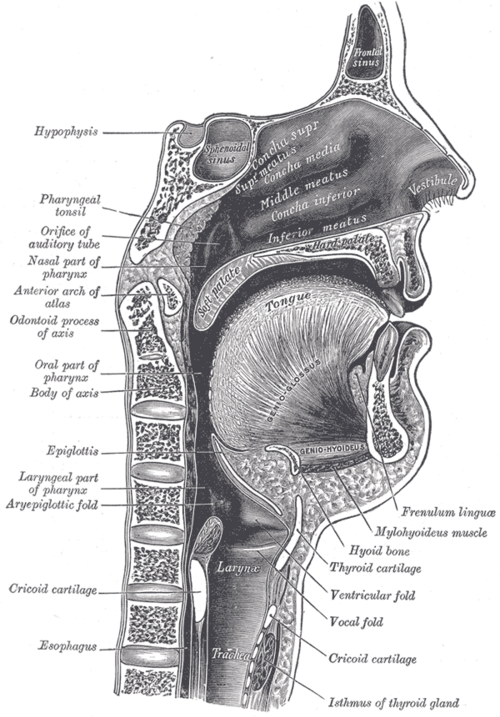
Fibromuscular tube from the skull base to C6, shared by the airway and the food passage. It is divided into nasopharynx, oropharynx and laryngopharynx, and the site of Zenker diverticulum and nasopharyngeal carcinoma.
Core anatomy
- Location
Behind the nasal cavity, mouth and larynx, in front of the cervical vertebrae, from the skull base to the lower border of the cricoid cartilage (C6), where it continues as the esophagus.
- Parts
- Nasopharynx: behind the choanae; contains the pharyngeal tonsil (adenoids) and the openings of the pharyngotympanic tubes (see external and middle ear)
- Oropharynx: behind the mouth, from the soft palate to the tip of the epiglottis; contains the palatine tonsils and the base of the tongue
- Laryngopharynx (hypopharynx): behind the larynx; the piriform recesses lie on each side of the laryngeal inlet (where fish bones lodge)
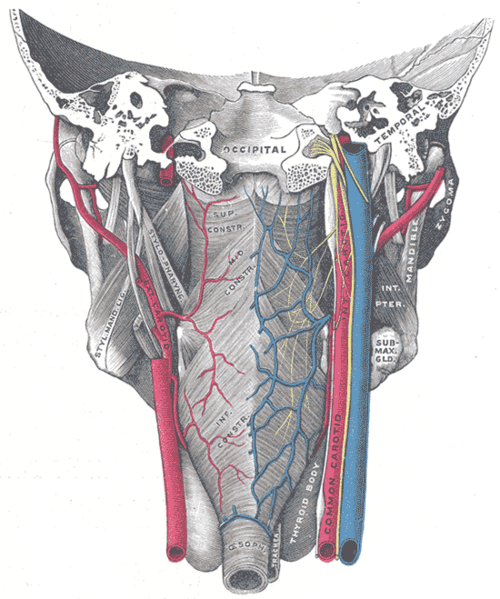
- Muscles: superior, middle and inferior constrictors (the inferior has thyropharyngeus and cricopharyngeus parts); stylopharyngeus, palatopharyngeus, salpingopharyngeus
- Killian triangle (dehiscence): weak area between thyropharyngeus and cricopharyngeus
- Relations
Behind lies the retropharyngeal space (see deep neck spaces); laterally the parapharyngeal space and the carotid sheath.
- Arterial supply
Ascending pharyngeal, facial, lingual and maxillary arteries (branches of the external carotid artery) and the inferior thyroid artery.
- Venous drainage
Pharyngeal venous plexus → internal jugular vein.
- Lymphatic drainage
Retropharyngeal and deep cervical nodes (see cervical lymph nodes).
Mentioned in
Generated automatically from links in other entries.


Clinical correlations
Zenker (pharyngoesophageal) diverticulum PANCE
- Mechanism / lesion
Pulsion diverticulum through Killian triangle above the cricopharyngeus, from cricopharyngeal dysfunction; older adults.
- Classic presentation
Dysphagia, regurgitation of undigested food, halitosis, gurgling in the neck, aspiration. Diagnose with a barium swallow; endoscopy carries a perforation risk.
Nasopharyngeal carcinoma
- Mechanism / lesion
Associated with EBV, higher incidence in Southern China and North Africa.
- Classic presentation
Unilateral serous otitis media in an adult (eustachian tube obstruction), epistaxis, nasal obstruction, neck nodes, cranial nerve palsies.
Adenoid hypertrophy
- Mechanism / lesion
Enlarged pharyngeal tonsil in children.
- Classic presentation
Mouth breathing, snoring and obstructive sleep apnea, hyponasal speech, recurrent otitis media with effusion.
Oropharyngeal cancer PANCE
- Mechanism / lesion
Increasingly HPV-16-related squamous cell carcinoma (tonsil, base of tongue), often in younger nonsmokers; otherwise tobacco and alcohol.
- Classic presentation
Persistent sore throat, dysphagia, referred otalgia, or a painless neck mass (cystic nodal metastasis).
High-yield PANCE pearls
- Elderly with regurgitation of undigested food + halitosis → Zenker diverticulum → barium swallow.
- Adult with new unilateral serous otitis media → rule out nasopharyngeal carcinoma (EBV).
- Gag reflex: afferent CN IX, efferent CN X.
- Adult with a new neck mass → think head and neck cancer (HPV oropharyngeal).
Imaging anatomy
- X-ray
Barium swallow (videofluoroscopy) for Zenker diverticulum and dysphagia; lateral neck film for adenoids and retropharyngeal swelling.
- CT
Contrast CT neck for tumors and deep neck infections.
- MRI
Nasopharyngeal carcinoma extent and skull base involvement.
- Key views & landmarks
- Barium swallow / modified barium swallow
Physical exam
- Surface landmarks
The pharynx ends at the cricoid cartilage (C6).
- Strength / function testing
Inspect the oropharynx with a tongue depressor; nasopharyngoscopy/laryngoscopy (flexible endoscope) for the nasopharynx and laryngopharynx. CN IX/X: palate elevation (uvula deviates away from a CN X lesion), gag reflex, swallowing, voice.
Self-quiz
A 74-year-old man has progressive dysphagia, regurgitation of food eaten days earlier, bad breath and a gurgling sound in his neck when he swallows. What is the most likely diagnosis?
Correct answer: B
Zenker diverticulum — a pulsion pouch through Killian triangle above the cricopharyngeus — causes regurgitation of undigested food, halitosis and a gurgling neck mass in older adults. Diagnose with a barium swallow.
Show answer
B
Zenker diverticulum — a pulsion pouch through Killian triangle above the cricopharyngeus — causes regurgitation of undigested food, halitosis and a gurgling neck mass in older adults. Diagnose with a barium swallow.
Which muscle of the pharynx is supplied by the glossopharyngeal nerve?
Correct answer: C
Stylopharyngeus is the only muscle supplied by CN IX; all the other pharyngeal muscles are supplied by the vagus via the pharyngeal plexus.
Show answer
C
Stylopharyngeus is the only muscle supplied by CN IX; all the other pharyngeal muscles are supplied by the vagus via the pharyngeal plexus.
A 45-year-old man has a new unilateral middle ear effusion with no history of ear infections. What must be excluded?
Correct answer: E
A new unilateral serous otitis media in an adult can result from a nasopharyngeal mass blocking the pharyngotympanic tube — rule out nasopharyngeal carcinoma (EBV-associated). Adenoid hypertrophy causes effusions in children.
Show answer
E
A new unilateral serous otitis media in an adult can result from a nasopharyngeal mass blocking the pharyngotympanic tube — rule out nasopharyngeal carcinoma (EBV-associated). Adenoid hypertrophy causes effusions in children.