Larynx
Cartilaginous airway organ from C3 to C6 that protects the airway and produces voice. Epiglottitis, croup, vocal cord paralysis from recurrent laryngeal nerve injury and emergency cricothyrotomy are the key topics.
Core anatomy
- Location
Anterior neck at C3–C6, below the hyoid bone and above the trachea, in front of the laryngopharynx (see pharynx).
- Parts
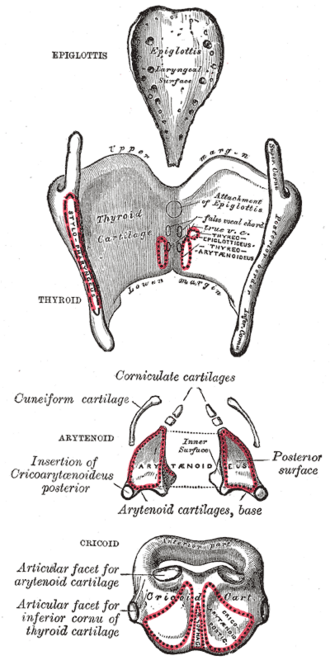
- Cartilages: thyroid (laryngeal prominence, "Adam's apple"), cricoid (the only complete ring, at C6), paired arytenoids, epiglottis, corniculate and cuneiform
- Membranes: thyrohyoid membrane (pierced by the internal laryngeal nerve and superior laryngeal artery); cricothyroid membrane (between thyroid and cricoid — the emergency airway site)
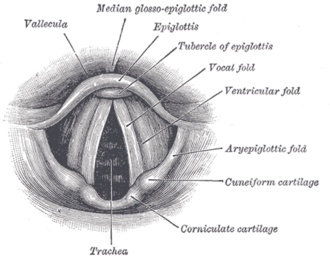
- Vestibular (false) folds above and vocal (true) folds below; the space between the vocal folds is the rima glottidis, the narrowest part of the adult airway. In infants the narrowest part is the subglottis at the cricoid level. verify
- Divisions: supraglottis, glottis, subglottis
- Relations
The thyroid gland lies on the front and sides of the lower larynx and upper trachea; the carotid sheaths lie laterally.
- Arterial supply
Superior laryngeal artery (from the superior thyroid artery, a branch of the external carotid artery) and inferior laryngeal artery (from the inferior thyroid artery).
- Venous drainage
Superior and inferior laryngeal veins → thyroid veins.
- Lymphatic drainage
Supraglottis → deep cervical nodes (rich drainage); glottis — very sparse lymphatics (early vocal cord cancers rarely spread); subglottis → pretracheal/paratracheal nodes.
- Innervation
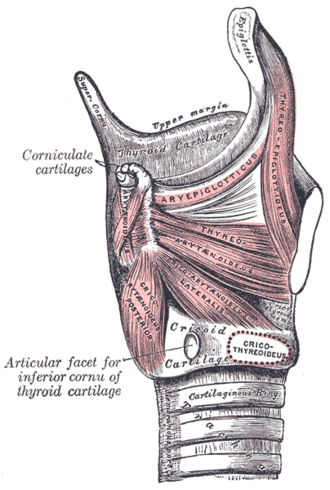
All from the vagus (CN X). Superior laryngeal nerve: internal branch — sensation above the vocal folds (cough reflex); external branch — cricothyroid (tenses the cords; pitch). Recurrent laryngeal nerve — all other intrinsic muscles and sensation below the vocal folds. Posterior cricoarytenoid is the only abductor (opens the glottis).
Forms a boundary of
Found in
Mentioned in
Generated automatically from links in other entries.
Swipe sideways to see the whole diagram →



Clinical correlations
Epiglottitis PANCE
- Mechanism / lesion
Bacterial cellulitis of the epiglottis and supraglottis — classically H. influenzae type b (now rare after vaccination); now also streptococci and S. aureus, and adults.
- Classic presentation
Rapid onset of high fever, severe sore throat, drooling, dysphagia, muffled voice, tripod positioning, toxic appearance; inspiratory stridor is late. Keep the patient calm; don't examine the throat with a tongue depressor; secure the airway in the OR; IV ceftriaxone. Lateral neck X-ray shows the thumbprint sign.
Croup (laryngotracheobronchitis) PANCE
- Mechanism / lesion
Parainfluenza virus causing subglottic edema; ages 6 months–3 years.
- Classic presentation
Barking (seal-like) cough, hoarseness, inspiratory stridor, worse at night; steeple sign on AP neck film. Treat with dexamethasone; add nebulized racemic epinephrine for stridor at rest.
Laryngeal cancer and hoarseness PANCE
- Mechanism / lesion
Squamous cell carcinoma — smoking and alcohol; glottic tumors cause early hoarseness.
- Classic presentation
Hoarseness lasting over about 4 weeks (especially in a smoker) needs laryngoscopy. Other causes: laryngitis, vocal nodules (voice overuse), reflux, recurrent laryngeal nerve palsy.
Emergency cricothyrotomy PANCE
- Mechanism / lesion
"Can't intubate, can't oxygenate" situations.
- Classic presentation
Incision through the cricothyroid membrane, which lies just below the thyroid cartilage and is relatively avascular and superficial. Needle cricothyrotomy is preferred in young children (under about 10–12 years). verify
High-yield PANCE pearls
- Drooling, tripod position, muffled voice, toxic → epiglottitis (thumbprint sign) → airway in OR; don't use a tongue depressor.
- Barking cough, steeple sign → croup (parainfluenza) → dexamethasone ± racemic epinephrine.
- Hoarseness > 4 weeks in a smoker → laryngoscopy (SCC).
- Only laryngeal abductor = posterior cricoarytenoid.
- Cricothyroid muscle = external laryngeal nerve; everything else = recurrent laryngeal.
Imaging anatomy
- X-ray
Lateral neck: thumbprint sign (epiglottitis). AP neck: steeple sign (croup). Airway imaging must not delay airway management.
- CT
Contrast CT of the neck for laryngeal cancer staging and trauma.
- MRI
Cartilage invasion and staging of laryngeal cancer.
- Key views & landmarks
- Soft-tissue lateral and AP neck
- Flexible laryngoscopy (not imaging, but the key examination)
Physical exam
- Surface landmarks
From top down: hyoid bone (C3), thyroid notch and laryngeal prominence (C4–C5), cricothyroid membrane (a soft dip), cricoid cartilage (C6), trachea.
- Palpation
Palpate the thyroid and cricoid cartilages and the cricothyroid membrane (practice this landmark); the larynx and thyroid move up with swallowing.
- Strength / function testing
Listen to the voice (hoarseness, breathiness), cough strength and stridor (inspiratory = supraglottic/glottic; biphasic = subglottic/tracheal); indirect mirror or flexible laryngoscopy for cord mobility.
Self-quiz
A 4-year-old unvaccinated child has a 6-hour history of high fever, drooling, muffled voice and sits leaning forward with the neck extended. What is the most appropriate next step?
Correct answer: B
This is epiglottitis (likely H. influenzae type b in an unvaccinated child). Agitating the child or using a tongue depressor can precipitate complete obstruction. Secure the airway in a controlled setting, then give IV antibiotics.
Show answer
B
This is epiglottitis (likely H. influenzae type b in an unvaccinated child). Agitating the child or using a tongue depressor can precipitate complete obstruction. Secure the airway in a controlled setting, then give IV antibiotics.
Which intrinsic laryngeal muscle is the only abductor of the vocal cords?
Correct answer: B
The posterior cricoarytenoid rotates the arytenoids to open the glottis; bilateral paralysis can cause airway obstruction. The cricothyroid tenses the cords.
Show answer
B
The posterior cricoarytenoid rotates the arytenoids to open the glottis; bilateral paralysis can cause airway obstruction. The cricothyroid tenses the cords.
A 2-year-old has a barking cough and inspiratory stridor at rest after a cold. What is the best initial treatment?
Correct answer: B
Moderate-to-severe croup (stridor at rest) is treated with corticosteroids (dexamethasone) plus nebulized racemic epinephrine, observing for rebound. It is viral, so antibiotics don't help.
Show answer
B
Moderate-to-severe croup (stridor at rest) is treated with corticosteroids (dexamethasone) plus nebulized racemic epinephrine, observing for rebound. It is viral, so antibiotics don't help.
Which nerve supplies the cricothyroid muscle?
Correct answer: D
Cricothyroid (tenses the cords; pitch) is the only intrinsic laryngeal muscle supplied by the external laryngeal nerve. All others, including the posterior cricoarytenoid, are supplied by the recurrent laryngeal nerve.
Show answer
D
Cricothyroid (tenses the cords; pitch) is the only intrinsic laryngeal muscle supplied by the external laryngeal nerve. All others, including the posterior cricoarytenoid, are supplied by the recurrent laryngeal nerve.
On an AP neck radiograph, what sign is typical of croup?
Correct answer: B
Croup (parainfluenza) causes subglottic narrowing, the steeple sign on an AP film. Epiglottitis shows the thumbprint sign on a lateral film; retropharyngeal abscess widens the prevertebral soft tissue.
Show answer
B
Croup (parainfluenza) causes subglottic narrowing, the steeple sign on an AP film. Epiglottitis shows the thumbprint sign on a lateral film; retropharyngeal abscess widens the prevertebral soft tissue.