Dorsal column–medial lemniscus pathway
Ascending pathway for fine touch, vibration and proprioception. It runs up the same side of the spinal cord and crosses in the medulla, so cord lesions cause ipsilateral loss and a positive Romberg sign.
Core anatomy
- Origin
First-order neurons in the dorsal root ganglia; large myelinated fibers from skin, joints and muscle spindles.
- Course
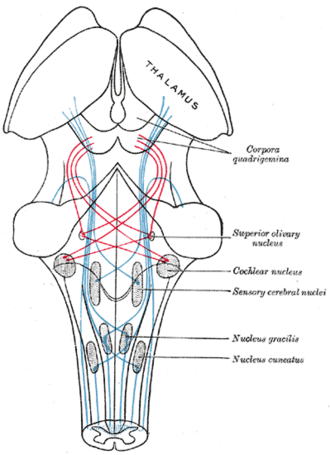
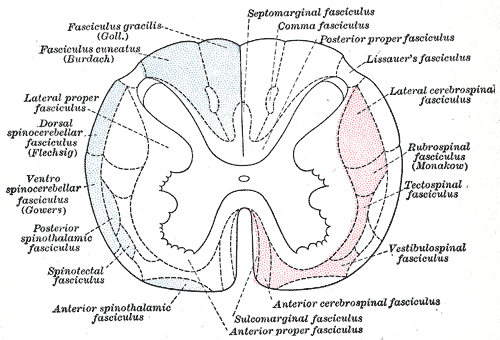
Enter the cord and ascend ipsilaterally without synapsing in the dorsal columns: fasciculus gracilis (medial — lower body, below about T6) and fasciculus cuneatus (lateral — upper body, above T6) → synapse in the nucleus gracilis and nucleus cuneatus of the lower medulla oblongata (second-order) → fibers cross as the internal arcuate fibers (sensory decussation) → ascend as the medial lemniscus → VPL of the thalamus (third-order) → posterior limb of the internal capsule → primary somatosensory cortex (postcentral gyrus; see cerebral cortex and lobes).
- Sensory
Fine (discriminative) touch, two-point discrimination, vibration, conscious proprioception (joint position).
- Relations
Supplied by the posterior spinal arteries (spared in anterior spinal artery syndrome — see spinal cord).
- Notes
Rule of thumb — the pathway crosses in the medulla, so a spinal cord lesion causes ipsilateral loss, while a lesion above the medulla (brainstem, thalamus, cortex) causes contralateral loss.
Swipe sideways to see the whole diagram →


Clinical correlations
Subacute combined degeneration PANCE
- Mechanism / lesion
Vitamin B12 deficiency (pernicious anemia, metformin, PPIs, vegan diet, gastric surgery) or nitrous oxide abuse, copper deficiency — demyelination of the dorsal columns and lateral corticospinal tracts.
- Classic presentation
Symmetric distal loss of vibration and proprioception, sensory ataxia with a positive Romberg, plus UMN signs (spasticity, Babinski) with reduced ankle reflexes (neuropathy); macrocytic anemia, raised methylmalonic acid. Treat with B12.
Tabes dorsalis
- Mechanism / lesion
Tertiary syphilis damaging the dorsal roots and columns.
- Classic presentation
Sensory ataxia, positive Romberg, lightning pains, absent reflexes, Argyll Robertson pupils (accommodate but do not react to light), Charcot joints.
Brown-Séquard syndrome (hemisection) PANCE
- Mechanism / lesion
Hemisection of the cord (penetrating trauma, tumor, MS).
- Classic presentation
Ipsilateral loss of vibration and proprioception and ipsilateral UMN weakness below the lesion, with contralateral loss of pain and temperature starting 1–2 levels below (see spinothalamic tract).
High-yield PANCE pearls
- Loss of vibration/proprioception + positive Romberg + UMN signs + macrocytosis → B12 deficiency (subacute combined degeneration).
- DCML crosses in the medulla → cord lesions give ipsilateral loss.
- Romberg positive → sensory (proprioceptive) ataxia, not cerebellar.
- Anterior spinal artery infarct spares the dorsal columns.
Imaging anatomy
- MRI
MRI of the spinal cord — T2 hyperintensity in the dorsal columns ("inverted V" sign) in B12 deficiency; MS plaques; compressive lesions.
- Key views & landmarks
- Serum B12, methylmalonic acid, homocysteine; syphilis serology
- Somatosensory evoked potentials
Physical exam
- Strength / function testing
Vibration with a 128 Hz tuning fork on the great toe, then more proximal bony points until felt; proprioception (move the great toe up or down with the patient's eyes closed); two-point discrimination; Romberg; tandem gait.
Romberg test
- Technique
Feet together, arms at sides; observe with eyes open, then closed for about 30 seconds.
- Positive test
Balance is maintained with eyes open but lost with eyes closed.
- Significance
Loss of proprioception (dorsal columns or large-fiber peripheral neuropathy).
Self-quiz
A 62-year-old vegan woman has numb feet, unsteadiness in the dark, loss of vibration sense at the toes and a positive Romberg sign. She has brisk knee reflexes and extensor plantar responses. MCV is 110 fL. What is the most likely cause?
Correct answer: B
Subacute combined degeneration — dorsal column loss (vibration, proprioception, Romberg) plus lateral corticospinal signs, with macrocytosis — from B12 deficiency. Folate deficiency causes macrocytosis without these neurologic signs.
Show answer
B
Subacute combined degeneration — dorsal column loss (vibration, proprioception, Romberg) plus lateral corticospinal signs, with macrocytosis — from B12 deficiency. Folate deficiency causes macrocytosis without these neurologic signs.
A stab wound hemisects the left side of the spinal cord at T8. Where is vibration sense lost?
Correct answer: A
The dorsal columns ascend ipsilaterally and cross only in the medulla, so a left hemisection causes left-sided loss of vibration and proprioception below the lesion. Pain and temperature are lost on the right.
Show answer
A
The dorsal columns ascend ipsilaterally and cross only in the medulla, so a left hemisection causes left-sided loss of vibration and proprioception below the lesion. Pain and temperature are lost on the right.
Fibers from which part of the body ascend in the fasciculus gracilis?
Correct answer: B
The fasciculus gracilis (medial) carries fibers from the lower body, below about T6; the fasciculus cuneatus (lateral) carries the upper body. Both ascend ipsilaterally to the medulla.
Show answer
B
The fasciculus gracilis (medial) carries fibers from the lower body, below about T6; the fasciculus cuneatus (lateral) carries the upper body. Both ascend ipsilaterally to the medulla.
A patient has sensory ataxia, lightning pains, absent reflexes and pupils that accommodate but don't react to light. What is the most likely diagnosis?
Correct answer: E
Tabes dorsalis damages the dorsal roots and columns, causing sensory ataxia, lightning pains, areflexia and Argyll Robertson pupils. B12 deficiency also affects the dorsal columns but adds UMN signs.
Show answer
E
Tabes dorsalis damages the dorsal roots and columns, causing sensory ataxia, lightning pains, areflexia and Argyll Robertson pupils. B12 deficiency also affects the dorsal columns but adds UMN signs.
The medial lemniscus relays in which thalamic nucleus?
Correct answer: A
The medial lemniscus (body touch, vibration, proprioception) synapses in the VPL, which projects to the somatosensory cortex. VPM relays the face.
Show answer
A
The medial lemniscus (body touch, vibration, proprioception) synapses in the VPL, which projects to the somatosensory cortex. VPM relays the face.