Spinothalamic tract
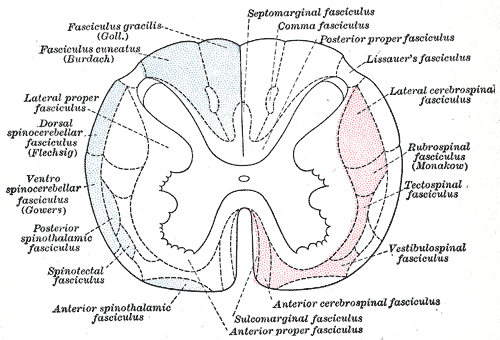
Ascending pathway for pain, temperature and crude touch. Its fibers cross within one or two segments of entering the cord, so cord lesions cause contralateral loss; syringomyelia damages the crossing fibers.
Core anatomy
- Origin
First-order neurons in the dorsal root ganglia; small, thinly myelinated (Aδ) and unmyelinated (C) fibers.
- Course
Enter the cord, ascend or descend 1–2 segments in Lissauer tract, and synapse in the dorsal horn (substantia gelatinosa and nucleus proprius). Second-order fibers cross in the anterior white commissure and ascend in the contralateral anterolateral column as the spinothalamic tract → through the lateral brainstem (lateral medulla, beside the spinal trigeminal tract) → VPL of the thalamus → somatosensory cortex.
- Sensory
Pain, temperature and crude (non-discriminative) touch and pressure from the contralateral body.
- Relations
Somatotopy: sacral fibers lie most lateral and cervical fibers most medial — expanding intramedullary tumors may spare sacral sensation ("sacral sparing"). Supplied by the anterior spinal artery (lost in anterior cord syndrome — see spinal cord).
- Notes
Pain and temperature from the face travel separately in the spinal trigeminal tract, which descends ipsilaterally in the lateral medulla — hence crossed face/body loss in Wallenberg syndrome (see medulla oblongata).
Mentioned in
Generated automatically from links in other entries.
Swipe sideways to see the whole diagram →

Clinical correlations
Syringomyelia PANCE
- Mechanism / lesion
Fluid-filled cavity (syrinx) in the central cord, usually cervical, often with Chiari I malformation or after trauma; damages the crossing fibers in the anterior white commissure.
- Classic presentation
Bilateral "cape-like" loss of pain and temperature over the shoulders and arms with preserved touch and vibration (dissociated sensory loss); painless burns of the hands; later LMN weakness and atrophy of the hands (ventral horns) and UMN signs in the legs. MRI of the cervical cord.
Brown-Séquard and anterior cord syndromes PANCE
- Mechanism / lesion
Cord hemisection; anterior spinal artery infarction.
- Classic presentation
Brown-Séquard: contralateral pain/temperature loss starting 1–2 segments below the lesion, with ipsilateral weakness and dorsal column loss. Anterior cord: bilateral pain/temperature loss and paralysis below the lesion with preserved vibration/proprioception.
Lateral medullary syndrome
- Mechanism / lesion
PICA/vertebral occlusion affecting the spinothalamic tract and spinal trigeminal nucleus.
- Classic presentation
Contralateral body and ipsilateral face loss of pain and temperature.
High-yield PANCE pearls
- Spinothalamic fibers cross within 1–2 segments → cord lesions give contralateral pain/temp loss.
- Cape-like bilateral loss of pain/temp in the arms with preserved touch → syringomyelia (often Chiari I).
- Brown-Séquard: ipsilateral motor + vibration loss, contralateral pain/temp loss.
- Face pain/temp = spinal trigeminal (ipsilateral in the medulla).
Imaging anatomy
- MRI
MRI of the cervical and thoracic cord (and craniocervical junction) — syrinx, Chiari malformation, tumors, infarcts.
Physical exam
- Strength / function testing
Pinprick (disposable pin) and temperature (cold tuning fork) — map the level and side of loss, comparing dermatomes; look for a sensory level on the trunk (cord lesion) and for dissociated loss (pain lost, touch preserved).
Self-quiz
A 30-year-old has painless burns on both hands. Pain and temperature sensation is lost over both shoulders and arms, but light touch and vibration are normal. MRI shows a Chiari I malformation. What is the most likely diagnosis?
Correct answer: B
A central cervical syrinx interrupts the crossing spinothalamic fibers in the anterior white commissure, causing bilateral cape-like pain/temperature loss with preserved dorsal column sensation.
Show answer
B
A central cervical syrinx interrupts the crossing spinothalamic fibers in the anterior white commissure, causing bilateral cape-like pain/temperature loss with preserved dorsal column sensation.
A right-sided hemisection of the cord at T10 causes loss of pain and temperature where?
Correct answer: B
Spinothalamic fibers cross within 1–2 segments of entry, so a right hemisection causes contralateral (left) pain and temperature loss starting 1–2 levels below the lesion.
Show answer
B
Spinothalamic fibers cross within 1–2 segments of entry, so a right hemisection causes contralateral (left) pain and temperature loss starting 1–2 levels below the lesion.
Where do the second-order spinothalamic fibers cross the midline?
Correct answer: C
Second-order fibers cross in the anterior white commissure within 1–2 segments and ascend in the contralateral anterolateral column. A central syrinx damages these crossing fibers.
Show answer
C
Second-order fibers cross in the anterior white commissure within 1–2 segments and ascend in the contralateral anterolateral column. A central syrinx damages these crossing fibers.
Why can an expanding intramedullary spinal cord tumor spare sacral pain and temperature sensation?
Correct answer: E
In the spinothalamic tract, sacral fibers lie most laterally and cervical fibers most medially, so a tumor expanding from the center compresses cervical fibers first (sacral sparing).
Show answer
E
In the spinothalamic tract, sacral fibers lie most laterally and cervical fibers most medially, so a tumor expanding from the center compresses cervical fibers first (sacral sparing).
Before synapsing in the dorsal horn, pain and temperature fibers travel up or down 1–2 segments in which tract?
Correct answer: B
Pain and temperature fibers run 1–2 segments in Lissauer tract before synapsing, which is why the contralateral sensory level in a hemisection starts 1–2 segments below the lesion.
Show answer
B
Pain and temperature fibers run 1–2 segments in Lissauer tract before synapsing, which is why the contralateral sensory level in a hemisection starts 1–2 segments below the lesion.