Sternocleidomastoid
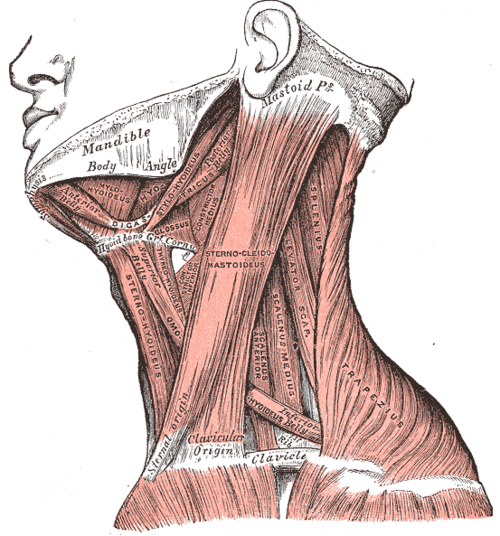
Prominent two-headed neck muscle that divides the neck into anterior and posterior triangles. It is supplied by the accessory nerve and is shortened in congenital muscular torticollis.
Core anatomy
- Group
Superficial lateral neck muscle, enclosed in the investing layer of deep cervical fascia (with trapezius)
- Origin
Sternal head — anterior surface of the manubrium; clavicular head — superior surface of the medial third of the clavicle (see sternum, clavicle).
- Insertion
Lateral surface of the mastoid process and the lateral half of the superior nuchal line (see skull).
- Innervation
Spinal accessory nerve (CN XI) (motor); C2–C3 ventral rami (proprioception, via the cervical plexus).
- Blood supply
Occipital and superior thyroid arteries (branches of the external carotid artery) and the suprascapular artery.
- Action
- One side: tilts the head to the same side and rotates the face to the opposite side
- Both sides: flex the neck (and extend the head at the atlanto-occipital joint)
- Accessory muscle of inspiration when the head is fixed (raises the sternum)
- Relations
Divides the neck into the anterior and posterior triangles (see triangles of the neck). Deep to it lies the carotid sheath (common and internal carotid arteries, internal jugular vein, vagus). The nerve point of the neck (Erb point), where the cutaneous branches of the cervical plexus emerge, is at the midpoint of its posterior border. The external jugular vein crosses it superficially.
- Notes
The small gap between the sternal and clavicular heads (lesser supraclavicular fossa) overlies the internal jugular vein — a landmark for central venous access.
Forms a boundary of
Mentioned in
- Accessory nerve (CN XI)
- Cervical lymph nodes
- Cervical plexus
- Common and internal carotid arteries
- Internal jugular vein
- Triangles of the neck
Generated automatically from links in other entries.

Clinical correlations
Congenital muscular torticollis PANCE
- Mechanism / lesion
Fibrosis and shortening of one SCM, associated with intrauterine positioning or birth trauma (breech, difficult delivery).
- Classic presentation
Infant with the head tilted toward the affected side and chin rotated to the opposite side; sometimes a palpable nontender mass ("SCM tumor") in the first weeks; plagiocephaly. Most respond to stretching/physical therapy. Check the hips (associated developmental dysplasia).
Spinal accessory nerve injury PANCE
- Mechanism / lesion
Most commonly iatrogenic in the posterior triangle (lymph node biopsy, neck dissection), where the nerve is superficial.
- Classic presentation
Posterior triangle injury usually spares SCM (its branch arises higher) but paralyzes trapezius → shoulder droop, lateral scapular winging, weak abduction above 90°. A proximal lesion also weakens SCM → weak head turning to the opposite side.
Cervical dystonia (spasmodic torticollis)
- Mechanism / lesion
Focal dystonia in adults with involuntary contraction of neck muscles including SCM.
- Classic presentation
Involuntary head turning or tilting, often with pain; treated with botulinum toxin injections.
High-yield PANCE pearls
- Infant head tilted toward one side, chin to the other → congenital muscular torticollis → stretching; check the hips.
- SCM and trapezius are supplied by CN XI.
- Right SCM turns the face to the left.
- Posterior triangle node biopsy → CN XI injury → trapezius weakness (shoulder droop).
Imaging anatomy
- CT
Neck masses deep to SCM (e.g. branchial cleft cyst along its anterior border, carotid body tumor).
- Ultrasound
Confirms fibromatosis colli (SCM thickening) in infants; avoids radiation.
Physical exam
- Surface landmarks
Visible and palpable from the mastoid to the sternum and clavicle, especially when the head is turned to the opposite side; the suprasternal notch lies between the two sternal heads.
- Palpation
Palpate along the anterior border for lymph nodes (deep cervical chain) and masses.
- Strength / function testing
CN XI (SCM): ask the patient to turn the head against your hand — the opposite SCM contracts (turning to the left tests the right SCM). Compare both sides; test trapezius with a shoulder shrug.
Self-quiz
A 3-week-old infant keeps her head tilted to the right with the chin pointing to the left. A firm, nontender mass is palpable in the right side of the neck. What is the most appropriate initial management?
Correct answer: B
Congenital muscular torticollis from a shortened right SCM (tilt to the right, chin to the left) usually resolves with stretching and positioning. Surgery is reserved for persistent cases; evaluate the hips for developmental dysplasia.
Show answer
B
Congenital muscular torticollis from a shortened right SCM (tilt to the right, chin to the left) usually resolves with stretching and positioning. Surgery is reserved for persistent cases; evaluate the hips for developmental dysplasia.
A patient is asked to turn his head to the left against resistance. Which muscle is mainly being tested?
Correct answer: B
Each SCM rotates the face to the opposite side, so turning the head to the left tests the right SCM (CN XI).
Show answer
B
Each SCM rotates the face to the opposite side, so turning the head to the left tests the right SCM (CN XI).
An infant with congenital muscular torticollis should also be examined for which associated condition?
Correct answer: D
Congenital muscular torticollis is associated with intrauterine positioning and birth trauma, and with developmental dysplasia of the hip, so the hips should be examined. Most torticollis responds to stretching.
Show answer
D
Congenital muscular torticollis is associated with intrauterine positioning and birth trauma, and with developmental dysplasia of the hip, so the hips should be examined. Most torticollis responds to stretching.
What does bilateral contraction of the sternocleidomastoids produce?
Correct answer: A
Both SCMs together flex the neck (and extend the head at the atlanto-occipital joint). One SCM tilts the head to the same side and rotates the face to the opposite side.
Show answer
A
Both SCMs together flex the neck (and extend the head at the atlanto-occipital joint). One SCM tilts the head to the same side and rotates the face to the opposite side.
What is the usual treatment for adult cervical dystonia (spasmodic torticollis)?
Correct answer: C
Cervical dystonia (involuntary contraction of neck muscles including SCM) is treated with botulinum toxin injections.
Show answer
C
Cervical dystonia (involuntary contraction of neck muscles including SCM) is treated with botulinum toxin injections.