Trapezius
Large superficial triangular muscle of the upper back and neck that elevates, retracts and rotates the scapula. It is supplied by the spinal accessory nerve (CN XI), whose injury causes a drooping shoulder and lateral winging.
Core anatomy
- Location
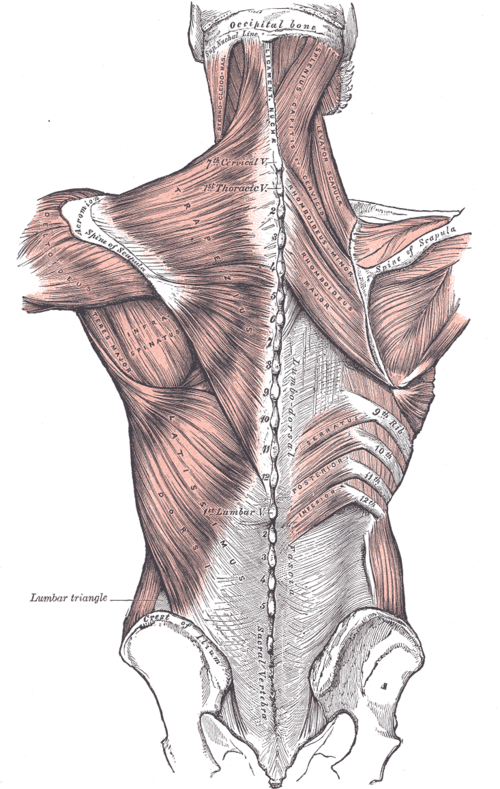
Superficial posterior neck and upper back, from the occiput to T12 and out to the shoulder.
- Group
Superficial extrinsic back muscles (posterior axioappendicular), with latissimus dorsi.
- Origin
Medial third of the superior nuchal line, external occipital protuberance, nuchal ligament, and the spinous processes of C7–T12.
- Innervation
Spinal accessory nerve (CN XI) for motor; C3–C4 (cervical plexus) for pain and proprioception.
- Blood supply
Transverse cervical artery (superficial branch), plus the occipital artery and dorsal branches of posterior intercostal arteries.
- Action
- Upper (descending) fibers: elevate the scapula (shrug)
- Middle (transverse) fibers: retract the scapula
- Lower (ascending) fibers: depress the scapula
- Upper and lower fibers together rotate the glenoid upward (with serratus anterior) for abduction above 90°
- Relations
The spinal accessory nerve crosses the posterior triangle of the neck superficially (within the investing fascia) to reach the deep surface of trapezius, where it is vulnerable. Trapezius and latissimus dorsi bound the triangle of auscultation.
Forms a boundary of
Mentioned in
Generated automatically from links in other entries.

Clinical correlations
Spinal accessory nerve (CN XI) injury PANCE
- Mechanism / lesion
Iatrogenic injury during posterior triangle lymph node biopsy or neck dissection, or penetrating trauma to the posterior triangle.
- Classic presentation
Drooping shoulder, weak shoulder shrug on the affected side, difficulty abducting the arm above the horizontal, lateral winging of the scapula, and trapezius atrophy. Sternocleidomastoid is spared if the injury is distal to its branch.
Trapezius strain and myofascial pain
- Mechanism / lesion
Posture, stress or overuse (desk work), whiplash.
- Classic presentation
Neck and upper shoulder pain with tender trigger points in the upper trapezius, sometimes causing tension-type headache.
High-yield PANCE pearls
- CN XI injury (posterior triangle biopsy) → weak shrug, drooping shoulder, lateral winging.
- Test CN XI: resisted shoulder shrug (trapezius) and head turning (SCM).
- Lateral winging = trapezius (CN XI); medial winging = serratus anterior (long thoracic).
Imaging anatomy
- MRI
Denervation atrophy of trapezius after CN XI injury; soft-tissue masses.
- Ultrasound
The spinal accessory nerve can be traced in the posterior triangle with high-frequency ultrasound.
- Key views & landmarks
- EMG confirms CN XI denervation
Physical exam
- Surface landmarks
The upper border forms the slope of the neck; the muscle outline is visible with the shoulders braced back.
- Palpation
Palpate the upper trapezius for bulk, tenderness and trigger points.
- Strength / function testing
Resisted shoulder shrug (upper fibers); resisted retraction (middle); observe scapular position at rest and during arm elevation for lateral winging.
Self-quiz
Three weeks after excisional biopsy of a lymph node in the right posterior triangle of the neck, a patient can't shrug her right shoulder fully and the shoulder droops. Which nerve was injured?
Correct answer: B
The spinal accessory nerve (CN XI) runs superficially across the posterior triangle to trapezius; injury weakens the shrug, causes a drooping shoulder and lateral winging.
Show answer
B
The spinal accessory nerve (CN XI) runs superficially across the posterior triangle to trapezius; injury weakens the shrug, causes a drooping shoulder and lateral winging.
Trapezius inserts on which structures?
Correct answer: B
Trapezius inserts on the lateral third of the clavicle, acromion and spine of the scapula, the mirror image of the deltoid origin.
Show answer
B
Trapezius inserts on the lateral third of the clavicle, acromion and spine of the scapula, the mirror image of the deltoid origin.
Which pattern of scapular winging results from trapezius paralysis?
Correct answer: B
Trapezius paralysis (CN XI) produces lateral winging with a drooping shoulder. Serratus anterior paralysis produces medial winging.
Show answer
B
Trapezius paralysis (CN XI) produces lateral winging with a drooping shoulder. Serratus anterior paralysis produces medial winging.
Which part of trapezius retracts the scapula?
Correct answer: A
The middle fibers retract the scapula, the upper fibers elevate it (shrug) and the lower fibers depress it. Upper and lower fibers together rotate the glenoid upward.
Show answer
A
The middle fibers retract the scapula, the upper fibers elevate it (shrug) and the lower fibers depress it. Upper and lower fibers together rotate the glenoid upward.
Trapezius receives motor supply from CN XI. Which spinal nerves carry its pain and proprioception?
Correct answer: E
Trapezius is motor-supplied by the spinal accessory nerve (CN XI), with pain and proprioception from C3–C4 through the cervical plexus. It is an extrinsic back muscle, so it isn't supplied by dorsal rami.
Show answer
E
Trapezius is motor-supplied by the spinal accessory nerve (CN XI), with pain and proprioception from C3–C4 through the cervical plexus. It is an extrinsic back muscle, so it isn't supplied by dorsal rami.