Nasal cavity
Paired air passages from the nostrils to the choanae, divided by the septum and lined by the conchae that warm and humidify air. Anterior epistaxis from Kiesselbach plexus is the classic problem.
Core anatomy
- Location
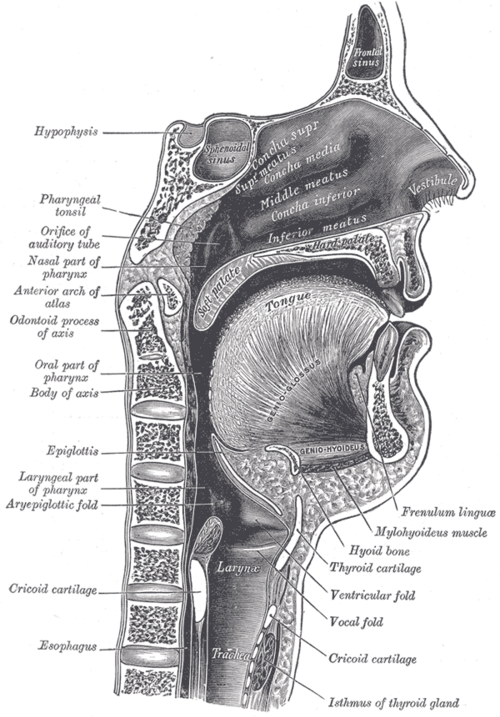
Above the hard palate, between the orbits, opening in front through the nares and behind through the choanae into the nasopharynx (see pharynx).
- Boundaries
- roof
- Nasal bones, cribriform plate of the ethmoid (olfactory nerve fibers), body of the sphenoid
- floor
- Hard palate (maxilla and palatine bones)
- medial wall
- Nasal septum — septal cartilage, perpendicular plate of the ethmoid, vomer
- lateral wall
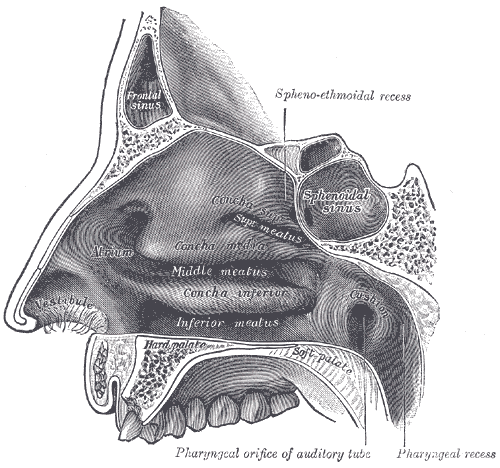
- Superior, middle and inferior conchae (turbinates) with the meatuses beneath them
- Contents
- Olfactory epithelium in the roof (CN I)
- Respiratory mucosa with a rich venous plexus (warms and humidifies air)
- Kiesselbach plexus (Little area) on the anterior septum — anastomosis of the anterior ethmoidal, sphenopalatine, greater palatine and superior labial (facial) arteries
- Openings of the paranasal sinuses and the nasolacrimal duct
- Communications
Sphenoethmoidal recess → sphenoid sinus. Superior meatus → posterior ethmoid cells. Middle meatus → frontal, maxillary and anterior ethmoid sinuses (the ostiomeatal complex). Inferior meatus → nasolacrimal duct (tears). Choanae → nasopharynx.
Mentioned in
Generated automatically from links in other entries.


Clinical correlations
Epistaxis PANCE
- Mechanism / lesion
Anterior (about 90%) — Kiesselbach plexus (digital trauma, dry air, rhinitis, anticoagulants). Posterior — sphenopalatine artery branches; older patients with hypertension, atherosclerosis or anticoagulation, heavier bleeding.
- Classic presentation
Anterior: lean forward and pinch the soft part of the nose for 10–15 minutes; topical vasoconstrictor (oxymetazoline), then cautery (silver nitrate, one side at a time) or anterior packing. Posterior: bleeding into the pharynx despite anterior packing → posterior packing/balloon, admission, ENT (sphenopalatine ligation or embolization).
Septal hematoma PANCE
- Mechanism / lesion
Nasal trauma causing blood to collect between the septal cartilage and its perichondrium.
- Classic presentation
A bulging, fluctuant, bluish swelling of the septum after trauma; must be drained promptly to prevent cartilage necrosis (saddle nose) or abscess.
Rhinitis and nasal polyps
- Mechanism / lesion
Allergic rhinitis (IgE-mediated), nonallergic/vasomotor rhinitis, rhinitis medicamentosa (rebound from overuse of topical decongestants); nasal polyps with chronic rhinosinusitis, asthma and aspirin sensitivity (Samter triad).
- Classic presentation
Allergic — pale boggy turbinates, clear discharge, allergic shiners; first-line intranasal corticosteroid. Polyps in a child → test for cystic fibrosis.
Nasal foreign body
- Mechanism / lesion
Common in young children.
- Classic presentation
Unilateral foul-smelling purulent discharge in a child.
High-yield PANCE pearls
- Most nosebleeds are anterior from Kiesselbach plexus → lean forward, pinch 10–15 min.
- Bleeding into the throat despite anterior packing → posterior (sphenopalatine) epistaxis.
- Nasal trauma + fluctuant septal swelling → septal hematoma → drain now.
- Unilateral foul discharge in a child → foreign body.
- Nasal polyps in a child → cystic fibrosis; asthma + aspirin sensitivity + polyps → Samter triad.
Imaging anatomy
- X-ray
Nasal bone films are rarely useful; nasal fractures are a clinical diagnosis.
- CT
CT of the sinuses/face for fractures, chronic rhinosinusitis, tumors and before sinus surgery (not needed for simple epistaxis).
- MRI
Tumors of the nasal cavity and skull base.
Physical exam
- Surface landmarks
Nasal bones (upper third), septal cartilage, alar cartilages.
- Palpation
Palpate the nasal bones for deformity or crepitus after trauma.
- Strength / function testing
Anterior rhinoscopy with a nasal speculum (or otoscope with a large speculum): septum (deviation, hematoma, bleeding point), turbinates (color, swelling), polyps, discharge. Check patency of each nostril.
Self-quiz
A 10-year-old has a nosebleed from the left nostril that started while picking his nose. What is the most appropriate first step?
Correct answer: B
Most pediatric nosebleeds are anterior from Kiesselbach plexus. Leaning forward (to avoid swallowing blood) and continuous firm pinching for 10–15 minutes stops most; cautery or packing is next if needed.
Show answer
B
Most pediatric nosebleeds are anterior from Kiesselbach plexus. Leaning forward (to avoid swallowing blood) and continuous firm pinching for 10–15 minutes stops most; cautery or packing is next if needed.
Which structure drains into the inferior meatus?
Correct answer: C
The nasolacrimal duct opens into the inferior meatus, which is why crying makes the nose run. The frontal, maxillary and anterior ethmoid sinuses drain into the middle meatus.
Show answer
C
The nasolacrimal duct opens into the inferior meatus, which is why crying makes the nose run. The frontal, maxillary and anterior ethmoid sinuses drain into the middle meatus.
Which artery is the main source of posterior epistaxis?
Correct answer: E
Posterior nosebleeds arise from sphenopalatine artery branches; they are heavier and more common in older patients with hypertension or anticoagulation. About 90% of nosebleeds are anterior, from Kiesselbach plexus.
Show answer
E
Posterior nosebleeds arise from sphenopalatine artery branches; they are heavier and more common in older patients with hypertension or anticoagulation. About 90% of nosebleeds are anterior, from Kiesselbach plexus.
After a punch to the nose, a patient has a fluctuant, bluish swelling of the nasal septum. What is the most appropriate management?
Correct answer: B
A septal hematoma must be drained promptly to prevent necrosis of the septal cartilage (saddle nose deformity) or abscess.
Show answer
B
A septal hematoma must be drained promptly to prevent necrosis of the septal cartilage (saddle nose deformity) or abscess.
A 3-year-old has a unilateral, foul-smelling purulent nasal discharge. What is the most likely cause?
Correct answer: D
Unilateral foul-smelling discharge in a young child suggests a nasal foreign body. Nasal polyps in a child should prompt testing for cystic fibrosis.
Show answer
D
Unilateral foul-smelling discharge in a young child suggests a nasal foreign body. Nasal polyps in a child should prompt testing for cystic fibrosis.