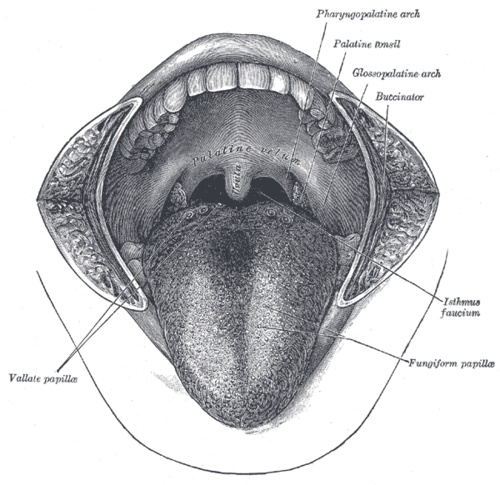
Palatine tonsils
Paired masses of lymphoid tissue in the tonsillar fossae of the oropharynx, part of Waldeyer ring. Streptococcal pharyngitis, peritonsillar abscess and infectious mononucleosis are the key problems.
Core anatomy
- Location
In the tonsillar fossa between the palatoglossal (anterior) and palatopharyngeal (posterior) arches of the oropharynx (see pharynx).
- Drains
The oral cavity and oropharynx; they sample antigens entering through the mouth and nose (with the pharyngeal tonsil — adenoids — and lingual tonsil, forming Waldeyer ring).
- Drains to
Jugulodigastric (tonsillar) node of the deep cervical chain, just below the angle of the mandible (see cervical lymph nodes).
- Relations
Lateral: the tonsillar bed (superior constrictor) with the glossopharyngeal nerve; the internal carotid artery lies about 2–2.5 cm posterolateral. Blood supply mainly from the tonsillar branch of the facial artery; the external palatine (paratonsillar) vein is the usual source of post-tonsillectomy bleeding.
- Notes
Tonsils are large in childhood and shrink after puberty. Pain after tonsillectomy is often referred to the ear via CN IX.
Mentioned in
Generated automatically from links in other entries.

Clinical correlations
Group A streptococcal pharyngitis PANCE
- Mechanism / lesion
Streptococcus pyogenes infection of the tonsils and pharynx; peaks at ages 5–15.
- Classic presentation
Sudden sore throat, fever, tonsillar exudates, tender anterior cervical nodes, absence of cough (Centor/McIsaac criteria). Confirm with a rapid antigen test (± culture in children); treat with penicillin V or amoxicillin for 10 days to prevent rheumatic fever. Viral pharyngitis has cough, rhinorrhea, conjunctivitis.
Peritonsillar abscess (quinsy) PANCE
- Mechanism / lesion
Spread of tonsillitis into the space between the tonsillar capsule and the superior constrictor; adolescents and young adults.
- Classic presentation
Severe unilateral throat pain, "hot potato" voice, trismus, drooling, uvula deviated away from the affected side, bulging soft palate. Treat with needle aspiration or incision and drainage plus antibiotics.
Infectious mononucleosis PANCE
- Mechanism / lesion
Epstein–Barr virus infection of B cells.
- Classic presentation
Exudative tonsillitis, fever, posterior cervical lymphadenopathy, fatigue, splenomegaly, atypical lymphocytes, positive heterophile (Monospot) test. Amoxicillin causes a rash; avoid contact sports for at least 3–4 weeks (splenic rupture risk).
High-yield PANCE pearls
- Centor: fever, exudates, tender anterior nodes, no cough → test for GAS → penicillin/amoxicillin.
- Treat strep throat to prevent rheumatic fever (not post-streptococcal glomerulonephritis).
- Hot potato voice, trismus, uvula deviated away → peritonsillar abscess → drain.
- Exudative pharyngitis + posterior nodes + splenomegaly → mono; amoxicillin rash; no contact sports.
Imaging anatomy
- CT
Contrast CT of the neck if the diagnosis is unclear or a deeper (parapharyngeal/retropharyngeal) infection is suspected.
- Ultrasound
Intraoral or transcervical ultrasound helps confirm a peritonsillar abscess and guide aspiration.
Physical exam
- Surface landmarks
Between the anterior and posterior tonsillar pillars; the uvula in the midline.
- Palpation
Palpate the jugulodigastric node below the angle of the jaw and the anterior and posterior cervical chains.
- Strength / function testing
Inspect with a tongue depressor and light: tonsil size (grade 0–4), exudate, symmetry, uvula position, palatal bulging; assess trismus and voice.
Self-quiz
A 19-year-old has 4 days of severe left throat pain, fever, muffled voice and difficulty opening his mouth. The left soft palate bulges and the uvula is deviated to the right. What is the most appropriate treatment?
Correct answer: B
A bulging palate with uvula deviated away, trismus and a "hot potato" voice indicate a peritonsillar abscess, treated with drainage (aspiration or I&D) and antibiotics.
Show answer
B
A bulging palate with uvula deviated away, trismus and a "hot potato" voice indicate a peritonsillar abscess, treated with drainage (aspiration or I&D) and antibiotics.
An 18-year-old has sore throat, fever and fatigue. She has tonsillar exudates, posterior cervical lymphadenopathy and a palpable spleen. She developed a rash after amoxicillin. What is the most likely diagnosis?
Correct answer: B
EBV mononucleosis: exudative tonsillitis with posterior cervical nodes, splenomegaly, and the classic rash after amoxicillin. Advise avoiding contact sports because of splenic rupture risk.
Show answer
B
EBV mononucleosis: exudative tonsillitis with posterior cervical nodes, splenomegaly, and the classic rash after amoxicillin. Advise avoiding contact sports because of splenic rupture risk.
What is the main reason to treat group A streptococcal pharyngitis with antibiotics?
Correct answer: D
Treating GAS pharyngitis with penicillin V or amoxicillin prevents acute rheumatic fever. Antibiotics do not reliably prevent post-streptococcal glomerulonephritis.
Show answer
D
Treating GAS pharyngitis with penicillin V or amoxicillin prevents acute rheumatic fever. Antibiotics do not reliably prevent post-streptococcal glomerulonephritis.
What is the usual source of bleeding after tonsillectomy?
Correct answer: A
The external palatine (paratonsillar) vein is the usual source of post-tonsillectomy bleeding. The main arterial supply is the tonsillar branch of the facial artery; the internal carotid lies about 2–2.5 cm posterolateral.
Show answer
A
The external palatine (paratonsillar) vein is the usual source of post-tonsillectomy bleeding. The main arterial supply is the tonsillar branch of the facial artery; the internal carotid lies about 2–2.5 cm posterolateral.
After tonsillectomy, a patient has ear pain. Which nerve refers this pain?
Correct answer: C
The glossopharyngeal nerve (CN IX) lies in the tonsillar bed and also supplies the middle ear via its tympanic branch, so pain from the tonsillar fossa is referred to the ear.
Show answer
C
The glossopharyngeal nerve (CN IX) lies in the tonsillar bed and also supplies the middle ear via its tympanic branch, so pain from the tonsillar fossa is referred to the ear.