Gluteus maximus
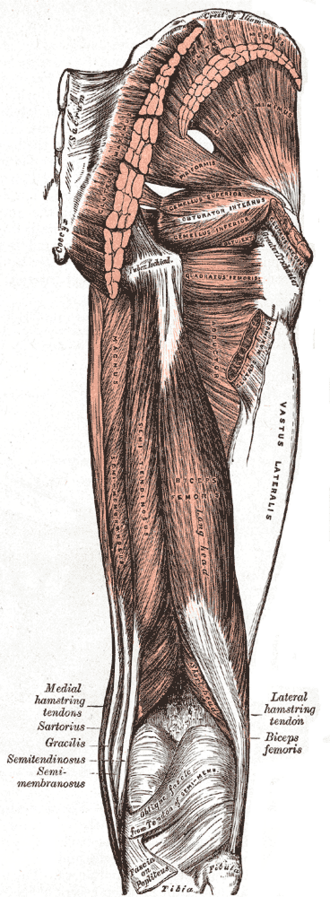
The largest and most superficial gluteal muscle, the main extensor of the hip for rising, climbing and running. Weakness from an inferior gluteal nerve lesion causes a backward-lurching gait.
Core anatomy
- Location
Forms the bulk of the buttock, superficial to the other gluteal muscles and the sciatic nerve.
- Group
Gluteal region, superficial layer
- Origin
Posterior gluteal line and adjacent ilium of the hip bone, the dorsal surface of the sacrum and coccyx and coccyx, the thoracolumbar fascia and the sacrotuberous ligament.
- Insertion
Most fibers into the iliotibial tract (and through it to the lateral tibial condyle); deep lower fibers into the gluteal tuberosity of the femur.
- Innervation
Inferior gluteal nerve (L5–S2), from the sacral plexus
- Blood supply
Inferior and superior gluteal arteries (from the internal iliac artery).
- Action
- Powerful extension of the hip (rising from sitting, climbing stairs, running) — little used in level walking
- Lateral rotation of the hip
- Through the iliotibial tract, helps stabilize the extended knee
- Relations
Deep to it: piriformis, the short lateral rotators, the sciatic nerve, the gluteal vessels and nerves, and the ischial tuberosity (covered when standing, uncovered when sitting). The trochanteric bursa lies between it and the greater trochanter.

Clinical correlations
Inferior gluteal nerve injury
- Mechanism / lesion
Posterior hip surgery, pelvic fracture or intramuscular injection.
- Classic presentation
Difficulty rising from a chair or climbing stairs; a gluteus maximus (backward-lurching) gait — the trunk is thrown backward at heel strike to keep the hip extended.
Greater trochanteric pain syndrome PANCE
- Mechanism / lesion
Tendinopathy of gluteus medius/minimus and trochanteric bursitis under gluteus maximus and the iliotibial tract; common in middle-aged women.
- Classic presentation
Lateral hip pain, tenderness over the greater trochanter, pain lying on that side; normal hip range of motion.
Safe intramuscular injection site PANCE
- Mechanism / lesion
The sciatic nerve runs deep to the lower medial part of the buttock.
- Classic presentation
Give dorsogluteal injections in the upper outer quadrant, or use the ventrogluteal site (gluteus medius, between the ASIS and iliac tubercle).
High-yield PANCE pearls
- Gluteus maximus = main hip extensor (stairs, rising) — inferior gluteal nerve.
- Lateral hip pain with trochanteric tenderness → greater trochanteric pain syndrome.
- Buttock IM injection → upper outer quadrant.
Imaging anatomy
- MRI
Tendon tears, muscle injury, trochanteric bursitis.
- Ultrasound
Guides trochanteric bursa injections and shows gluteal tendinopathy.
Physical exam
- Surface landmarks
The buttock; the gluteal fold is formed by fat below the lower border of gluteus maximus (not the muscle border itself).
- Palpation
Palpate the greater trochanter and bursa.
- Strength / function testing
Resisted hip extension with the patient prone and knee flexed (isolates gluteus maximus from the hamstrings); rising from a chair without using the arms.
Self-quiz
A patient has difficulty climbing stairs and rising from a chair, but walks on level ground almost normally. Which nerve is most likely injured?
Correct answer: B
Gluteus maximus (inferior gluteal nerve) is the powerful hip extensor for climbing and rising but is little used in level walking. Superior gluteal nerve injury causes a Trendelenburg gait.
Show answer
B
Gluteus maximus (inferior gluteal nerve) is the powerful hip extensor for climbing and rising but is little used in level walking. Superior gluteal nerve injury causes a Trendelenburg gait.
How is the hip extended most selectively when testing gluteus maximus strength?
Correct answer: A
Flexing the knee shortens the hamstrings, reducing their contribution, so resisted hip extension in the prone position with the knee bent mainly tests gluteus maximus.
Show answer
A
Flexing the knee shortens the hamstrings, reducing their contribution, so resisted hip extension in the prone position with the knee bent mainly tests gluteus maximus.
A 52-year-old woman has lateral hip pain that is worse lying on that side. The greater trochanter is tender and hip range of motion is normal. What is the most likely diagnosis?
Correct answer: A
Greater trochanteric pain syndrome (gluteal tendinopathy and trochanteric bursitis beneath gluteus maximus and the iliotibial tract) causes lateral hip pain with trochanteric tenderness and normal hip range of motion. Hip osteoarthritis limits motion, especially internal rotation.
Show answer
A
Greater trochanteric pain syndrome (gluteal tendinopathy and trochanteric bursitis beneath gluteus maximus and the iliotibial tract) causes lateral hip pain with trochanteric tenderness and normal hip range of motion. Hip osteoarthritis limits motion, especially internal rotation.