Infraspinatus
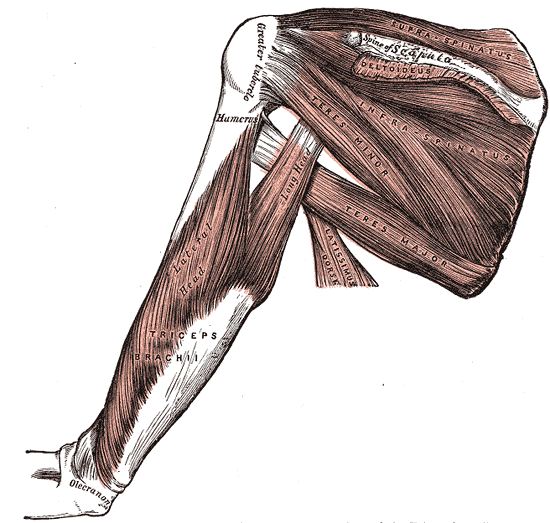
Rotator cuff muscle in the infraspinous fossa and the main lateral (external) rotator of the arm.
Core anatomy
- Location
Infraspinous fossa of the scapula, below the spine, covered partly by deltoid and trapezius.
- Group
Rotator cuff (SITS); scapulohumeral muscles.
- Origin
Infraspinous fossa of the scapula and the deep fascia covering it.
- Insertion
Middle facet of the greater tubercle of the humerus.
- Innervation
Suprascapular nerve (C5, C6)
- Blood supply
Suprascapular and circumflex scapular arteries verify
- Action
- Laterally (externally) rotates the arm
- With the other rotator cuff muscles, holds the humeral head in the glenoid cavity
- Relations
The suprascapular nerve reaches infraspinatus by passing around the lateral border of the scapular spine through the spinoglenoid notch after supplying supraspinatus.
Swipe sideways to see the whole diagram →

Clinical correlations
Suprascapular nerve entrapment
- Mechanism / lesion
Compression at the suprascapular notch (affects both supraspinatus and infraspinatus) or at the spinoglenoid notch (affects infraspinatus only). Causes include a paralabral ganglion cyst (often with a labral tear), traction in overhead athletes (volleyball, baseball) and fractures.
- Classic presentation
Deep, poorly localized posterior shoulder pain, weak external rotation, and visible wasting of the infraspinous fossa. Isolated infraspinatus atrophy points to the spinoglenoid notch.
Posterosuperior rotator cuff tear PANCE
- Mechanism / lesion
Extension of a supraspinatus tear posteriorly, or an isolated tear, usually degenerative.
- Classic presentation
Weak external rotation with a positive external rotation lag sign, and difficulty with overhead and reaching activities.
High-yield PANCE pearls
- Infraspinatus = main external rotator; tested by resisted external rotation with the elbow at the side.
- Suprascapular nerve supplies both supraspinatus and infraspinatus; spinoglenoid notch lesions affect infraspinatus only.
- Infraspinous fossa wasting → think suprascapular neuropathy or a chronic posterior cuff tear.
Imaging anatomy
- X-ray
Usually normal. Shoulder radiographs exclude fractures of the scapula or glenoid.
- MRI
Assesses tendon tears, muscle atrophy and fatty infiltration (sagittal oblique). A paralabral cyst in the spinoglenoid notch with denervation edema of infraspinatus alone suggests suprascapular nerve compression at that level.
- Ultrasound
The posterior approach shows the infraspinatus tendon inserting on the greater tuberosity and posterior joint recess. Dynamic external/internal rotation helps.
- Key views & landmarks
- MRI sagittal oblique (muscle bulk) and axial (spinoglenoid notch)
Physical exam
- Surface landmarks
Infraspinous fossa below the palpable spine of the scapula. Atrophy shows as hollowing.
- Strength / function testing
Resisted external rotation with the arm adducted and the elbow flexed at 90°.
External rotation lag sign
- Technique
With the elbow flexed at 90° and the arm at the side (slight abduction), the examiner passively rotates the shoulder into near-maximal external rotation and asks the patient to hold the position after release.
- Positive test
The forearm drifts back toward internal rotation (a lag).
- Significance
Suggests a tear of infraspinatus (± supraspinatus).
Self-quiz
A 26-year-old volleyball player has vague posterior shoulder pain and weak external rotation. There is visible wasting of the infraspinous fossa, but the supraspinous fossa is normal and abduction is strong. MRI shows a ganglion cyst. Where is the cyst most likely located?
Correct answer: B
At the spinoglenoid notch the suprascapular nerve has already supplied supraspinatus, so only infraspinatus is affected. A lesion at the suprascapular notch would weaken both muscles. The quadrangular space contains the axillary nerve (teres minor and deltoid).
Show answer
B
At the spinoglenoid notch the suprascapular nerve has already supplied supraspinatus, so only infraspinatus is affected. A lesion at the suprascapular notch would weaken both muscles. The quadrangular space contains the axillary nerve (teres minor and deltoid).
Which pair of muscles laterally rotates the arm?
Correct answer: C
Infraspinatus (suprascapular nerve) and teres minor (axillary nerve) are the primary lateral rotators, with help from the posterior deltoid. The other pairs are mainly medial rotators, abductors or flexors.
Show answer
C
Infraspinatus (suprascapular nerve) and teres minor (axillary nerve) are the primary lateral rotators, with help from the posterior deltoid. The other pairs are mainly medial rotators, abductors or flexors.
The infraspinatus tendon inserts on which part of the humerus?
Correct answer: C
From superior to inferior on the greater tubercle the insertions are supraspinatus (superior facet), infraspinatus (middle facet) and teres minor (inferior facet). Subscapularis inserts on the lesser tubercle.
Show answer
C
From superior to inferior on the greater tubercle the insertions are supraspinatus (superior facet), infraspinatus (middle facet) and teres minor (inferior facet). Subscapularis inserts on the lesser tubercle.
Which nerve supplies infraspinatus?
Correct answer: A
The suprascapular nerve (C5, C6) supplies supraspinatus, then passes through the spinoglenoid notch to infraspinatus. Teres minor, the other external rotator, is supplied by the axillary nerve.
Show answer
A
The suprascapular nerve (C5, C6) supplies supraspinatus, then passes through the spinoglenoid notch to infraspinatus. Teres minor, the other external rotator, is supplied by the axillary nerve.
Which bedside test best isolates infraspinatus?
Correct answer: C
Infraspinatus is the main external rotator and is tested by resisted external rotation with the elbow at the side; a positive external rotation lag sign suggests a posterosuperior cuff tear. Empty-can tests supraspinatus, lift-off tests subscapularis, Speed tests the biceps tendon, and Hawkins–Kennedy is an impingement sign.
Show answer
C
Infraspinatus is the main external rotator and is tested by resisted external rotation with the elbow at the side; a positive external rotation lag sign suggests a posterosuperior cuff tear. Empty-can tests supraspinatus, lift-off tests subscapularis, Speed tests the biceps tendon, and Hawkins–Kennedy is an impingement sign.