Triceps brachii
Three-headed muscle of the posterior arm and the chief extensor of the elbow; supplied by the radial nerve.
Core anatomy
- Location
Posterior compartment of the arm.
- Group
Posterior (extensor) compartment of the arm, with anconeus.
- Origin
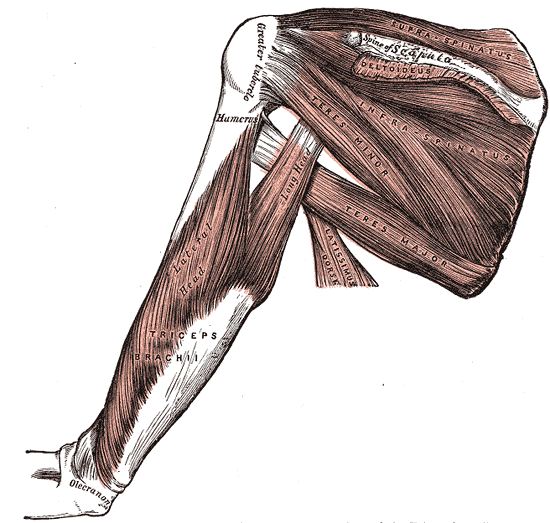
Long head: infraglenoid tubercle of the scapula. Lateral head: posterior surface of the humerus superior to the radial groove. Medial head: posterior surface of the humerus inferior to the radial groove.
- Insertion
Proximal end of the olecranon of the ulna and the deep fascia of the forearm.
- Innervation
Radial nerve (C6, C7, C8)
- Blood supply
Profunda brachii (deep brachial) artery verify
- Action
- Chief extensor of the elbow
- The long head also extends and adducts the arm at the shoulder and steadies the humeral head when the arm is adducted
- Relations
The long head passes between teres minor and teres major, dividing the region into the quadrangular space (laterally) and the triangular space (medially). The radial nerve and profunda brachii artery run in the radial groove between the lateral and medial heads.
Mentioned in
Generated automatically from links in other entries.

Clinical correlations
Triceps weakness from radial nerve injury PANCE
- Mechanism / lesion
High (axillary) radial nerve lesions such as crutch palsy. Midshaft humerus fractures usually spare triceps because its branches arise proximal to the radial groove.
- Classic presentation
Weak elbow extension and a reduced triceps reflex together with wrist drop.
Triceps tendon rupture
- Mechanism / lesion
Uncommon. Forced flexion against a contracting triceps (fall on an outstretched hand) or a direct blow. Risk factors include anabolic steroid use.
- Classic presentation
Posterior elbow pain, a palpable gap above the olecranon, and inability to extend against gravity with a complete tear.
High-yield PANCE pearls
- Triceps reflex = C7 (C6–C7), radial nerve.
- Radial nerve injury at the midshaft humerus usually spares triceps; an axillary lesion does not.
- Long head of triceps = medial border of the quadrangular space.
Imaging anatomy
- X-ray
A small bony fleck avulsed from the olecranon on the lateral elbow view ("flake sign") suggests triceps tendon avulsion.
- MRI
Defines partial vs complete tendon tears and retraction.
- Ultrasound
Dynamic assessment of the distal tendon at the olecranon. Also shows snapping of the medial head over the medial epicondyle.
Physical exam
- Surface landmarks
The olecranon and the distal tendon just above it are easily palpable posteriorly.
- Strength / function testing
Resisted elbow extension. Triceps reflex (C7), tapping the tendon just above the olecranon.
Modified Thompson test (triceps squeeze)
- Technique
With the arm supported and the elbow flexed and hanging freely (e.g. patient prone with the arm over the table edge), the examiner squeezes the triceps muscle belly.
- Positive test
No passive elbow extension.
- Significance
Suggests complete triceps tendon rupture. verify
Self-quiz
Which nerve root is primarily tested by the triceps reflex?
Correct answer: C
The triceps reflex is mainly C7 (with C6), carried by the radial nerve. The biceps reflex is C5–C6 and the brachioradialis reflex C6.
Show answer
C
The triceps reflex is mainly C7 (with C6), carried by the radial nerve. The biceps reflex is C5–C6 and the brachioradialis reflex C6.
The long head of triceps brachii originates from which structure?
Correct answer: C
The long head arises from the infraglenoid tubercle of the scapula. The lateral and medial heads arise from the posterior humerus above and below the radial groove.
Show answer
C
The long head arises from the infraglenoid tubercle of the scapula. The lateral and medial heads arise from the posterior humerus above and below the radial groove.
A 30-year-old man has a spiral fracture of the humeral shaft with wrist drop. Elbow extension is strong. What explains the preserved triceps function?
Correct answer: B
The triceps branches of the radial nerve arise in the axilla and proximal arm, before the nerve enters the radial groove, so they are usually spared in shaft fractures.
Show answer
B
The triceps branches of the radial nerve arise in the axilla and proximal arm, before the nerve enters the radial groove, so they are usually spared in shaft fractures.
Flashcards
See also
- Radial nerve
- Wrist drop after a night on the sofa (clinical case)