Parotid gland
The largest salivary gland, in front of the ear, with the facial nerve branching through it. Mumps, bacterial parotitis, stones and tumors (most often pleomorphic adenoma) are its key problems.
Core anatomy
- Location
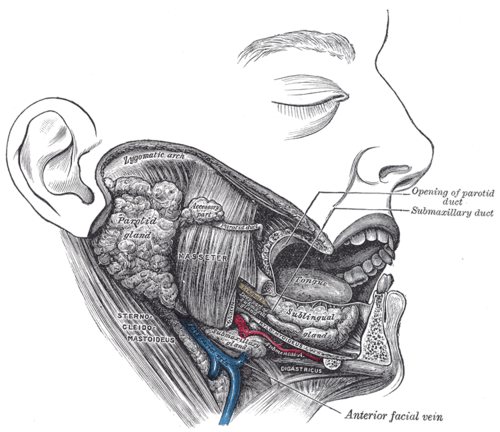
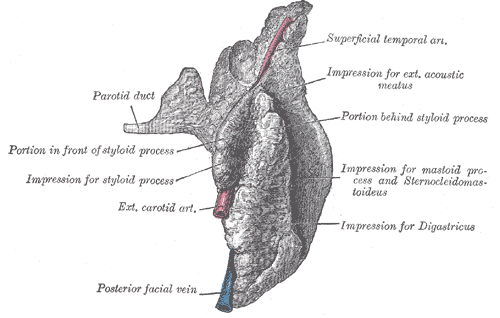
Wrapped around the ramus of the mandible, in front of the ear and below the zygomatic arch, extending behind the mandible toward the mastoid; enclosed in a tough parotid capsule (investing fascia).
- Parts
- Superficial and deep lobes (surgical division by the plane of the facial nerve)
- Parotid (Stensen) duct: crosses the masseter, pierces buccinator and opens opposite the upper second molar
- Structures within the gland, superficial to deep: facial nerve (and its five branches), retromandibular vein, external carotid artery (dividing into maxillary and superficial temporal arteries)
- Relations
The temporomandibular joint and external acoustic meatus lie behind; masseter in front; the styloid process and internal jugular vein deep.
- Arterial supply
Branches of the external carotid artery (transverse facial, superficial temporal).
- Venous drainage
Retromandibular vein.
- Lymphatic drainage
Parotid (preauricular) nodes → deep cervical nodes (see cervical lymph nodes).
- Innervation
Secretomotor: parasympathetic from the glossopharyngeal nerve (CN IX) — inferior salivatory nucleus → lesser petrosal nerve → otic ganglion → auriculotemporal nerve (V3). Sensory: auriculotemporal and great auricular nerves. The facial nerve passes through the gland but does not supply it.
Mentioned in
Generated automatically from links in other entries.


Clinical correlations
Parotid tumors PANCE
- Mechanism / lesion
About 80% of salivary gland tumors arise in the parotid, and most parotid tumors are benign — pleomorphic adenoma (most common) and Warthin tumor (smokers, often bilateral). Mucoepidermoid carcinoma is the most common malignant salivary tumor.
- Classic presentation
A slow-growing, painless, mobile mass in front of or below the ear. Facial nerve weakness, pain, rapid growth or fixation suggest malignancy. Evaluate with ultrasound/MRI and fine-needle aspiration; treatment is superficial parotidectomy with facial nerve preservation.
Mumps and bacterial parotitis PANCE
- Mechanism / lesion
Mumps (paramyxovirus) — usually bilateral in unvaccinated patients. Acute suppurative parotitis (S. aureus) — dehydrated, elderly or postoperative patients with reduced salivary flow.
- Classic presentation
Painful swelling obscuring the angle of the jaw, raised ear lobe. Mumps — fever, bilateral swelling, possible orchitis. Bacterial — unilateral, red, tender, with pus from Stensen duct on massage; treat with hydration, sialagogues and anti-staphylococcal antibiotics.
Frey syndrome (gustatory sweating)
- Mechanism / lesion
After parotidectomy, regenerating parasympathetic fibers (auriculotemporal nerve) innervate sweat glands of the overlying skin.
- Classic presentation
Sweating and flushing over the parotid area when eating.
Sjögren syndrome
- Mechanism / lesion
Autoimmune lymphocytic infiltration of salivary and lacrimal glands.
- Classic presentation
Dry mouth and dry eyes, bilateral parotid enlargement; increased risk of lymphoma.
High-yield PANCE pearls
- Most common salivary tumor = pleomorphic adenoma (parotid).
- Parotid mass + facial nerve palsy → malignancy until proven otherwise.
- Stensen duct opens opposite the upper 2nd molar.
- Parotid secretomotor supply = CN IX (otic ganglion); the facial nerve only passes through.
- Postoperative elderly dehydrated patient with a painful parotid → bacterial parotitis (S. aureus).
Imaging anatomy
- CT
Abscess, stones (sialolithiasis) and staging.
- MRI
Best characterization of tumors, deep-lobe extension and perineural spread along the facial nerve.
- Ultrasound
First-line for parotid swelling and superficial masses; guides fine-needle aspiration.
- Key views & landmarks
- Ultrasound with FNA
- MRI of the parotid
Physical exam
- Surface landmarks
In front of the tragus, over the ramus and angle of the mandible; the duct can be rolled over the anterior border of the clenched masseter, about a finger's breadth below the zygomatic arch.
- Palpation
Bimanual palpation (one finger inside the cheek); inspect and massage toward the duct opening opposite the upper 2nd molar for pus or saliva.
- Strength / function testing
Always test facial nerve function (raise eyebrows, close eyes, smile) in any parotid mass.
Self-quiz
A 45-year-old woman has a painless, mobile mass in front of her right ear that has grown slowly over 3 years. Facial movement is normal. What is the most likely diagnosis?
Correct answer: B
A slow-growing, painless, mobile parotid mass with normal facial nerve function is most likely a pleomorphic adenoma, the most common salivary gland tumor. Facial nerve weakness would suggest malignancy.
Show answer
B
A slow-growing, painless, mobile parotid mass with normal facial nerve function is most likely a pleomorphic adenoma, the most common salivary gland tumor. Facial nerve weakness would suggest malignancy.
Which cranial nerve provides secretomotor (parasympathetic) fibers to the parotid gland?
Correct answer: B
Parasympathetic fibers from CN IX travel in the lesser petrosal nerve to the otic ganglion, then hitch a ride on the auriculotemporal nerve (V3) to the parotid. The facial nerve passes through the gland without supplying it.
Show answer
B
Parasympathetic fibers from CN IX travel in the lesser petrosal nerve to the otic ganglion, then hitch a ride on the auriculotemporal nerve (V3) to the parotid. The facial nerve passes through the gland without supplying it.
Opposite which tooth does the parotid (Stensen) duct open?
Correct answer: E
The parotid duct crosses masseter, pierces buccinator and opens opposite the upper second molar, where pus can be expressed in bacterial parotitis.
Show answer
E
The parotid duct crosses masseter, pierces buccinator and opens opposite the upper second molar, where pus can be expressed in bacterial parotitis.
A year after a parotidectomy, a patient notices sweating and flushing over the cheek whenever he eats. What is this called, and why does it happen?
Correct answer: A
In Frey syndrome (gustatory sweating), regenerating parasympathetic secretomotor fibers of the auriculotemporal nerve grow into the sweat glands of the overlying skin, so eating causes sweating and flushing.
Show answer
A
In Frey syndrome (gustatory sweating), regenerating parasympathetic secretomotor fibers of the auriculotemporal nerve grow into the sweat glands of the overlying skin, so eating causes sweating and flushing.
What is the pathway of the parasympathetic secretomotor fibers to the parotid gland?
Correct answer: C
Parotid secretomotor fibers come from the inferior salivatory nucleus (CN IX) → lesser petrosal nerve → otic ganglion → auriculotemporal nerve (V3). The facial nerve passes through the gland but doesn't supply it.
Show answer
C
Parotid secretomotor fibers come from the inferior salivatory nucleus (CN IX) → lesser petrosal nerve → otic ganglion → auriculotemporal nerve (V3). The facial nerve passes through the gland but doesn't supply it.