Scaphoid
Boat-shaped bone of the proximal carpal row. It is the most commonly fractured carpal bone and its proximal pole is prone to avascular necrosis.
Core anatomy
- Location
Lateral part of the proximal carpal row, forming the floor of the anatomical snuffbox.
- Classification
Short bone (carpal).
- Key features & landmarks
- Proximal pole, waist, distal pole
- Tubercle: palpable at the base of the thenar eminence; attachment of the flexor retinaculum
- Articulates with the radius proximally; with the lunate, capitate, trapezium and trapezoid
- Relations
Forms the floor of the anatomical snuffbox, with the radial artery crossing over it. It links the proximal and distal carpal rows, which is part of why it is so often fractured.
- Notes
Blood supply is retrograde: the main vessels (from the radial artery, mainly dorsal carpal branches) enter at the waist and distal pole and supply the proximal pole by flowing backward. A fracture through the waist can cut off the proximal pole, causing avascular necrosis and nonunion.
Swipe sideways to see the whole diagram →
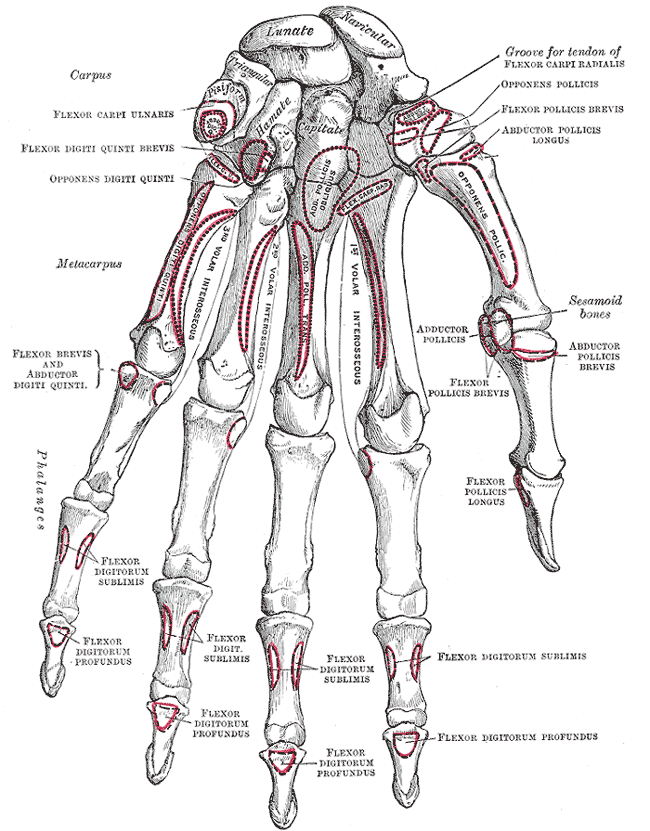

Clinical correlations
Scaphoid fracture PANCE
- Mechanism / lesion
Fall on an outstretched hand with the wrist dorsiflexed and radially deviated. The waist is the most common site. Typically young adults.
- Classic presentation
Radial-sided wrist pain with anatomical snuffbox tenderness, scaphoid tubercle tenderness, and pain with axial loading of the thumb. Initial radiographs can be normal. With clinical suspicion, immobilize in a thumb spica splint and repeat imaging in 10–14 days, or obtain MRI (or CT) early.
Avascular necrosis and nonunion PANCE
- Mechanism / lesion
Interrupted retrograde blood flow to the proximal pole, especially in proximal pole or displaced fractures, or from delayed diagnosis.
- Classic presentation
Persistent wrist pain. Radiographs show sclerosis and collapse of the proximal pole. Long-term, the result is scaphoid nonunion advanced collapse (SNAC) arthritis.
Scapholunate ligament injury
- Mechanism / lesion
Fall on an outstretched hand. The most common carpal instability.
- Classic presentation
Dorsal wrist pain and weakness. On PA radiograph, a widened scapholunate gap ("Terry Thomas" sign). verify Positive Watson scaphoid shift test.
High-yield PANCE pearls
- Most commonly fractured carpal bone. Snuffbox tenderness + normal X-ray → thumb spica splint and repeat imaging (or MRI).
- Retrograde blood supply → proximal pole AVN and nonunion.
- Anatomical snuffbox: floor = scaphoid (and trapezium); contains the radial artery.
Imaging anatomy
- X-ray
PA, lateral, oblique, plus a dedicated scaphoid view (PA with ulnar deviation), which elongates the scaphoid and shows the waist. Fractures can be radiographically occult at first. Late signs: sclerosis of the proximal pole (AVN), nonunion, collapse.
- CT
Shows fracture displacement, union and nonunion. Useful for surgical planning.
- MRI
The most sensitive modality for occult scaphoid fracture (marrow edema, fracture line). Also assesses proximal pole viability.
- Key views & landmarks
- Scaphoid series: PA, lateral, oblique, PA in ulnar deviation
- MRI wrist if radiographs are negative and suspicion persists
Physical exam
- Surface landmarks
Anatomical snuffbox: a depression on the dorsolateral wrist when the thumb is extended, bounded by the EPL tendon (medial/ulnar) and the APL and EPB tendons (lateral/radial). The scaphoid lies in its floor. The scaphoid tubercle is palpable on the volar wrist at the distal wrist crease, at the base of the thenar eminence.
- Palpation
Palpate the snuffbox and scaphoid tubercle for tenderness; compare with the other side.
Scaphoid compression (axial load) test
- Technique
The examiner applies axial compression along the long axis of the thumb metacarpal.
- Positive test
Pain at the radial wrist.
- Significance
Suggests scaphoid fracture. Sensitivity is higher when combined with snuffbox and tubercle tenderness.
Watson scaphoid shift test
- Technique
The examiner presses the scaphoid tubercle volarly with a thumb while moving the wrist from ulnar to radial deviation.
- Positive test
Pain and/or a clunk as the scaphoid subluxes dorsally and then reduces.
- Significance
Scapholunate instability.
Self-quiz
A 22-year-old man fell on his outstretched hand while skateboarding. He has tenderness in the anatomical snuffbox. Wrist radiographs, including a scaphoid view, show no fracture. What is the most appropriate next step?
Correct answer: B
Scaphoid fractures are often occult on initial films. With snuffbox tenderness, immobilize in a thumb spica and re-image, or get an MRI, to avoid missing a fracture that could progress to nonunion or AVN.
Show answer
B
Scaphoid fractures are often occult on initial films. With snuffbox tenderness, immobilize in a thumb spica and re-image, or get an MRI, to avoid missing a fracture that could progress to nonunion or AVN.
Which portion of the scaphoid is most at risk of avascular necrosis after a waist fracture?
Correct answer: C
Blood enters distally and flows retrograde, so a waist fracture can leave the proximal pole without a blood supply.
Show answer
C
Blood enters distally and flows retrograde, so a waist fracture can leave the proximal pole without a blood supply.
Which tendons form the boundaries of the anatomical snuffbox?
Correct answer: B
The snuffbox is bounded by EPL on the ulnar (medial) side and APL/EPB on the radial (lateral) side. The scaphoid and trapezium form the floor, and the radial artery crosses it.
Show answer
B
The snuffbox is bounded by EPL on the ulnar (medial) side and APL/EPB on the radial (lateral) side. The scaphoid and trapezium form the floor, and the radial artery crosses it.
After a fall on an outstretched hand, a PA wrist radiograph shows an abnormally wide gap between the scaphoid and lunate. Which injury does this sign indicate?
Correct answer: B
A widened scapholunate gap on the PA view (the "Terry Thomas" sign) indicates scapholunate ligament injury, the most common carpal instability. The Watson scaphoid shift test may be positive.
Show answer
B
A widened scapholunate gap on the PA view (the "Terry Thomas" sign) indicates scapholunate ligament injury, the most common carpal instability. The Watson scaphoid shift test may be positive.
A scaphoid fracture goes undiagnosed and progresses to nonunion. What is the long-term consequence?
Correct answer: D
Delayed diagnosis and interrupted retrograde blood supply lead to proximal pole AVN and nonunion, which progresses to SNAC wrist arthritis. This is why snuffbox tenderness is immobilized and reimaged even when the first radiographs are normal.
Show answer
D
Delayed diagnosis and interrupted retrograde blood supply lead to proximal pole AVN and nonunion, which progresses to SNAC wrist arthritis. This is why snuffbox tenderness is immobilized and reimaged even when the first radiographs are normal.
Flashcards
See also
- Wrist joint
- Radial artery
- Fall on an outstretched hand (clinical case)