Ulna
Medial, stabilizing bone of the forearm. Its trochlear notch forms the hinge of the elbow with the humerus.
Core anatomy
- Location
Medial (little finger side) of the forearm; large proximally, small distally.
- Classification
Long bone.
- Key features & landmarks
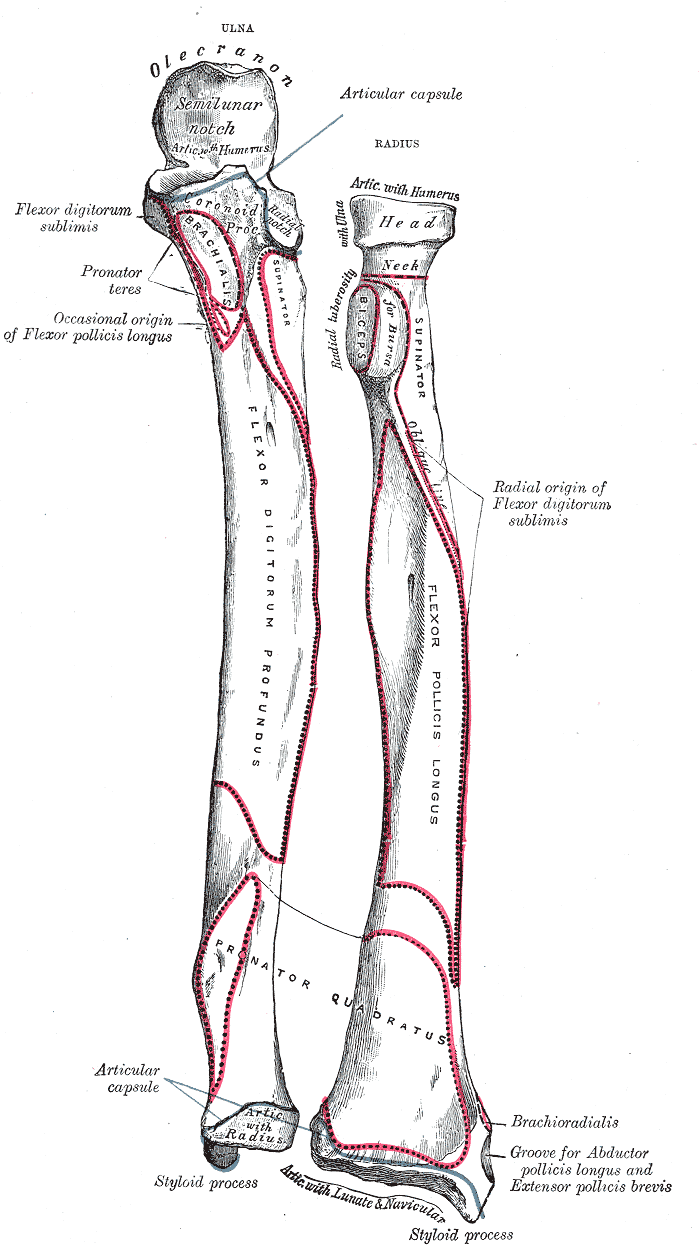
- Olecranon: posterior projection, the point of the elbow; insertion of triceps brachii
- Coronoid process: anterior projection; origin of the ulnar head of pronator teres
- Trochlear notch: articulates with the trochlea of the humerus
- Radial notch: articulates with the head of the radius (proximal radioulnar joint)
- Tuberosity of the ulna: insertion of brachialis
- Supinator crest: origin of part of supinator
- Head (distal) and ulnar styloid process; separated from the carpals by the articular disc of the TFCC
- Subcutaneous posterior border palpable along its whole length
- Relations
The ulnar nerve runs along its medial side, deep to flexor carpi ulnaris. The interosseous membrane links it to the radius.
Muscle attachments
- Pronator teres — origin
- Triceps brachii — insertion
Joints
Mentioned in
Generated automatically from links in other entries.

Clinical correlations
Monteggia fracture-dislocation PANCE
- Mechanism / lesion
Fracture of the proximal third of the ulna with dislocation of the radial head, e.g. a fall with forced pronation or a direct blow.
- Classic presentation
Forearm deformity and elbow pain. The radial head dislocation is easily missed unless the elbow is imaged. The posterior interosseous nerve may be injured.
Nightstick fracture
- Mechanism / lesion
Isolated fracture of the ulnar shaft from a direct blow, classically when raising the forearm to protect the face.
- Classic presentation
Localized tenderness and swelling over the subcutaneous border of the ulna.
Olecranon fracture
- Mechanism / lesion
A fall directly onto the point of the elbow, or avulsion by triceps.
- Classic presentation
Posterior elbow pain and swelling. Displacement by triceps may prevent active extension against gravity.
Olecranon bursitis
- Mechanism / lesion
Inflammation of the subcutaneous olecranon bursa from repetitive pressure ("student's elbow"), trauma, gout, or infection.
- Classic presentation
Fluctuant swelling over the olecranon. Erythema, warmth and fever suggest septic bursitis, which needs aspiration.
High-yield PANCE pearls
- MUGR: Monteggia = Ulnar fracture + radial head dislocation.
- Forearm fractures: always image the elbow and the wrist (joint above and below).
- Nightstick fracture = isolated ulnar shaft fracture from a direct blow.
- Olecranon bursitis: aspirate if septic bursitis is suspected (fever, erythema, warmth).
Imaging anatomy
- X-ray
Forearm AP and lateral including the elbow and wrist. In Monteggia, the radiocapitellar line does not pass through the capitellum. Elbow lateral view for olecranon fractures.
- CT
Comminuted or intra-articular proximal ulna and coronoid fractures.
- Ultrasound
Characterizes olecranon bursal fluid and guides aspiration.
- Key views & landmarks
- Forearm AP and lateral with the elbow and wrist included
- Elbow lateral (olecranon, coronoid)
Physical exam
- Surface landmarks
The olecranon, the entire posterior border, the ulnar head (dorsomedial wrist) and the ulnar styloid are subcutaneous and palpable.
- Palpation
Run a finger along the posterior border from the olecranon to the styloid, feeling for step-off or tenderness.
- Strength / function testing
Elbow flexion and extension, forearm rotation, and ulnar nerve function.
Self-quiz
A 10-year-old boy has a displaced fracture of the proximal ulnar shaft after a fall. What associated injury must be excluded?
Correct answer: B
Monteggia fracture-dislocation: proximal ulnar fracture with radial head dislocation. Check the radiocapitellar line. Galeazzi involves the DRUJ with a radial fracture.
Show answer
B
Monteggia fracture-dislocation: proximal ulnar fracture with radial head dislocation. Check the radiocapitellar line. Galeazzi involves the DRUJ with a radial fracture.
Which muscle inserts on the olecranon?
Correct answer: C
Triceps brachii inserts on the olecranon. Brachialis inserts on the ulnar tuberosity and coronoid process; biceps inserts on the radial tuberosity.
Show answer
C
Triceps brachii inserts on the olecranon. Brachialis inserts on the ulnar tuberosity and coronoid process; biceps inserts on the radial tuberosity.
A police officer raised his forearm to block a baton strike and has an isolated fracture of the ulnar shaft. What is this called?
Correct answer: C
An isolated ulnar shaft fracture from a direct blow is a nightstick fracture. Monteggia and Galeazzi involve a joint dislocation.
Show answer
C
An isolated ulnar shaft fracture from a direct blow is a nightstick fracture. Monteggia and Galeazzi involve a joint dislocation.