Prostate
Walnut-sized gland around the prostatic urethra below the bladder. BPH arises in the transition zone and carcinoma mostly in the peripheral zone, which is the part felt on digital rectal exam.
Core anatomy
- Location
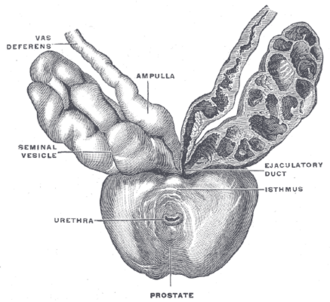
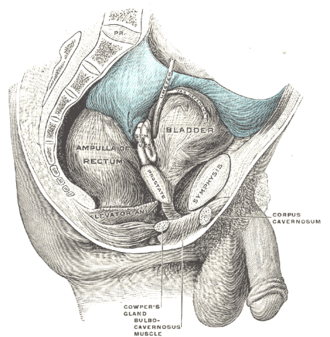
Below the bladder neck and above the external urethral sphincter/perineal membrane, behind the pubic symphysis (retropubic space) and in front of the rectum, from which it is separated by the rectoprostatic (Denonvilliers) fascia.
- Parts
- Base against the bladder neck; apex inferiorly at the external sphincter
- Peripheral zone: about 70% of the glandular tissue, posterior and lateral; the site of most carcinomas; the part palpated on DRE
- Central zone: about 25%, surrounds the ejaculatory ducts
- Transition zone: about 5–10%, surrounds the proximal prostatic urethra; the site of benign prostatic hyperplasia (BPH)
- Anterior fibromuscular stroma: non-glandular
- Older lobar terms: anterior, median (middle), two lateral and posterior lobes; an enlarged median lobe projects into the bladder and obstructs the internal orifice
- Relations
Traversed by the prostatic urethra and the two ejaculatory ducts (formed by the ductus deferens and seminal glands and the seminal gland ducts). Seminal glands lie above its base behind the bladder.
- Arterial supply
Prostatic branches of the inferior vesical artery, plus the middle rectal and internal pudendal arteries (from the internal iliac artery).
- Venous drainage
Prostatic venous plexus (receiving the deep dorsal vein of the penis) → internal iliac veins. It communicates with the vertebral venous plexus, a route for metastasis to the lumbar spine and pelvis.
- Lymphatic drainage
Internal iliac and sacral nodes, and obturator/external iliac nodes (see pelvic and inguinal lymph drainage).
- Innervation
Prostatic plexus from the inferior hypogastric plexus: sympathetic fibers (α1) contract the stromal smooth muscle during emission; parasympathetic (S2–S4) fibers are secretory. The cavernous nerves to the penis run posterolateral to the prostate (see pelvic autonomic nerves).
Mentioned in
- Ductus deferens and seminal glands
- Internal iliac artery
- Pelvic and inguinal lymph drainage
- Pelvic autonomic nerves
- Rectum
- Urethra
- Urinary bladder
Generated automatically from links in other entries.


Clinical correlations
Benign prostatic hyperplasia PANCE
- Mechanism / lesion
Age- and androgen (DHT)-dependent nodular hyperplasia of the transition zone compressing the urethra.
- Classic presentation
Lower urinary tract symptoms in older men — hesitancy, weak stream, straining, incomplete emptying, frequency, nocturia. DRE: smooth, rubbery, symmetrically enlarged gland. Complications: urinary retention, UTI, bladder stones, hydronephrosis.
- Notes
α1-blockers (tamsulosin) relax smooth muscle for rapid relief (orthostatic hypotension; floppy iris syndrome in cataract surgery). 5-α-reductase inhibitors (finasteride) shrink the gland over months and roughly halve PSA. Surgery (e.g. TURP) for refractory symptoms or complications.
Prostate cancer PANCE
- Mechanism / lesion
Adenocarcinoma, most often in the peripheral zone. Risk factors — age, Black race, family history, BRCA2.
- Classic presentation
Usually asymptomatic; found by PSA or a hard, nodular area on DRE. Advanced disease causes bone pain from osteoblastic metastases (lumbar spine, pelvis) and raised alkaline phosphatase.
- Notes
USPSTF: PSA screening for men 55–69 is an individual decision after shared decision-making; not recommended at 70 or older. Evaluation of a raised PSA: repeat PSA, then multiparametric MRI and targeted biopsy.
Acute bacterial prostatitis PANCE
- Mechanism / lesion
Ascending infection, usually gram-negative rods (E. coli); gonorrhea/chlamydia in younger sexually active men.
- Classic presentation
Fever, chills, dysuria, perineal or low back pain, and obstructive symptoms. DRE: exquisitely tender, warm, boggy prostate — avoid vigorous massage (risk of bacteremia). Treat with a fluoroquinolone or TMP-SMX for 2–4 weeks.
Erectile dysfunction and incontinence after radical prostatectomy
- Mechanism / lesion
Injury to the cavernous nerves (posterolateral neurovascular bundles) and the external sphincter.
- Classic presentation
Erectile dysfunction and stress urinary incontinence; nerve-sparing technique reduces the risk.
High-yield PANCE pearls
- BPH = transition zone, smooth symmetric enlargement; cancer = peripheral zone, hard nodule.
- BPH: α1-blocker (fast) ± 5-α-reductase inhibitor (shrinks gland, halves PSA).
- Febrile man with perineal pain and a tender, boggy prostate → acute prostatitis; no vigorous massage.
- Prostate cancer metastases are osteoblastic; spread to the spine via the vertebral venous (Batson) plexus.
- PSA screening, age 55–69 → shared decision.
Imaging anatomy
- CT
Staging of nodes; less useful for the gland itself. Bone scan or PSMA PET for metastases.
- MRI
Multiparametric MRI (T2, diffusion-weighted, dynamic contrast) scored with PI-RADS is used before biopsy for a raised PSA, and for local staging.
- Ultrasound
Transrectal ultrasound (TRUS) measures gland volume and guides biopsy (or a transperineal approach). Transabdominal ultrasound measures post-void residual and shows bladder wall thickening in BPH.
- Key views & landmarks
- Multiparametric prostate MRI (PI-RADS)
- TRUS for volume and biopsy guidance
Physical exam
- Surface landmarks
Palpable through the anterior rectal wall, about 3–4 cm above the anal verge.
- Palpation
DRE: the normal gland is about walnut-sized, rubbery and non-tender, with a palpable median sulcus between the lateral lobes. Note size, symmetry, consistency (rubbery vs hard), nodules, obliteration of the median sulcus and tenderness.
- Strength / function testing
Assess obstructive symptoms with the IPSS questionnaire; measure post-void residual.
Self-quiz
A 70-year-old man has nocturia, a weak stream and hesitancy. DRE shows a smooth, rubbery, symmetrically enlarged prostate. Which zone of the prostate is primarily involved?
Correct answer: C
BPH arises in the transition zone around the proximal urethra, which is why it causes obstructive symptoms early. Carcinoma arises mostly in the peripheral zone, which lies posteriorly and is felt on DRE.
Show answer
C
BPH arises in the transition zone around the proximal urethra, which is why it causes obstructive symptoms early. Carcinoma arises mostly in the peripheral zone, which lies posteriorly and is felt on DRE.
A man with metastatic prostate cancer develops low back pain. Through which route do tumor cells most likely reach the lumbar vertebrae?
Correct answer: B
The prostatic venous plexus communicates with the valveless vertebral venous (Batson) plexus, allowing spread to the lumbar spine and pelvis, where the metastases are typically osteoblastic.
Show answer
B
The prostatic venous plexus communicates with the valveless vertebral venous (Batson) plexus, allowing spread to the lumbar spine and pelvis, where the metastases are typically osteoblastic.
A 34-year-old man has fever, chills, dysuria and perineal pain. DRE reveals an exquisitely tender, warm, boggy prostate. Which action should be avoided?
Correct answer: C
In acute bacterial prostatitis, vigorous prostatic massage can cause bacteremia and is contraindicated. A gentle DRE is acceptable; send urine (and blood) cultures and STI testing in younger men.
Show answer
C
In acute bacterial prostatitis, vigorous prostatic massage can cause bacteremia and is contraindicated. A gentle DRE is acceptable; send urine (and blood) cultures and STI testing in younger men.
Which zone of the prostate is the site of most carcinomas and is the part palpated on digital rectal exam?
Correct answer: A
The peripheral zone (about 70% of glandular tissue, posterior and lateral) is where most prostate cancers arise and is felt on DRE as a hard nodule. BPH arises in the transition zone around the proximal urethra.
Show answer
A
The peripheral zone (about 70% of glandular tissue, posterior and lateral) is where most prostate cancers arise and is felt on DRE as a hard nodule. BPH arises in the transition zone around the proximal urethra.
A man starts finasteride for benign prostatic hyperplasia. What effect on his PSA should be expected?
Correct answer: D
5-α-reductase inhibitors (finasteride) shrink the gland over months and roughly halve the PSA, which must be taken into account when interpreting PSA values. α1-blockers (tamsulosin) give faster relief by relaxing smooth muscle.
Show answer
D
5-α-reductase inhibitors (finasteride) shrink the gland over months and roughly halve the PSA, which must be taken into account when interpreting PSA values. α1-blockers (tamsulosin) give faster relief by relaxing smooth muscle.