Quadriceps femoris
Four-headed extensor of the knee in the anterior thigh, supplied by the femoral nerve. It tests the L4 reflex, and its tendon, patella and patellar ligament form the knee's extensor mechanism.
Core anatomy
- Location
Anterior compartment of the thigh.
- Group
Anterior compartment of the thigh
- Origin
Rectus femoris: straight head from the AIIS of the hip bone; reflected head from above the acetabulum. Vastus lateralis: greater trochanter and lateral lip of the linea aspera of the femur. Vastus medialis: intertrochanteric line and medial lip of the linea aspera. Vastus intermedius: anterior and lateral surfaces of the femoral shaft.
- Insertion
The four heads form the quadriceps tendon to the base of the patella, continuing as the patellar ligament to the tibial tuberosity of the tibia.
- Innervation
Femoral nerve (L2–L4)
- Blood supply
Lateral circumflex femoral and deep femoral arteries, and the femoral artery.
- Action
- Extension of the knee
- Rectus femoris also flexes the hip (crosses both joints)
- Vastus medialis (oblique fibers) helps keep the patella tracking medially
- Relations
Sartorius (also femoral nerve) crosses the thigh obliquely in front; the femoral vessels run medially in the femoral triangle and adductor canal.
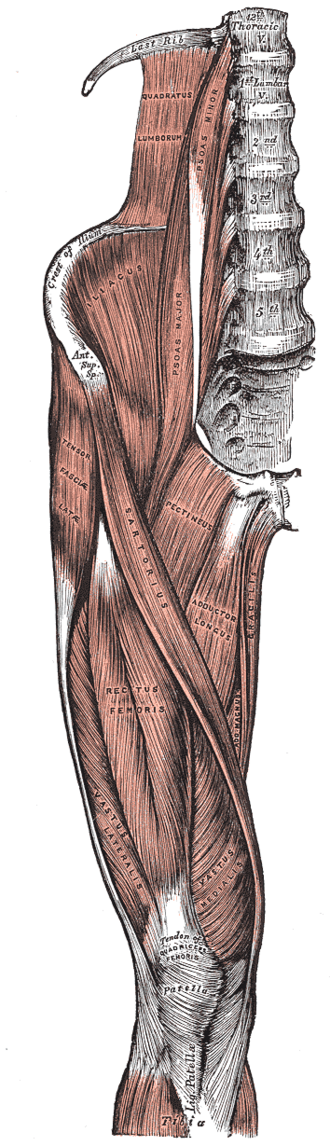

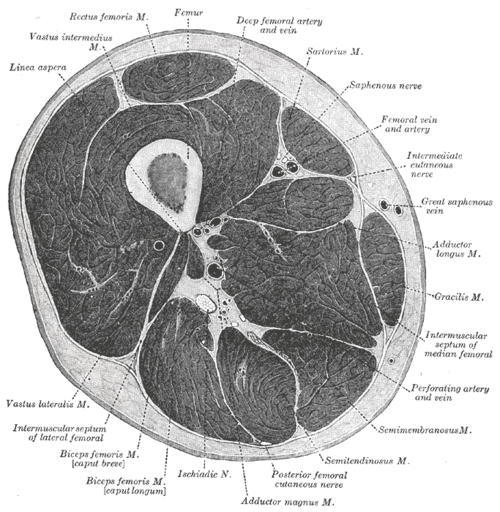

Clinical correlations
Quadriceps tendon or patellar ligament rupture PANCE
- Mechanism / lesion
Quadriceps tendon: older adults (over 40) with eccentric load; risk with diabetes, CKD, steroids, fluoroquinolones. Patellar ligament: younger athletes.
- Classic presentation
A palpable gap above (quadriceps) or below (patellar ligament) the patella, inability to do a straight-leg raise, patella baja or alta on X-ray; needs early surgical repair.
Quadriceps contusion and myositis ossificans
- Mechanism / lesion
A direct blow to the thigh ("charley horse"); heterotopic bone may form in the hematoma.
- Classic presentation
Painful swelling, reduced knee flexion; a firm mass with calcification on X-ray weeks later. Early gentle knee flexion helps prevent it.
Quadriceps weakness in femoral neuropathy and L4 radiculopathy PANCE
- Mechanism / lesion
Femoral nerve lesions (diabetic amyotrophy, iliopsoas hematoma) or L3/L4 root compression.
- Classic presentation
Knee buckling, trouble with stairs, and a reduced patellar reflex (L4). Hip adduction weakness points to a root/plexus problem rather than a femoral nerve lesion.
High-yield PANCE pearls
- Patellar (knee-jerk) reflex = L4 (femoral nerve).
- Can't straight-leg raise after injury → extensor mechanism rupture.
- Fluoroquinolones increase tendon rupture risk.
- Rectus femoris crosses two joints: hip flexion + knee extension.
Imaging anatomy
- X-ray
Patella alta (patellar ligament rupture) or baja (quadriceps tendon rupture); avulsion fragments; myositis ossificans.
- MRI
Partial vs complete tendon tears, muscle strains.
- Ultrasound
Rapid confirmation of tendon rupture and hematoma.
Physical exam
- Surface landmarks
The vastus medialis bulge above the medial knee; the rectus femoris in the midline of the thigh; the quadriceps tendon above and patellar ligament below the patella.
- Palpation
Palpate for a gap in the tendon; assess muscle bulk and wasting (vastus medialis wastes early after knee injury).
- Strength / function testing
Resisted knee extension; straight-leg raise; patellar reflex (L4); sit-to-stand.
Self-quiz
A 58-year-old man on levofloxacin for pneumonia stumbles on a stair and feels a pop above his knee. He cannot raise his straightened leg off the bed, and there is a gap just above the patella. What is the most likely injury?
Correct answer: B
A gap above the patella with loss of active knee extension indicates quadriceps tendon rupture, typical in men over 40 and more likely with fluoroquinolones, steroids, diabetes and CKD. It needs early surgical repair.
Show answer
B
A gap above the patella with loss of active knee extension indicates quadriceps tendon rupture, typical in men over 40 and more likely with fluoroquinolones, steroids, diabetes and CKD. It needs early surgical repair.
Which part of the quadriceps also flexes the hip?
Correct answer: D
Rectus femoris arises from the pelvis (AIIS), so it crosses the hip as well as the knee; the vasti arise from the femur and act only on the knee.
Show answer
D
Rectus femoris arises from the pelvis (AIIS), so it crosses the hip as well as the knee; the vasti arise from the femur and act only on the knee.
The straight head of rectus femoris arises from which landmark?
Correct answer: B
Rectus femoris arises by a straight head from the AIIS and a reflected head from above the acetabulum. Because it crosses both the hip and knee, it flexes the hip as well as extending the knee. Sartorius arises from the ASIS.
Show answer
B
Rectus femoris arises by a straight head from the AIIS and a reflected head from above the acetabulum. Because it crosses both the hip and knee, it flexes the hip as well as extending the knee. Sartorius arises from the ASIS.
Six weeks after a hard knee to the anterior thigh, a soccer player has a firm, tender mass in the quadriceps. Radiographs show calcification within it. What is the most likely diagnosis?
Correct answer: C
Myositis ossificans is heterotopic bone forming in the hematoma after a quadriceps contusion ("charley horse"). Early gentle knee flexion helps prevent it.
Show answer
C
Myositis ossificans is heterotopic bone forming in the hematoma after a quadriceps contusion ("charley horse"). Early gentle knee flexion helps prevent it.
A 24-year-old basketball player lands from a jump, feels a pop, and can't do a straight-leg raise. There is a gap below the patella, and the patella rides high. Which structure is ruptured?
Correct answer: D
A gap below the patella with a high-riding patella in a younger athlete indicates patellar ligament rupture. Quadriceps tendon rupture (gap above the patella) is more typical after 40 and with risk factors such as fluoroquinolones or steroids. Both need early surgical repair.
Show answer
D
A gap below the patella with a high-riding patella in a younger athlete indicates patellar ligament rupture. Quadriceps tendon rupture (gap above the patella) is more typical after 40 and with risk factors such as fluoroquinolones or steroids. Both need early surgical repair.