Hamstrings
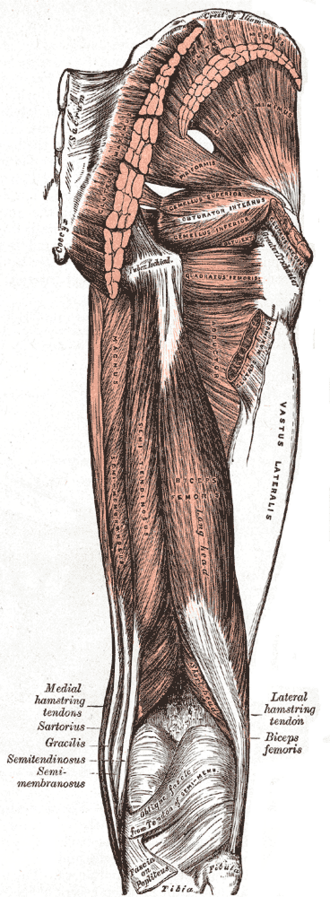
Posterior thigh muscles — biceps femoris, semitendinosus and semimembranosus — that extend the hip and flex the knee. Hamstring strains are common in sprinting sports.
Core anatomy
- Location
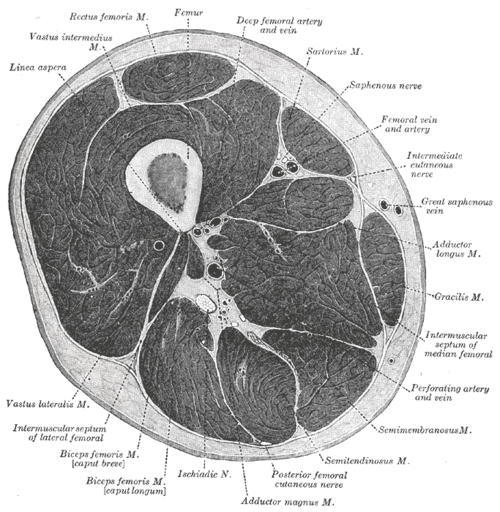
Posterior compartment of the thigh.
- Group
Posterior compartment of the thigh
- Origin
Ischial tuberosity of the hip bone (long head of biceps femoris, semitendinosus, semimembranosus). Short head of biceps femoris: lateral lip of the linea aspera of the femur (so not a "true" hamstring).
- Insertion
Biceps femoris: head of the fibula. Semitendinosus: upper medial tibia as part of the pes anserinus (with sartorius and gracilis). Semimembranosus: posterior medial tibial condyle.
- Innervation
Sciatic nerve: tibial division (L5–S2) for the long head of biceps, semitendinosus and semimembranosus; common fibular division for the short head of biceps femoris
- Blood supply
Perforating branches of the deep femoral artery, and the inferior gluteal artery.
- Action
- Extension of the hip (except the short head of biceps) — important in walking
- Flexion of the knee
- With the knee flexed: biceps femoris rotates the leg laterally; semitendinosus and semimembranosus rotate it medially
- Relations
The sciatic nerve runs deep to the long head of biceps femoris. At the knee, the hamstring tendons form the upper borders of the popliteal fossa (biceps laterally; semitendinosus and semimembranosus medially).
Forms a boundary of
Mentioned in
Generated automatically from links in other entries.


Clinical correlations
Hamstring strain PANCE
- Mechanism / lesion
Eccentric overload during sprinting or kicking, usually at the musculotendinous junction of biceps femoris.
- Classic presentation
Sudden posterior thigh pain ("pulled hamstring") during running, bruising, pain with resisted knee flexion and stretch. Most heal with rehabilitation (eccentric strengthening).
Proximal hamstring avulsion
- Mechanism / lesion
Forceful hip flexion with the knee extended (e.g. water-skiing, slipping into the splits); in adolescents, avulsion of the ischial tuberosity apophysis.
- Classic presentation
A pop, large posterior thigh bruise, and weakness; complete avulsions with retraction usually need surgical repair.
High-yield PANCE pearls
- Sprinter with sudden posterior thigh pain → hamstring strain (biceps femoris).
- Hamstrings = tibial division of the sciatic nerve (short head of biceps = common fibular).
- Pes anserinus: Sartorius, Gracilis, semiTendinosus ("Say Grace before Tea").
Imaging anatomy
- X-ray
Ischial tuberosity avulsion fragments in adolescents.
- MRI
Grades strains and detects proximal avulsions (retraction distance guides surgery).
- Ultrasound
Hematoma and tendon continuity.
Physical exam
- Surface landmarks
The tendons are palpable behind the knee with resisted flexion — biceps femoris laterally, semitendinosus (cord-like) and semimembranosus medially.
- Palpation
Localize tenderness along the posterior thigh and at the ischial tuberosity.
- Strength / function testing
Resisted knee flexion prone; passive straight-leg raise (hamstring tightness vs neural tension).
Self-quiz
A sprinter feels sudden sharp pain in the back of her thigh during a race. Which muscle is most commonly injured?
Correct answer: B
Biceps femoris (long head) is the most commonly strained hamstring, typically at the musculotendinous junction during high-speed running.
Show answer
B
Biceps femoris (long head) is the most commonly strained hamstring, typically at the musculotendinous junction during high-speed running.
Which part of the hamstring group is supplied by the common fibular division of the sciatic nerve?
Correct answer: D
The short head of biceps femoris is supplied by the common fibular division; all the other hamstrings (and the hamstring part of adductor magnus) are supplied by the tibial division.
Show answer
D
The short head of biceps femoris is supplied by the common fibular division; all the other hamstrings (and the hamstring part of adductor magnus) are supplied by the tibial division.
A water-skier's hip is forced into flexion with the knee extended. He feels a pop and develops a large bruise on the back of the thigh. From which bony attachment have the tendons most likely avulsed?
Correct answer: C
The hamstrings arise from the ischial tuberosity. Forceful hip flexion with the knee extended can cause a proximal hamstring avulsion (or, in adolescents, avulsion of the ischial apophysis). The ASIS and AIIS give origin to sartorius and rectus femoris.
Show answer
C
The hamstrings arise from the ischial tuberosity. Forceful hip flexion with the knee extended can cause a proximal hamstring avulsion (or, in adolescents, avulsion of the ischial apophysis). The ASIS and AIIS give origin to sartorius and rectus femoris.
Which hamstring muscle inserts on the tibia as part of the pes anserinus?
Correct answer: D
The pes anserinus is formed by sartorius, gracilis and semitendinosus ("Say Grace before Tea") on the upper medial tibia. Semimembranosus inserts on the posterior medial tibial condyle, and biceps femoris on the fibular head.
Show answer
D
The pes anserinus is formed by sartorius, gracilis and semitendinosus ("Say Grace before Tea") on the upper medial tibia. Semimembranosus inserts on the posterior medial tibial condyle, and biceps femoris on the fibular head.
With the knee flexed, which hamstring rotates the leg laterally?
Correct answer: A
Biceps femoris (inserting on the fibular head) laterally rotates the flexed knee. Semitendinosus and semimembranosus, inserting medially, rotate it medially.
Show answer
A
Biceps femoris (inserting on the fibular head) laterally rotates the flexed knee. Semitendinosus and semimembranosus, inserting medially, rotate it medially.