Pectoralis major
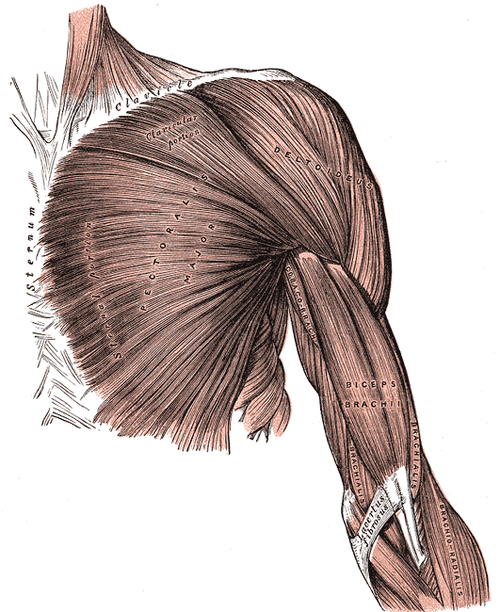
Large fan-shaped muscle of the anterior chest that adducts and medially rotates the arm. It forms the anterior axillary fold and lies deep to the breast.
Core anatomy
- Group
Anterior axioappendicular (pectoral) muscles.
- Origin
Clavicular head: anterior surface of the medial half of the clavicle. Sternocostal head: anterior surface of the sternum, the superior six costal cartilages, and the aponeurosis of the external oblique.
- Insertion
Lateral lip of the intertubercular groove (crest of the greater tubercle) of the humerus.
- Innervation
Lateral and medial pectoral nerves (clavicular head mainly C5–C6; sternocostal head C7, C8, T1) verify
- Blood supply
Pectoral branches of the thoracoacromial artery (from the axillary artery), with contributions from perforating branches of the internal thoracic artery.
- Action
- Adducts and medially rotates the humerus
- The clavicular head flexes the arm; the sternocostal head extends it from a flexed position
- Draws the scapula anteriorly and inferiorly (with the arm fixed, acts as an accessory muscle of inspiration)
- Relations
Its inferolateral border forms the anterior axillary fold. The breast lies on the pectoral fascia, separated by the retromammary space. The deltopectoral groove (cephalic vein) separates it from deltoid. Pectoralis minor lies deep to it.

Clinical correlations
Pectoralis major tendon rupture
- Mechanism / lesion
Eccentric overload, classically during bench pressing, usually in young men (anabolic steroid use is a risk factor).
- Classic presentation
Sudden pain and a pop at the anterior shoulder, bruising of the arm and chest, loss of the anterior axillary fold contour, and weak adduction and internal rotation.
Poland syndrome
- Mechanism / lesion
Congenital unilateral absence of the sternocostal head of pectoralis major.
- Classic presentation
Chest wall asymmetry, often with an ipsilateral hand anomaly (syndactyly or brachydactyly) and breast/nipple hypoplasia.
Breast cancer fixation to the pectoral fascia PANCE
- Mechanism / lesion
Infiltration of the retromammary space and pectoral fascia by a deep breast carcinoma.
- Classic presentation
The breast mass moves with contraction of pectoralis major (tested with the hands pressed on the hips). Fixation indicates deeper invasion.
High-yield PANCE pearls
- Pectoralis major = adduction + medial rotation; lateral and medial pectoral nerves.
- Bench-press injury with loss of the anterior axillary fold → pectoralis major rupture.
- During breast exam, have the patient press hands on hips to contract pectoralis and reveal fixation or dimpling.
Imaging anatomy
- X-ray
Absence of the muscle (Poland syndrome) can make one hemithorax appear hyperlucent on CXR.
- MRI
MRI defines the site of rupture (musculotendinous junction vs tendon avulsion from the humerus) and retraction.
- Ultrasound
Dynamic assessment of tendon continuity at the humeral insertion.
Physical exam
- Surface landmarks
The anterior axillary fold. The clavicular and sternocostal heads are visible on resisted adduction.
- Palpation
Palpate the anterior axillary fold bilaterally while the patient presses the palms together in front of the chest.
- Strength / function testing
Resisted adduction and medial rotation. Resisted adduction from 90° flexion (clavicular head) vs from 60° abduction (sternocostal head).
Self-quiz
A 28-year-old weightlifter felt a pop in his right anterior shoulder while bench pressing. He has bruising and loss of the anterior axillary fold. Which action is weakest?
Correct answer: C
Pectoralis major rupture weakens adduction and medial (internal) rotation of the humerus. It forms the anterior axillary fold.
Show answer
C
Pectoralis major rupture weakens adduction and medial (internal) rotation of the humerus. It forms the anterior axillary fold.
Pectoralis major inserts onto which part of the humerus?
Correct answer: C
Pectoralis major inserts on the lateral lip of the intertubercular groove. Latissimus dorsi inserts in the floor and teres major on the medial lip ("a lady between two majors").
Show answer
C
Pectoralis major inserts on the lateral lip of the intertubercular groove. Latissimus dorsi inserts in the floor and teres major on the medial lip ("a lady between two majors").
During a breast exam, the patient presses her hands firmly on her hips. What is the purpose of this maneuver?
Correct answer: B
Pressing on the hips contracts pectoralis major. Skin dimpling or a mass that moves with the muscle suggests malignancy tethering suspensory ligaments or fixing to the pectoral fascia.
Show answer
B
Pressing on the hips contracts pectoralis major. Skin dimpling or a mass that moves with the muscle suggests malignancy tethering suspensory ligaments or fixing to the pectoral fascia.
Flashcards
See also
- Breast
- Axilla
- Stab wound to the chest (clinical case)