Obturator nerve
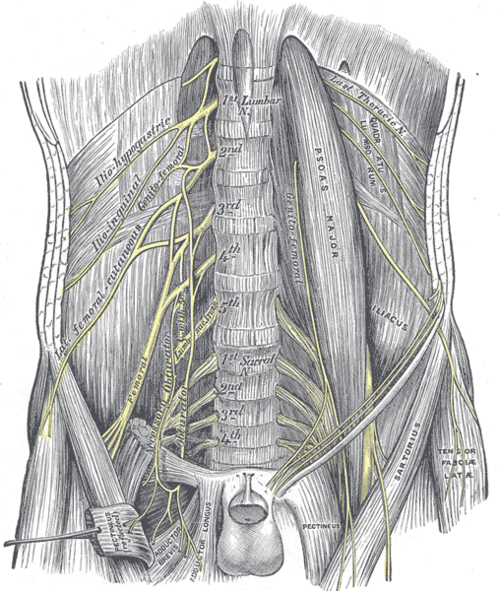
Lumbar plexus branch (L2–L4) that runs along the lateral pelvic wall through the obturator canal to supply the hip adductors and a patch of medial thigh skin. It is injured in pelvic surgery and childbirth.
Core anatomy
- Location
Lateral pelvic wall, then the medial compartment of the thigh.
- Root values
Anterior divisions of the ventral rami of L2–L4.
- Origin
Lumbar plexus, emerging from the medial border of psoas major
- Course
Crosses the pelvic brim behind the common iliac vessels, runs along the lateral pelvic wall (in the floor of the ovarian fossa in females) and leaves through the obturator canal into the thigh, dividing into anterior and posterior branches around adductor brevis.
- Branches
- Anterior branch: adductor longus, adductor brevis, gracilis (± pectineus); skin of the medial thigh; branch to the hip joint
- Posterior branch: obturator externus and the adductor part of adductor magnus; branch to the knee joint
- Motor
The adductor muscles of the thigh (except pectineus and the hamstring part of adductor magnus) and obturator externus.
- Sensory
A variable area of skin on the medial thigh.
- Relations
Accompanied by the obturator artery and vein in the obturator canal. Hip pain may be referred to the medial knee along its articular branches.
Muscles innervated
- Adductor muscles of the thigh — obturator nerve (L2–L4) for most; pectineus mainly by the femoral nerve; the hamstring part of adductor magnus by the tibial division of the sciatic nerve
Other structures innervated
Mentioned in
Generated automatically from links in other entries.

Clinical correlations
Obturator nerve injury
- Mechanism / lesion
Pelvic surgery (lymph node dissection, hysterectomy), pelvic fractures, compression by the fetal head during labor, pelvic tumors, obturator hernia.
- Classic presentation
Weak hip adduction, a wide-based (circumducting) gait, and numbness of the medial thigh.
Obturator hernia and Howship–Romberg sign
- Mechanism / lesion
Herniation through the obturator canal, typically in thin elderly women.
- Classic presentation
Small-bowel obstruction with medial thigh/knee pain that worsens with hip extension, abduction or medial rotation (Howship–Romberg sign).
Referred pain from ovary and hip
- Mechanism / lesion
The nerve lies against the ovarian fossa and supplies the hip joint.
- Classic presentation
Ovarian or pelvic disease can cause medial thigh pain; hip disease can present as medial knee pain.
High-yield PANCE pearls
- Obturator nerve: L2–L4, hip adduction, medial thigh skin.
- Thin elderly woman with bowel obstruction + medial thigh pain → obturator hernia (Howship–Romberg).
- Hip pain may be felt at the knee (obturator/femoral articular branches).
Imaging anatomy
- CT
Shows obturator hernias (bowel between pectineus and obturator externus) and pelvic masses.
- MRI
Lumbosacral plexus and pelvic wall lesions.
Physical exam
- Strength / function testing
Resisted hip adduction (squeeze a fist between the knees); sensation over the medial thigh. Adductor reflex (L2–L4) is sometimes tested.
Self-quiz
After a radical hysterectomy with pelvic lymph node dissection, a woman has difficulty crossing her legs and numbness over a small area of her medial thigh. Which nerve was most likely injured?
Correct answer: B
The obturator nerve runs along the lateral pelvic wall next to the pelvic lymph nodes. Injury weakens the adductors (crossing the legs) and numbs a patch of medial thigh skin.
Show answer
B
The obturator nerve runs along the lateral pelvic wall next to the pelvic lymph nodes. Injury weakens the adductors (crossing the legs) and numbs a patch of medial thigh skin.
Through which opening does the obturator nerve reach the thigh?
Correct answer: C
The obturator nerve and vessels leave the pelvis through the obturator canal, a gap at the top of the obturator membrane.
Show answer
C
The obturator nerve and vessels leave the pelvis through the obturator canal, a gap at the top of the obturator membrane.
A thin 82-year-old woman has small-bowel obstruction and pain down the inner thigh to the knee that worsens when her hip is extended and internally rotated. What is the most likely cause?
Correct answer: B
An obturator hernia passes through the obturator canal, typically in thin elderly women, and compresses the obturator nerve: medial thigh and knee pain worsened by hip extension, abduction or medial rotation is the Howship–Romberg sign.
Show answer
B
An obturator hernia passes through the obturator canal, typically in thin elderly women, and compresses the obturator nerve: medial thigh and knee pain worsened by hip extension, abduction or medial rotation is the Howship–Romberg sign.