Olfactory nerve (CN I)
Special sensory nerve for smell. Its fibers pass through the cribriform plate to the olfactory bulb, so head trauma and anterior fossa tumors cause anosmia.
Core anatomy
- Origin
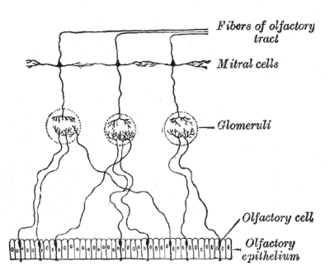
Bipolar olfactory receptor neurons in the olfactory epithelium in the roof of the nasal cavity. Their axons (about 20 bundles, the "olfactory nerves" proper) pass through the cribriform plate of the ethmoid to synapse in the olfactory bulb.
- Course
Olfactory bulb → olfactory tract along the orbital surface of the frontal lobe → lateral olfactory stria → primary olfactory cortex (piriform cortex, uncus/entorhinal area of the medial temporal lobe) and the amygdala. Olfaction is the only sense that does not relay through the thalamus before reaching the cortex.
- Sensory
Smell (special visceral afferent).
- Relations
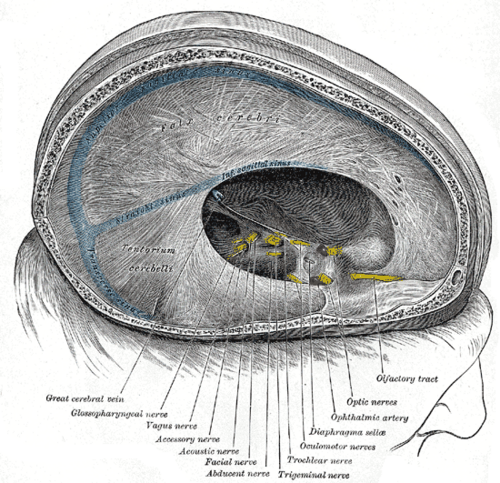
The olfactory bulb and tract lie in the olfactory sulcus under the frontal lobe, close to the olfactory groove (a site of meningiomas) and above the cribriform plate.
- Notes
Olfactory receptor neurons are replaced throughout life, one of the few neurons in the adult to regenerate.


Clinical correlations
Anosmia PANCE
- Mechanism / lesion
Most commonly after viral URI (including COVID-19) and chronic rhinosinusitis/nasal polyps (conductive loss); head trauma shearing the fibers at the cribriform plate; early Parkinson disease and Alzheimer disease; Kallmann syndrome (anosmia + hypogonadotropic hypogonadism, failed GnRH neuron migration).
- Classic presentation
Loss of smell and often reduced "taste" (flavor depends on smell). Patients may not notice gas leaks or spoiled food — a safety issue.
CSF rhinorrhea PANCE
- Mechanism / lesion
Fracture of the cribriform plate (anterior skull base) tearing the dura.
- Classic presentation
Clear watery nasal discharge after head trauma, worse leaning forward; positive for beta-2 transferrin; risk of meningitis. Often with anosmia and periorbital ecchymosis ("raccoon eyes").
Olfactory groove meningioma (Foster Kennedy syndrome)
- Mechanism / lesion
A mass under the frontal lobe compressing the olfactory tract and one optic nerve while raising intracranial pressure.
- Classic presentation
Anosmia, ipsilateral optic atrophy and contralateral papilledema; personality change from frontal lobe compression.
High-yield PANCE pearls
- Anosmia + hypogonadotropic hypogonadism → Kallmann syndrome.
- Clear nasal discharge after head trauma → CSF rhinorrhea (cribriform plate) → beta-2 transferrin.
- Loss of smell can precede motor signs in Parkinson disease.
- Smell is the only sense that bypasses the thalamus.
Imaging anatomy
- CT
Thin-section CT of the skull base for cribriform plate fractures and CSF leak localization.
- MRI
MRI brain with attention to the olfactory bulbs and frontal lobes (tumors, Kallmann syndrome — absent or small bulbs).
Physical exam
- Strength / function testing
Test each nostril separately with the eyes closed, occluding the other nostril, using a familiar non-irritating scent (coffee, soap, peppermint). Avoid ammonia or alcohol pads, which stimulate trigeminal pain fibers (CN V) rather than smell. Examine the nose first to exclude obstruction.
Self-quiz
A 17-year-old boy has not entered puberty. He has never been able to smell. LH and FSH are low. What is the most likely diagnosis?
Correct answer: B
Kallmann syndrome — failed migration of GnRH neurons (which travel with olfactory neurons from the olfactory placode) — causes hypogonadotropic hypogonadism with anosmia. Klinefelter causes high LH/FSH.
Show answer
B
Kallmann syndrome — failed migration of GnRH neurons (which travel with olfactory neurons from the olfactory placode) — causes hypogonadotropic hypogonadism with anosmia. Klinefelter causes high LH/FSH.
Why should ammonia not be used to test the olfactory nerve?
Correct answer: B
Irritants like ammonia are sensed by trigeminal fibers, so a patient with complete anosmia may still react. Use a familiar, non-irritating scent.
Show answer
B
Irritants like ammonia are sensed by trigeminal fibers, so a patient with complete anosmia may still react. Use a familiar, non-irritating scent.
A man has a clear, watery nasal discharge after a fall onto his forehead. It increases when he leans forward and he can no longer smell. Which test confirms the cause?
Correct answer: D
A cribriform plate fracture can tear the dura (CSF rhinorrhea) and the olfactory fibers (anosmia). The fluid is confirmed as CSF by beta-2 transferrin; there is a risk of meningitis.
Show answer
D
A cribriform plate fracture can tear the dura (CSF rhinorrhea) and the olfactory fibers (anosmia). The fluid is confirmed as CSF by beta-2 transferrin; there is a risk of meningitis.
Flashcards
See also
- Nasal cavity
- Limbic system
- Skull
- Cranial nerves at a glance (comparison table)