Long thoracic nerve
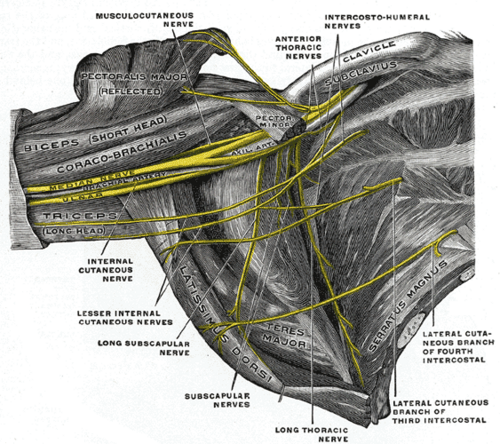
Branch arising directly from the C5–C7 roots that supplies serratus anterior; injury causes medial winging of the scapula.
Core anatomy
- Location
Medial wall of the axilla, on the superficial (external) surface of serratus anterior.
- Root values
C5, C6, C7
- Origin
Directly from the roots of the brachial plexus (C5–C7), before the trunks form.
- Course
Passes through the cervicoaxillary canal posterior to the other components of the plexus, then descends on the external surface of serratus anterior on the lateral thoracic wall, giving branches to each of its digitations. Because it lies on the superficial surface of the muscle, it is exposed during axillary surgery and to blows or penetrating injury to the lateral chest.
- Motor
Serratus anterior only.
- Sensory
None (purely motor).
Muscles innervated
- Serratus anterior — long thoracic nerve (C5, C6, C7)
Found in
Mentioned in
Generated automatically from links in other entries.

Clinical correlations
Medial winging of the scapula PANCE
- Mechanism / lesion
Injury to the nerve with paralysis of serratus anterior. Causes include axillary lymph node dissection or mastectomy, chest tube placement or thoracic surgery, a direct blow to the lateral chest wall, heavy backpack straps and repetitive overhead activity.
- Classic presentation
The medial border and inferior angle of the scapula lift away from the thoracic wall, most obvious when the patient pushes against a wall or presses the outstretched arms forward. The patient has difficulty raising the arm above the horizontal, because serratus anterior normally rotates the glenoid upward.
High-yield PANCE pearls
- Post-mastectomy/axillary dissection + scapula winging when pushing on a wall → long thoracic nerve (serratus anterior).
- Medial winging = long thoracic nerve / serratus anterior; lateral winging = spinal accessory nerve (CN XI) / trapezius.
- Serratus anterior is needed to abduct the arm above 90° (upward rotation of the scapula).
Imaging anatomy
- X-ray
The nerve is not visible. Chest or shoulder films exclude fractures or masses in trauma.
- CT
Not routinely used for the nerve. May show surgical changes or chest-wall pathology.
- MRI
The nerve is usually too small to assess directly. Serratus anterior shows denervation edema (T2/STIR hyperintensity) acutely and fatty atrophy chronically.
- Ultrasound
Can be traced with a high-frequency probe on the superficial surface of serratus anterior along the lateral chest wall. verify
- Key views & landmarks
- Diagnosis is mainly clinical. EMG/nerve conduction studies confirm it and help with prognosis.
Physical exam
- Surface landmarks
Lateral thoracic wall, roughly along the mid-axillary line, over the digitations of serratus anterior.
- Strength / function testing
Resisted protraction of the scapula (punching forward). Observe scapular motion while the patient slowly raises and lowers the arms.
Wall push-up test
- Technique
The patient stands facing a wall and pushes against it with the arms extended at shoulder height. The examiner observes the scapulae from behind.
- Positive test
The medial border and inferior angle of the scapula lift off the thoracic wall (winging).
- Significance
Serratus anterior weakness, usually from long thoracic nerve injury.
Self-quiz
A 52-year-old woman is seen 4 weeks after a left mastectomy with axillary lymph node dissection. When she pushes against a wall, the medial border of her left scapula protrudes posteriorly. Which nerve was most likely injured?
Correct answer: B
The long thoracic nerve runs on the superficial surface of serratus anterior on the medial wall of the axilla and is at risk during axillary dissection. Serratus anterior paralysis causes medial winging. Thoracodorsal injury weakens latissimus dorsi (extension, adduction, medial rotation) without winging. Spinal accessory injury causes lateral winging with a drooping shoulder.
Show answer
B
The long thoracic nerve runs on the superficial surface of serratus anterior on the medial wall of the axilla and is at risk during axillary dissection. Serratus anterior paralysis causes medial winging. Thoracodorsal injury weakens latissimus dorsi (extension, adduction, medial rotation) without winging. Spinal accessory injury causes lateral winging with a drooping shoulder.
A patient with long thoracic nerve palsy will have the greatest difficulty with which movement?
Correct answer: C
Serratus anterior (with trapezius) rotates the scapula upward, turning the glenoid cavity superiorly. That rotation is needed to abduct the arm above about 90°. Scapular elevation (trapezius, levator scapulae) and retraction (rhomboids, trapezius) are not supplied by the long thoracic nerve.
Show answer
C
Serratus anterior (with trapezius) rotates the scapula upward, turning the glenoid cavity superiorly. That rotation is needed to abduct the arm above about 90°. Scapular elevation (trapezius, levator scapulae) and retraction (rhomboids, trapezius) are not supplied by the long thoracic nerve.
The long thoracic nerve arises from which part of the brachial plexus?
Correct answer: A
The long thoracic nerve (C5–C7) and the dorsal scapular nerve (C5) arise directly from the roots. The superior trunk gives the suprascapular nerve and the nerve to subclavius.
Show answer
A
The long thoracic nerve (C5–C7) and the dorsal scapular nerve (C5) arise directly from the roots. The superior trunk gives the suprascapular nerve and the nerve to subclavius.
Why is the long thoracic nerve so easily injured by blows to the lateral chest or during axillary surgery?
Correct answer: D
The long thoracic nerve descends on the superficial surface of serratus anterior on the lateral chest wall, so it is exposed to direct blows, heavy straps, chest tubes and axillary surgery.
Show answer
D
The long thoracic nerve descends on the superficial surface of serratus anterior on the lateral chest wall, so it is exposed to direct blows, heavy straps, chest tubes and axillary surgery.
A patient has an isolated long thoracic nerve injury. Which sensory deficit is expected?
Correct answer: B
The long thoracic nerve is purely motor (serratus anterior only), so injury causes medial scapular winging without sensory loss. Medial arm and axillary numbness after axillary surgery comes from the intercostobrachial nerve.
Show answer
B
The long thoracic nerve is purely motor (serratus anterior only), so injury causes medial scapular winging without sensory loss. Medial arm and axillary numbness after axillary surgery comes from the intercostobrachial nerve.
Flashcards
See also
- Brachial plexus
- Axilla
- Upper limb nerve injuries (comparison table)