Lateral ankle ligaments
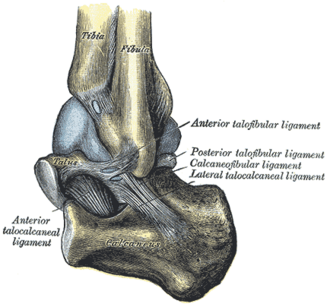
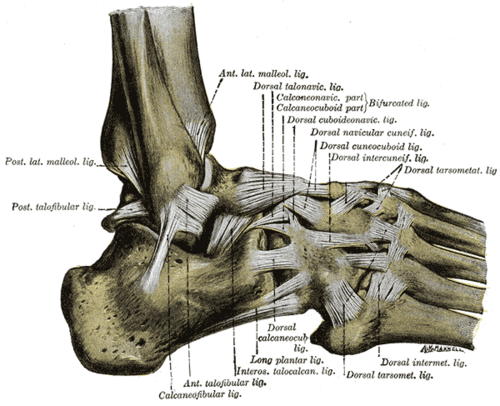
Three ligaments from the lateral malleolus — anterior talofibular, calcaneofibular and posterior talofibular — that resist inversion. The ATFL is the most commonly injured ligament in the body.
Core anatomy
- Location
Lateral side of the ankle joint, radiating from the lateral malleolus of the fibula.
- Attachments
Anterior talofibular ligament (ATFL): anterior margin of the lateral malleolus → neck of the talus; the weakest. Calcaneofibular ligament (CFL): tip of the lateral malleolus → lateral surface of the calcaneus (crosses both the ankle and subtalar joints). Posterior talofibular ligament (PTFL): malleolar fossa → lateral tubercle of the talus; the strongest.
- Function
Resist inversion and anterior displacement of the talus. The ATFL is taut in plantarflexion; the CFL in dorsiflexion.
- Relations
The fibularis longus and brevis tendons pass behind the lateral malleolus over the CFL; the sural nerve runs behind the malleolus.


Clinical correlations
Lateral ankle sprain PANCE
- Mechanism / lesion
Inversion of the plantarflexed foot — the ATFL tears first; greater force also tears the CFL; PTFL tears are rare (dislocation).
- Classic presentation
Lateral swelling and bruising, tenderness in front of the lateral malleolus. Grade I (stretch), II (partial tear), III (complete tear; positive anterior drawer). Treatment: protection, ice, compression, elevation, early weight-bearing, and balance/proprioception training to prevent recurrence; surgery rarely.
Chronic ankle instability
- Mechanism / lesion
Incomplete healing and proprioceptive deficit after recurrent sprains.
- Classic presentation
Repeated "giving way"; persistent pain may signal an osteochondral lesion of the talus or fibularis tendon injury.
Injuries mimicking a sprain PANCE
- Mechanism / lesion
The same inversion mechanism can fracture the base of the 5th metatarsal or the lateral malleolus, or injure the fibularis tendons or syndesmosis.
- Classic presentation
Always palpate the 5th metatarsal base, both malleoli, the proximal fibula and the syndesmosis.
High-yield PANCE pearls
- Most commonly sprained ligament: ATFL (inversion + plantarflexion).
- Order of failure: ATFL → CFL → PTFL.
- Prevent recurrence with proprioception/balance training.
Imaging anatomy
- X-ray
Only if the Ottawa rules are met — to exclude malleolar and 5th metatarsal fractures.
- MRI
Chronic instability or persistent pain (osteochondral lesions, tendon tears).
- Ultrasound
Dynamic assessment of ATFL and CFL integrity.
Physical exam
- Surface landmarks
The ATFL runs forward from the anterior edge of the lateral malleolus; the CFL runs down and back from its tip.
- Palpation
Maximal tenderness just anterior and inferior to the lateral malleolus = ATFL.
Anterior drawer test of the ankle
- Technique
Stabilize the tibia and pull the heel forward with the ankle slightly plantarflexed.
- Positive test
Excess anterior talar translation or a "suction" dimple in front of the lateral malleolus.
- Significance
ATFL tear.
Talar tilt (inversion stress) test
- Technique
Invert the hindfoot with the ankle in neutral.
- Positive test
Increased inversion compared with the other side.
- Significance
CFL injury.
Self-quiz
A basketball player lands on another player's foot and inverts his plantarflexed ankle. Which ligament is most likely torn?
Correct answer: B
The ATFL, the weakest lateral ligament and taut in plantarflexion, is the first to fail with inversion of the plantarflexed foot. The CFL tears with greater force.
Show answer
B
The ATFL, the weakest lateral ligament and taut in plantarflexion, is the first to fail with inversion of the plantarflexed foot. The CFL tears with greater force.
What is the most important intervention to prevent recurrent lateral ankle sprains?
Correct answer: B
Neuromuscular (balance/proprioception) training reduces recurrent sprains. Early functional mobilization is better than prolonged immobilization, and surgery is reserved for chronic instability.
Show answer
B
Neuromuscular (balance/proprioception) training reduces recurrent sprains. Early functional mobilization is better than prolonged immobilization, and surgery is reserved for chronic instability.
As inversion force increases during a lateral ankle sprain, which ligament usually tears second?
Correct answer: B
The usual order of failure is ATFL → CFL → PTFL. The ATFL is the weakest and tears first; the PTFL is the strongest and tears only with dislocation.
Show answer
B
The usual order of failure is ATFL → CFL → PTFL. The ATFL is the weakest and tears first; the PTFL is the strongest and tears only with dislocation.
After an inversion injury, the anterior drawer test of the ankle shows marked forward translation of the talus. What does this indicate?
Correct answer: C
A positive anterior drawer means the ATFL is completely torn (grade III), since the ATFL resists anterior displacement of the talus. Grade I is a stretch and grade II a partial tear.
Show answer
C
A positive anterior drawer means the ATFL is completely torn (grade III), since the ATFL resists anterior displacement of the talus. Grade I is a stretch and grade II a partial tear.
After rolling her ankle, a patient has tenderness at the base of the 5th metatarsal rather than over the lateral ligaments. What injury is most likely?
Correct answer: E
The inversion mechanism that sprains the ATFL can also make fibularis brevis avulse the 5th metatarsal tuberosity. Always palpate the 5th metatarsal base, both malleoli and the proximal fibula after an inversion injury.
Show answer
E
The inversion mechanism that sprains the ATFL can also make fibularis brevis avulse the 5th metatarsal tuberosity. Always palpate the 5th metatarsal base, both malleoli and the proximal fibula after an inversion injury.