Inner ear
Fluid-filled bony and membranous labyrinth in the petrous temporal bone — the cochlea for hearing and the vestibule and semicircular canals for balance. Sensorineural hearing loss and peripheral vertigo arise here.
Core anatomy
- Location
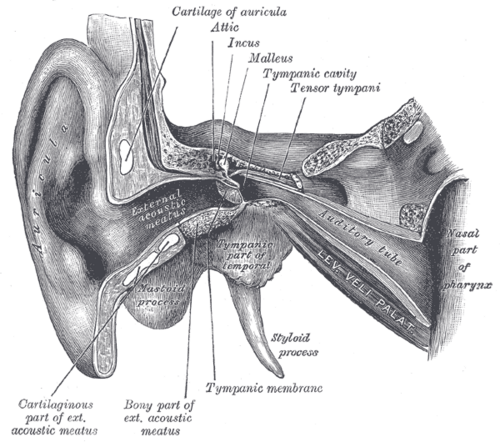
Within the petrous part of the temporal bone, medial to the external and middle ear.
- Parts
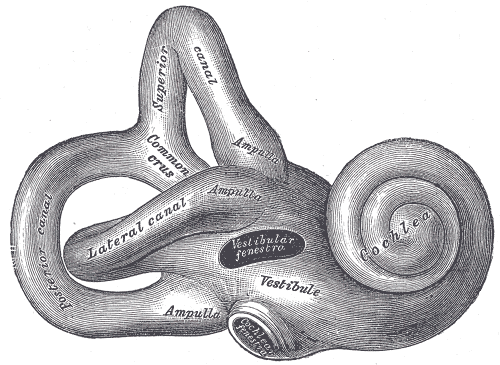
- Bony labyrinth (containing perilymph): vestibule, three semicircular canals, cochlea
- Membranous labyrinth (containing endolymph, high K+): utricle and saccule (linear acceleration, gravity — otoliths), semicircular ducts with ampullae (angular acceleration — cristae), cochlear duct with the organ of Corti (hair cells on the basilar membrane)
- Cochlea: 2½ turns; high frequencies are detected at the base, low frequencies at the apex
- Oval window (stapes footplate) and round window (pressure release)
- Relations
The internal acoustic meatus carries CN VII, CN VIII and the labyrinthine vessels toward the cerebellopontine angle.
- Arterial supply
Labyrinthine artery — usually from the anterior inferior cerebellar artery (vertebrobasilar system; see vertebral artery); an end artery.
- Venous drainage
Labyrinthine veins to the sigmoid and inferior petrosal sinuses.
- Lymphatic drainage
None.
- Innervation
Vestibulocochlear nerve (CN VIII) — cochlear and vestibular divisions — leaving through the internal acoustic meatus with the facial nerve.
Mentioned in
Generated automatically from links in other entries.


Clinical correlations
Benign paroxysmal positional vertigo (BPPV) PANCE
- Mechanism / lesion
Loose otoconia (canaliths) in a semicircular canal, most often the posterior canal.
- Classic presentation
Brief (under 1 minute) episodes of vertigo triggered by head position (rolling over in bed, looking up), no hearing loss. Diagnosed with Dix–Hallpike; treated with the Epley maneuver.
Vestibular neuritis and labyrinthitis PANCE
- Mechanism / lesion
Presumed viral inflammation of the vestibular nerve (neuritis) or labyrinth (labyrinthitis).
- Classic presentation
Acute continuous vertigo lasting days with nausea and horizontal nystagmus; labyrinthitis also causes hearing loss. Use the HINTS exam to distinguish from posterior circulation stroke.
Ménière disease PANCE
- Mechanism / lesion
Endolymphatic hydrops.
- Classic presentation
Episodic vertigo (20 minutes to hours) with the triad of fluctuating low-frequency sensorineural hearing loss, tinnitus and aural fullness. Low-salt diet, diuretics.
Sensorineural hearing loss PANCE
- Mechanism / lesion
Presbycusis (age-related, bilateral, high-frequency first), noise exposure, ototoxic drugs (aminoglycosides, loop diuretics, cisplatin), vestibular schwannoma (unilateral), sudden SNHL.
- Classic presentation
Sudden unilateral SNHL is an otologic emergency — urgent audiology and oral steroids. Unilateral SNHL or tinnitus → MRI for vestibular schwannoma (acoustic neuroma).
High-yield PANCE pearls
- Brief positional vertigo, no hearing loss → BPPV → Dix–Hallpike, Epley.
- Vertigo + hearing loss + tinnitus + fullness → Ménière.
- Days of vertigo without hearing loss → vestibular neuritis; with hearing loss → labyrinthitis.
- Unilateral SNHL/tinnitus → MRI for vestibular schwannoma.
- Sudden SNHL → steroids urgently.
Imaging anatomy
- CT
Temporal bone CT for fractures and bony labyrinth anomalies; head CT is insensitive for posterior fossa stroke.
- MRI
MRI with gadolinium (internal auditory canals) for vestibular schwannoma; MRI with diffusion-weighted imaging if central vertigo (stroke) is suspected.
- Key views & landmarks
- MRI internal auditory canals with contrast
Physical exam
- Surface landmarks
Not palpable; assessed by hearing and vestibular tests.
- Strength / function testing
Weber and Rinne (see external and middle ear), whispered voice, nystagmus, gait, cerebellar tests; formal audiometry.
Dix–Hallpike maneuver
- Technique
With the patient seated, turn the head 45° to one side, then quickly lie them back with the head extended about 20° over the edge of the table; watch the eyes for 30 seconds.
- Positive test
After a short latency, vertigo with upbeating, torsional nystagmus toward the lower ear that fatigues within about a minute.
- Significance
Posterior canal BPPV on the side turned down.
HINTS exam
- Technique
Head Impulse, Nystagmus type, Test of Skew, in a patient with acute continuous vertigo and nystagmus.
- Positive test
Central pattern ("INFARCT"): normal head impulse, direction-changing or vertical nystagmus, or skew deviation.
- Significance
Distinguishes posterior circulation stroke from vestibular neuritis; an abnormal (corrective saccade) head impulse is reassuring for a peripheral cause.
Self-quiz
A 62-year-old woman has 20-second episodes of intense spinning when she rolls over in bed or looks up to a high shelf. Hearing is normal. What is the best diagnostic maneuver?
Correct answer: B
Brief positional vertigo without hearing loss is BPPV. The Dix–Hallpike maneuver provokes the typical nystagmus, and the Epley maneuver repositions the canaliths.
Show answer
B
Brief positional vertigo without hearing loss is BPPV. The Dix–Hallpike maneuver provokes the typical nystagmus, and the Epley maneuver repositions the canaliths.
A 45-year-old has progressive right-sided hearing loss and tinnitus. Audiometry shows unilateral sensorineural loss. What is the next step?
Correct answer: B
Asymmetric sensorineural hearing loss needs MRI with gadolinium to exclude a vestibular schwannoma (acoustic neuroma) at the cerebellopontine angle.
Show answer
B
Asymmetric sensorineural hearing loss needs MRI with gadolinium to exclude a vestibular schwannoma (acoustic neuroma) at the cerebellopontine angle.
Which triad, with episodic vertigo, characterizes Ménière disease?
Correct answer: C
Ménière disease (endolymphatic hydrops) causes episodic vertigo lasting 20 minutes to hours with fluctuating low-frequency SNHL, tinnitus and aural fullness. Positional vertigo with normal hearing is BPPV.
Show answer
C
Ménière disease (endolymphatic hydrops) causes episodic vertigo lasting 20 minutes to hours with fluctuating low-frequency SNHL, tinnitus and aural fullness. Positional vertigo with normal hearing is BPPV.
A patient has several days of continuous vertigo after a viral illness. Which additional finding indicates labyrinthitis rather than vestibular neuritis?
Correct answer: B
Both cause days of vertigo with nausea and nystagmus, but labyrinthitis also causes hearing loss because the cochlea is involved. The HINTS exam helps exclude a posterior circulation stroke.
Show answer
B
Both cause days of vertigo with nausea and nystagmus, but labyrinthitis also causes hearing loss because the cochlea is involved. The HINTS exam helps exclude a posterior circulation stroke.
A 40-year-old wakes with sudden hearing loss in one ear. Audiometry confirms unilateral sensorineural loss. What is the most appropriate management?
Correct answer: E
Sudden sensorineural hearing loss is an otologic emergency treated with urgent evaluation and oral steroids. Unilateral SNHL also warrants MRI to exclude vestibular schwannoma.
Show answer
E
Sudden sensorineural hearing loss is an otologic emergency treated with urgent evaluation and oral steroids. Unilateral SNHL also warrants MRI to exclude vestibular schwannoma.