Erector spinae
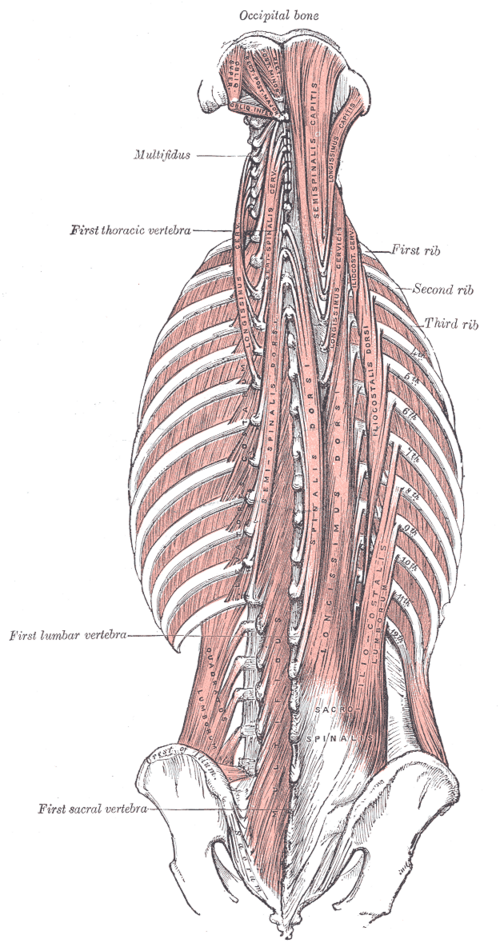
Main extensor of the vertebral column, running in three columns beside the spine. It is supplied by the dorsal rami of spinal nerves and is the usual site of mechanical low back strain.
Core anatomy
- Location
Paravertebral grooves on each side of the spinous processes, from the sacrum to the skull, deep to the thoracolumbar fascia.
- Group
Intrinsic (deep) back muscles, intermediate layer; three columns from lateral to medial: iliocostalis, longissimus, spinalis (mnemonic "I Love Spaghetti").
- Origin
A broad common tendon from the posterior iliac crest, posterior sacrum, sacroiliac ligaments, and the sacral and inferior lumbar spinous processes.
- Insertion
Iliocostalis: angles of the ribs and cervical transverse processes. Longissimus: transverse processes of the thoracic and cervical vertebrae, ribs, and the mastoid process (longissimus capitis). Spinalis: spinous processes of the upper thoracic and cervical vertebrae (and the skull).
- Innervation
Dorsal (posterior) rami of the spinal nerves and roots, segmentally.
- Blood supply
Dorsal branches of the posterior intercostal, subcostal and lumbar arteries.
- Action
- Bilaterally, extends the vertebral column and head; controls flexion eccentrically (e.g. when bending forward)
- Unilaterally, laterally flexes the vertebral column
- Relations
Enclosed with the other intrinsic muscles by the thoracolumbar fascia. The deeper transversospinalis group (multifidus, rotatores, semispinalis) lies beneath.
Mentioned in
Generated automatically from links in other entries.

Clinical correlations
Mechanical low back strain PANCE
- Mechanism / lesion
Muscle or ligament strain from lifting, twisting or sudden movement. It's the most common cause of acute low back pain.
- Classic presentation
Localized low back pain and paraspinal muscle spasm and tenderness, worse with movement, without radiation below the knee or neurologic deficit. Most cases improve within weeks. No imaging without red flags; stay active, NSAIDs, heat, and physical therapy for persistent symptoms.
High-yield PANCE pearls
- Erector spinae columns (lateral → medial): Iliocostalis, Longissimus, Spinalis ("I Love Spaghetti").
- Innervated by dorsal rami (unlike limb muscles, which use ventral rami).
- Acute mechanical low back pain without red flags → no imaging; stay active.
Imaging anatomy
- X-ray
Not indicated for uncomplicated low back strain.
- MRI
Reserved for red flags or persistent radicular symptoms; muscle edema after strain is rarely clinically useful.
- Key views & landmarks
- No imaging for acute nonspecific low back pain without red flags
Physical exam
- Surface landmarks
Visible as two vertical columns beside the lumbar spinous processes.
- Palpation
Paraspinal tenderness and spasm (a palpable, firm band).
- Strength / function testing
Range of motion of the lumbar spine (flexion is often painful and limited). Neurologic exam and straight leg raise are normal in simple strain.
Self-quiz
A 29-year-old man has low back pain for 3 days after moving furniture. There is paraspinal tenderness and spasm, no radiation, and a normal neurologic exam. What is the most appropriate management?
Correct answer: C
This is mechanical low back strain without red flags. Imaging isn't indicated; stay active with NSAIDs and heat. Bed rest delays recovery.
Show answer
C
This is mechanical low back strain without red flags. Imaging isn't indicated; stay active with NSAIDs and heat. Bed rest delays recovery.
Which nerves innervate erector spinae?
Correct answer: B
The intrinsic back muscles, including erector spinae, are supplied segmentally by the dorsal rami.
Show answer
B
The intrinsic back muscles, including erector spinae, are supplied segmentally by the dorsal rami.
Which is the most lateral column of erector spinae?
Correct answer: C
From lateral to medial: iliocostalis, longissimus, spinalis.
Show answer
C
From lateral to medial: iliocostalis, longissimus, spinalis.
What does bilateral contraction of erector spinae produce?
Correct answer: B
Acting bilaterally, erector spinae extends the vertebral column and head and controls flexion eccentrically when bending forward. Acting unilaterally, it laterally flexes the column.
Show answer
B
Acting bilaterally, erector spinae extends the vertebral column and head and controls flexion eccentrically when bending forward. Acting unilaterally, it laterally flexes the column.
Which fascia encloses erector spinae and the other intrinsic back muscles?
Correct answer: D
The thoracolumbar fascia encloses erector spinae and the other intrinsic back muscles. The intrinsic back muscles are supplied by dorsal rami.
Show answer
D
The thoracolumbar fascia encloses erector spinae and the other intrinsic back muscles. The intrinsic back muscles are supplied by dorsal rami.